
Does It Rain Every Day at Disney World? The Real Thunderstorm Pattern

Does it rain every day at Disney World? Almost. Central Florida sees storms 16 to 17 days a month in summer. Here is why, when, and what actually closes rides.
Advertisement
Pack your Magic Kingdom day around 2 p.m. and you're planning around the wrong clock. The area where Walt Disney World sits, a cluster of central Florida communities meteorologists call Four Corners, recorded the highest lightning strike density of anywhere in the United States in Vaisala's 2022 lightning data: 474 strikes per square kilometer, or 1,229 per square mile. That's not a coincidence of bad luck. It's geography. Does it rain every day at Disney World in the summer? Not quite every single day, but close enough that you should plan like it will.
Key facts about Florida's afternoon thunderstorms:
Frequency: Central Florida sees thunderstorms on roughly 16 to 17 days a month in June, July, and August, and most summer days bring at least a passing shower
Timing: Storms typically build through the hottest part of the day and most commonly arrive from early afternoon onward, often after 2 p.m.
Duration: Most individual storms pass within 30 to 60 minutes, though the overall unsettled window can run longer
Why it happens: Sea breezes off the Atlantic and the Gulf of Mexico push inland from both coasts and collide over the Florida peninsula, and that collision is what fires off the storms
Four Corners, where Disney World sits, recorded the highest lightning strike density of any location in the US in 2022, according to Vaisala's lightning data
Florida leads the nation in lightning strike density and averages around seven lightning deaths a year, more than any other state
Wet season timing: Typically starts in late May in the Orlando area and runs through October, when the first fall cold front usually ends it
A Florida theme park mid-storm. Rides here were closed for lightning in the area at the moment this was taken. Photo: MatthewHoobin, CC0.
Does it really rain every day at Disney World in the summer?
Almost, but not literally every single day. Central Florida gets measurable rain on roughly 16 to 17 days each month across June, July, and August, which means most days bring at least some rain, and the days that don't are still often cloudy and humid with storms nearby. If you're visiting for a week in summer, the realistic expectation is that at least one afternoon, and probably several, will include a thunderstorm somewhere in the area, even if it never reaches your specific park. Planning your trip assuming it rains every afternoon costs you nothing. Planning it assuming the sky will stay clear is the mistake.
Why does central Florida get thunderstorms almost every afternoon?
Because Florida is a narrow peninsula with ocean on both sides, and the two coastlines generate competing sea breezes that collide somewhere over the middle of the state most summer afternoons. The sun heats the land faster than the surrounding water, air rises over the warm ground, and cooler, moister air rushes in from the Atlantic coast and the Gulf coast to replace it. Where those two breezes meet, usually somewhere in the central ridge that includes the Orlando area, the air has nowhere to go but up, and that lift is what builds the towering afternoon thunderstorms. Four Corners, the cluster of communities where Walt Disney World is built, sits almost exactly where that collision tends to happen, which is part of why Vaisala's 2022 data put it at the top of the entire country for lightning density. A Vaisala meteorologist has estimated that sea breeze collisions account for roughly 80 percent of Florida's total lightning count.
Advertisement
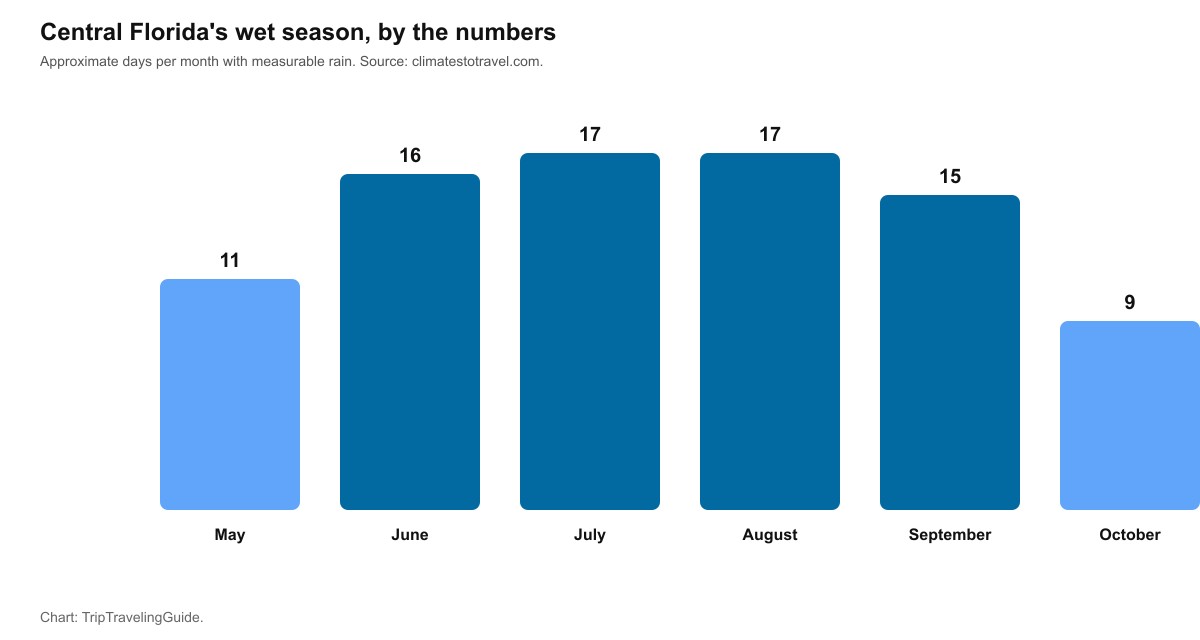
Summer in central Florida means rain on more days than not. Chart: TripTravelingGuide.
Month | Approximate rainy days | What to expect |
|---|---|---|
May | ~11 | Pre-wet-season buildup, storms becoming more frequent |
June | ~16 | Wet season underway, afternoon storms common |
July | ~17 | Peak of the pattern, storms most days |
August | ~17 | Same as July, hot and consistently stormy |
September | ~15 | Still wet, with added hurricane-season risk |
October | ~9 | Pattern breaks once the first cold front arrives |
What time of day do the storms usually hit?
Mostly afternoon and early evening, once the day's heat has had time to build. The ground needs hours of direct sun to heat up enough to trigger the lift that starts a storm, so mornings in central Florida are usually the clearest, calmest part of the day. On days the National Weather Service flags as a higher storm risk, forecasters have specifically called out windows starting around 2 p.m. as when activity typically increases. A given storm cell usually moves through in 30 to 60 minutes, so a rained-out early afternoon often clears into a dry evening, which is exactly why savvy park visitors build their schedule around mornings and evenings and treat early afternoon as flexible time.
Does rain actually shut down the rides?
Not by itself. Rain alone doesn't close Florida theme parks, and most guests barely slow down for a passing shower with a poncho on. What actually triggers a closure is lightning, and parks close outdoor and partially outdoor attractions as soon as lightning is detected within a set distance of the property, which can happen before a drop of rain ever reaches the ground. Indoor rides, shows, and most shops and restaurants keep running through a lightning hold. Once the lightning risk clears the immediate area, rides reopen gradually rather than all at once, so don't expect everything to switch back on the instant the rain stops. That distinction, lightning detection rather than rainfall, is the single most useful thing to understand if an afternoon storm rolls through your park day.
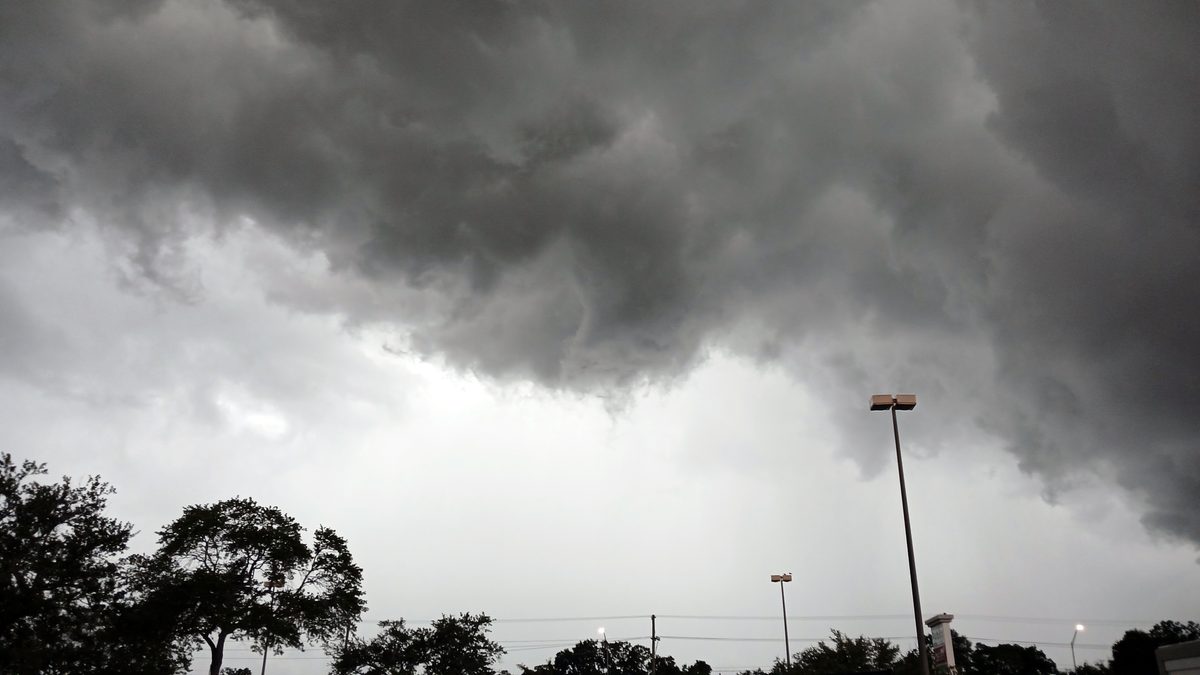
These clouds mean business. Rain and lightning followed within about half an hour. Photo: MatthewHoobin, CC BY-SA 4.0.
Advertisement
Is Florida's lightning actually dangerous for visitors?
It's rare, but Florida takes this seriously for good reason. The state has led the country in lightning deaths for decades, and recent estimates put the toll at around seven deaths a year, more than any other state. That's a small number against the roughly over 100 million people who visit Florida's theme parks and beaches annually, but it's exactly why parks are strict about clearing outdoor areas, pools, and open spaces the moment lightning is detected nearby rather than waiting for visible storm clouds or rainfall. If you're outdoors anywhere in Florida and hear thunder, that's already close enough to seek shelter. Waiting to see lightning or feel rain first is the mistake that shows up in the fatality statistics.
When is Florida's wet season, and should I plan around it?
The wet season typically starts in late May in the Orlando area and runs through October, when the season's first real cold front usually breaks the pattern. National Weather Service research on east central Florida pins the average onset around May 27 for Orlando specifically, though it has occasionally slipped into June or, rarely, even early July. If you want the best odds of a dry trip, the stretch from November through April is reliably drier and cooler, though it comes with its own trade-off of bigger holiday and spring break crowds. If a hurricane is part of your travel-timing worry rather than ordinary afternoon storms, that's a separate risk with its own forecasting window, covered in our Hurricane Isaias and Gulf Coast flights guide.
What are the limits of this guide?
The lightning death figures here, roughly seven a year and a multi-decade lead over every other state, come from varying compilations across different years and reporting sources, so treat the exact number as an approximate, not a precise annual count. The 16 to 17 rain-days-per-month figure comes from a modeled climate dataset rather than a single NWS station normal, and any individual summer can run wetter or drier than that average, sometimes by a lot. Ride-closure practices described here reflect how Florida theme parks generally handle lightning, but exact detection radius and reopening procedures vary by park and are not published in detail, so check the specific park's app or guest services for real-time status during your visit. None of this replaces a same-day forecast from the National Weather Service Melbourne office, which covers the Orlando area, if you're making decisions about outdoor plans on a specific date.
Quick answers about Florida's afternoon thunderstorms
Does it rain every day at Disney World in the summer?
Almost. Central Florida sees measurable rain on roughly 16 to 17 days a month in June, July, and August, so most summer days bring at least some rain.
What time do Florida's afternoon storms usually start?
Most commonly from early afternoon onward, often picking up noticeably after 2 p.m. once the day's heat has built enough to trigger them.
Does rain close down theme park rides?
Not by itself. Lightning detected near the park is what closes outdoor rides, which can happen before rain even arrives. Indoor attractions generally keep running.
Why does Disney World's area get so much lightning?
It sits near where sea breezes from Florida's Atlantic and Gulf coasts collide most summer afternoons, and that collision is what fires off the storms.
When does Florida's wet season end?
Usually in October, when the first fall cold front breaks the daily storm pattern. The wet season typically begins in late May.
Topics
Advertisement