


Winter 2025-2026 Snow Forecast: Will It Be a Snowy Winter in the USA?
Are you wondering if winter 2025-2026 will bring heavy snowfall to your area? This comprehensive forecast breaks down exactly what to expect across every region of the United States this winter season.
Will Winter 2025-2026 Be Snowy?
Yes, but it depends where you live. Northern states are in for a very snowy winter with above-average snowfall, while southern states will experience warmer and drier conditions with minimal snow.
Key Takeaway: La Niña weather patterns will create a classic “divided” winter—snowy north, dry south.
What’s Driving This Winter’s Weather?
La Niña Impact on Winter 2025-2026
La Niña is the primary climate driver this winter, bringing:
- Colder temperatures to northern states
- Warmer conditions to southern states
- Increased snowfall in the northern tier
- Drought conditions in the Southwest
The weak La Niña will persist through December 2025-February 2026, then transition to neutral conditions by spring.
Polar Vortex Disruption
A stratospheric warming event has disrupted the polar vortex, which means:
✓ Exceptionally cold Arctic air plunging into the USA
✓ Enhanced snowfall across the Midwest and East Coast
✓ Prolonged cold snaps throughout January
✓ Intense lake-effect snow events
Snow Forecast by Region: Where Will It Snow Most?
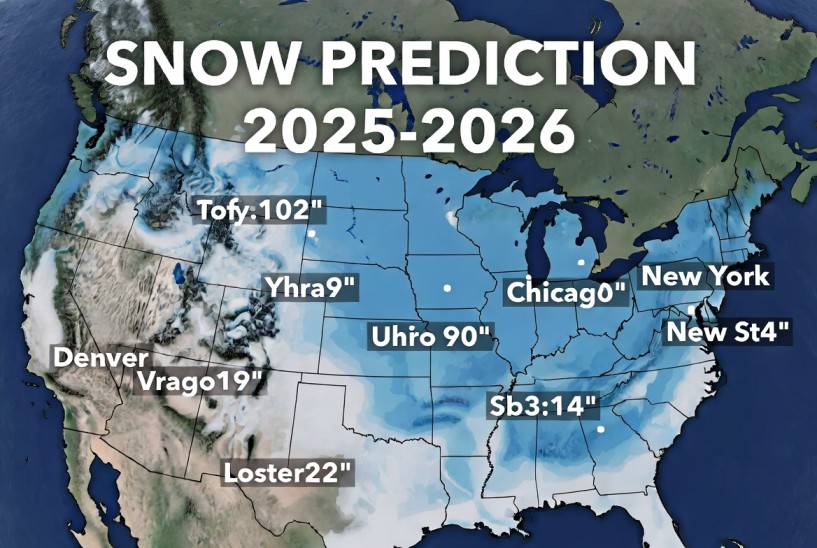
Snow Prediction 2025 2026 :
Northeast Snow Forecast 2025-2026
Overall Outlook: Above-average to near-average snowfall with frequent winter storms.
| City | Predicted Snowfall | Comparison to Last Year |
|---|---|---|
| Boston, MA | 45-55 inches | Above last year |
| New York City | 25-35 inches | Improved |
| Philadelphia | 20-30 inches | Above last winter |
| Buffalo, NY | 90-100 inches | Near historical average |
What to Expect:
- Multiple nor’easters, especially in early December and late February
- Intense lake-effect snow around the Great Lakes
- A “bookend winter” with heavy snow in early December and late winter
- Possible midwinter lull in January
Best Time for Snow: January will be the snowiest month, with secondary peaks in early December and late February/March.
Midwest and Great Lakes Winter Prediction 2025-2026
Overall Outlook: Above-average snowfall with exceptional lake-effect snow.
| City | Predicted Snowfall | Key Features |
|---|---|---|
| Chicago | 45-55 inches | Frequent storms |
| Detroit | 50-60 inches | Heavy lake-effect |
| Minneapolis | 55-65 inches | Alberta Clippers |
| Cleveland | 60-70 inches | Intense lake-effect |
Why This Region Will See Heavy Snow:
- Near-record warm lake waters creating massive temperature contrasts
- Frequent Alberta Clipper systems every 2-3 days
- Could rival heavy snow years like 2013-2014
- 12-24 inches above average in Upper Midwest
Travel Warning: Interstate 90 and I-94 corridors will experience frequent disruptions.
Rocky Mountains Winter Forecast 2025-2026
Overall Outlook: Above-average snowfall—HIGHEST CONFIDENCE REGION.
| Location | Predicted Snowfall | Confidence Level |
|---|---|---|
| Montana Mountains | 200-300+ inches | 80-90% |
| Wyoming Mountains | 180-250 inches | 80-90% |
| Idaho (Northern) | 250-350 inches | 80-90% |
| Colorado (Northern) | Near to above average | 65% |
| Colorado (Southern) | Below average | 45% |
Ski Resort Outlook: Montana, Wyoming, and Idaho resorts are expecting their best season in years. Northern Colorado resorts will have good conditions, while southern resorts may struggle.
Pacific Northwest Snow Prediction 2025-2026
Overall Outlook: Mixed signals—elevation matters greatly.
Mountain Snowfall:
- Washington Cascades: 300-500 inches (near to above average)
- Oregon Northern Mountains: 250-350 inches (near average)
- Oregon Southern: Below average
Key Point: Higher elevations will do well, but lower elevations will see more rain than snow due to warmer temperatures.
Southwest and California Winter Forecast 2025-2026
Overall Outlook: Below-average snowfall—DRIEST REGION.
| Location | Predicted Snowfall | Status |
|---|---|---|
| California Sierra Nevada | 200-300 inches | 24-36″ below average |
| Southern California | Minimal | Extremely unlikely |
| Arizona | Minimal | Virtually no snow |
| New Mexico | Below average | Drought concerns |
Drought Alert: The Southwest faces a classic La Niña dry pattern with 60-80% probability of below-normal precipitation. Ski resorts will rely heavily on snowmaking.
Southern States Winter Outlook 2025-2026
Overall Outlook: Minimal to no snowfall for most areas.
Regional Breakdown:
- Texas: 1-2 possible winter storms, mostly in January
- Florida: No snow expected, warmer than normal
- Deep South (GA, AL, MS): Minimal/no snow
- Mid-Atlantic (VA, MD): Above-average compared to recent years
Best Chance for Winter Weather: Mid-January could bring one ice or snow event to Texas, Oklahoma, and Arkansas.
Month-by-Month Winter Timeline
December 2025: Early Winter Setup
What to Expect:
- First major snowfalls in northern states by early December
- Lake-effect snow ramps up around the Great Lakes
- Pre-holiday travel disruptions likely (December 15-25)
- White Christmas highly likely in Montana, Wyoming, Idaho, Minnesota, Wisconsin, Michigan, and parts of New England
Snowfall Leaders: Northern Rockies building excellent base early.
January 2026: Peak Winter Month
SNOWIEST MONTH for most of the USA
Key Features:
- Alberta Clipper systems every 2-3 days in northern states
- Multiple nor’easters expected for the East Coast
- Deep freeze across Plains and Midwest (well below normal)
- 3-5 major winter storms across different regions
- Possible ice storm for southern states mid-month
Travel Impact: HIGH—multiple periods of hazardous travel conditions.
Temperature: Coldest month of the winter with temperatures well below normal in the North.
February 2026: Continued Active Pattern
What to Expect:
- La Niña influence continues but begins weakening
- Mixed precipitation more common at lower elevations
- Northern areas remain cold and snowy
- Late February (15-28): Pattern shifts, late-winter storms possible for Northeast
Regional Focus:
- Northern Rockies: Continued heavy snowfall
- Great Lakes: Lake-effect snow continues
- Northeast: More mix of snow and rain
- Southwest: Drought intensifies
March 2026: Winter’s Final Chapter
Overall Outlook: Extended winter for north, early spring for south.
What Happens:
- La Niña transitions to ENSO-neutral
- Snowfall focuses on northern tier and mountains
- Southern two-thirds of USA warms significantly
- Most areas see last significant snow by mid-March
Extended Season: Mountain resorts in Montana, Wyoming, and Idaho will continue operations into April.
Will There Be a White Christmas 2025?
Yes, for northern states!
High Probability (80%+):
- Montana, Wyoming, Idaho
- North Dakota, South Dakota
- Minnesota, Wisconsin, Michigan
- Parts of Vermont, New Hampshire, Maine
Moderate Probability (40-60%):
- Northern New England
- Upper Peninsula of Michigan
- Northern Minnesota
Low Probability (<20%):
- Southern states
- West Coast cities
- Southwest region
Lake-Effect Snow Forecast 2025-2026
Why This Year Will Be Intense
Three Key Factors:
- Near-record warm Great Lakes temperatures
- Cold Arctic air outbreaks throughout winter
- Massive temperature contrasts creating heavy snow bands
Most Affected Areas:
- Buffalo, NY (lake Erie)
- Cleveland, OH (Lake Erie)
- Erie, PA (Lake Erie)
- Eastern shores of Lake Michigan
- Eastern Lake Ontario (Watertown, NY area)
Potential: Some lake-effect events could drop 18+ inches in 24 hours, especially in January and February.
Similar Years: This setup resembles the 2013-2014 winter, which produced historic lake-effect snowfall.
Nor’easter Predictions 2025-2026
How Many Nor’easters Will We See?
Forecast: Multiple nor’easters expected throughout winter.
Most Likely Periods:
- Early December (holiday travel period)
- Mid to late January (peak winter)
- Late February/Early March (late-season storms)
Impact Areas:
- I-95 corridor (Boston to Washington DC)
- Coastal New England
- New York City metropolitan area
- Philadelphia and surrounding areas
Key Point: The southern jet stream will be more vigorous than expected, increasing nor’easter potential.
Snow Forecast Confidence Levels
Highest Confidence Regions (80-90%)
Above-Average Snow:
- Northern Rockies (Montana, Wyoming, Idaho)
- Northern High Plains (Dakotas)
- Upper Midwest (Minnesota, Wisconsin, Michigan)
- Great Lakes snow belts
Below-Average Snow:
- Southwest (California, Arizona, New Mexico)
- Southeast (Georgia, Alabama, Florida)
- Texas and Gulf Coast
Moderate Confidence (60-75%)
- Northeast cities (Boston, NYC, Philadelphia)
- Pacific Northwest mountains
- Central Rockies
- Ohio Valley
Lower Confidence (45-50%)
- Mid-Atlantic (Virginia, Maryland)
- Southern Rockies
- Central USA (Kansas, Nebraska, Iowa)
Best States for Snow 2025-2026
Top 10 Snowiest States This Winter
- Idaho (250-350 inches in mountains)
- Wyoming (180-250 inches in mountains)
- Montana (200-300+ inches in mountains)
- Michigan (50-60+ inches, heavy lake-effect)
- Minnesota (55-65 inches)
- Wisconsin (heavy lake-effect snow)
- Vermont (above-average mountain snow)
- New Hampshire (above-average)
- Maine (above-average)
- North Dakota (45-55 inches)
Worst States for Snow 2025-2026
Regions with Minimal/No Snow
Southern Tier:
- Florida (0 inches)
- Louisiana (trace amounts only)
- Southern Texas (minimal)
- Southern California (minimal)
Drought-Affected Southwest:
- Arizona (minimal except high elevations)
- New Mexico (below average)
- Nevada (below average)
- Southern Utah (below average)
Winter Travel Safety: High-Risk Periods
Most Dangerous Travel Dates
| Time Period | Risk Level | Affected Regions |
|---|---|---|
| Dec 15-25, 2025 | HIGH | Midwest, Northeast |
| Jan 5-15, 2026 | VERY HIGH | Northern states |
| Jan 20-30, 2026 | EXTREME | Midwest, East Coast |
| Feb 10-20, 2026 | HIGH | Multiple regions |
| Late Feb/Early Mar | MODERATE-HIGH | Northeast |
Most Impacted Highways:
- Interstate 90 (Seattle to Boston)
- Interstate 94 (Montana to Chicago)
- Interstate 80 (Wyoming to Pennsylvania)
- I-95 (Boston to DC during nor’easters)
Safety Recommendations:
✓ Prepare vehicle emergency kits (blankets, food, water, flashlight, phone charger) ✓ Monitor forecasts 3-7 days before traveling ✓ Allow extra time for winter travel ✓ Check 511 systems for real-time road conditions ✓ Consider travel insurance for winter trips
Ski Resort Snow Outlook 2025-2026
Excellent Conditions (Above-Average Snow)
Best Resorts This Winter:
- Big Sky, Montana
- Jackson Hole, Wyoming
- Grand Targhee, Wyoming
- Sun Valley, Idaho
- Schweitzer, Idaho
- Vermont resorts (Stowe, Killington, Sugarbush)
- New Hampshire resorts (Cannon, Wildcat)
- Upper Michigan resorts
Good Conditions (Near-Average)
- Steamboat, Colorado
- Winter Park, Colorado
- Northern Washington Cascades (higher elevations)
- Whistler, BC (Canada)
Fair to Poor Conditions (Below-Average)
Resorts That Will Struggle:
- Mammoth Mountain, California
- Big Bear, California
- Southern Utah resorts
- Purgatory, Colorado
- Taos, New Mexico
- Arizona Snowbowl
Note: Western resorts will rely heavily on snowmaking due to La Niña drought conditions.
Temperature Outlook Winter 2025-2026
Colder Than Normal Regions
- Pacific Northwest (Washington, Oregon)
- Northern Rockies (Montana, Wyoming)
- Northern Plains (Dakotas)
- Upper Midwest (Minnesota, Wisconsin)
- Northern New England (Maine, Vermont, NH)
Warmer Than Normal Regions
- East Coast (Massachusetts to Florida)
- Southeast (Georgia, Alabama, Mississippi)
- Gulf Coast (Louisiana, Texas coast)
- Southwest (California, Arizona, Nevada)
Near Normal
- Central USA (Kansas, Nebraska, Iowa, Missouri)
- Central Rockies (Colorado, Utah)
- Mid-Atlantic (Virginia, Maryland)
Drought and Flooding Concerns
Drought Watch Areas (High Risk)
Worsening Drought Expected:
- California (all regions)
- Arizona
- New Mexico
- Nevada
- Southern Texas
- Deep South potential expansion
Wildfire Risk: Southwest and Southern California face elevated wildfire danger due to dry conditions and warm temperatures.
Potential Flooding Concerns
Spring Flooding Risk (March-April):
- Northern Plains (from heavy snowmelt)
- Great Lakes region (rain-on-snow events)
- Pacific Northwest (atmospheric rivers in December)
Power Outage Risk Areas
High Risk for Winter Power Outages
Reasons for Outages:
- Great Lakes: Heavy wet snow on trees and power lines
- Northeast: Ice storms and heavy snow accumulation
- Midwest: Extreme cold stress on power grid
Preparation Tips:
- Have backup heating sources
- Stock non-perishable food
- Keep flashlights and batteries ready
- Charge portable power banks
- Know how to safely use generators
Historical Comparison: Similar Winters
This Winter Most Resembles:
2013-2014 Winter:
- Heavy lake-effect snow
- Frequent cold air outbreaks
- Above-average snowfall in Midwest and Northeast
- Polar vortex disruptions
2010-2011 Winter:
- Strong La Niña influence
- Snowy northern tier
- Dry Southwest
- Multiple nor’easters
Differences: This La Niña is weaker, so extreme cold may be less persistent than 2013-2014.
When Does Winter 2025-2026 Start and End?
Key Dates to Remember
| Date | Event |
|---|---|
| December 1, 2025 | Meteorological winter begins |
| December 21, 2025 | Astronomical winter begins (winter solstice – 10:03 AM EST) |
| January 2026 | Typically snowiest month |
| February 2026 | La Niña transitions to neutral |
| March 20, 2026 | Spring equinox (astronomical winter ends) |
Note: Northern mountainous areas may see snow continuing into April.
How Accurate Are Winter Forecasts?
Understanding Forecast Reliability
What Long-Range Forecasts CAN Predict (60-70% accuracy): ✓ General temperature trends (above/below normal) ✓ Overall precipitation patterns ✓ Regional differences ✓ Season character (active vs. quiet)
What They CANNOT Predict: ✗ Specific storm timing (beyond 7-10 days) ✗ Exact snowfall amounts for individual storms ✗ Day-to-day weather ✗ Precise storm tracks
Best Practice: Use seasonal forecasts for general planning, but check short-term forecasts (1-10 days out) for specific events.
Expert Sources and Methodology
This forecast is compiled from 20+ authoritative sources:
Primary Sources:
- NOAA Climate Prediction Center
- National Weather Service
- AccuWeather
- The Weather Channel
- Old Farmer’s Almanac
- Severe Weather Europe
- Direct Weather
Climate Indicators Used:
- ENSO conditions (La Niña)
- Pacific Decadal Oscillation (PDO)
- North Atlantic Oscillation (NAO)
- Arctic Oscillation (AO)
- Stratospheric conditions
- Sea surface temperatures
Frequently Asked Questions (FAQ)
Will it be a snowy winter in 2025-2026?
Yes, northern states will experience a very snowy winter with above-average snowfall. Montana, Wyoming, Idaho, Minnesota, Wisconsin, Michigan, and parts of New England will see significant snow. Southern states will have minimal snow due to La Niña creating warmer, drier conditions.
What month will be the snowiest in 2026?
January 2026 will be the snowiest month across most of the United States, with peak winter conditions, frequent storms, and intense lake-effect snow around the Great Lakes.
Will California get snow in winter 2025-2026?
California will see below-average snowfall. The Sierra Nevada mountains are expected to receive 200-300 inches (24-36 inches below normal). Southern California will see minimal to no snow. This is a classic La Niña dry pattern.
Will there be a White Christmas in 2025?
Yes, White Christmas 2025 is highly likely for northern states including Montana, Wyoming, Idaho, North Dakota, Minnesota, Wisconsin, Michigan, and parts of New England. Southern and western states have very low chances.
How will La Niña affect winter 2025-2026?
La Niña will bring colder, snowier conditions to northern states while keeping southern states warmer and drier. The jet stream will dip deeper into the northern U.S., bringing frequent cold air and storm systems.
Will New York City get snow this winter?
New York City is forecasted to receive 25-35 inches of snow, which is above last year’s total but below the historical average. Most snow will fall in January and February with several nor’easter storms expected.
What is the snow forecast for Chicago 2025-2026?
Chicago is predicted to receive 45-55 inches of snow, which is above average. The city will experience frequent Alberta Clipper systems and occasional heavy snow events, especially in January and February.
Will Texas get snow in 2025-2026?
Texas will see minimal snowfall with only 1-2 possible winter storms. Most of Texas will remain warm and dry throughout the winter. Northern Texas has the best chance for occasional snow or ice events in January.
Will the 2025-2026 ski season be good?
Yes, for northern and Rocky Mountain resorts! Montana, Wyoming, Idaho, Vermont, New Hampshire, and Michigan resorts will have excellent conditions. California and southwestern resorts will struggle with below-average snow.
What areas will have the worst winter weather?
The northern Rockies, northern Plains, Upper Midwest, and Great Lakes regions will experience the most severe winter weather with heavy snow, extreme cold, and frequent storms.
When will winter officially start in 2025?
Meteorological winter begins December 1, 2025. Astronomical winter (winter solstice) begins December 21, 2025 at 10:03 AM EST.
Will there be ice storms this winter?
Yes, ice storms are possible, especially in the Mid-Atlantic, Ohio Valley, and southern Plains states during January and February 2026. Mixed precipitation will be more common in transition zones.
How much snow will Boston get in 2025-2026?
Boston is forecasted to receive 45-55 inches of snow, above last year’s total but below the historical average. The city should prepare for multiple nor’easters.
Will Florida get any snow this winter?
No. Florida will not see any snow during winter 2025-2026. The state will experience warmer-than-normal temperatures throughout the season.
What is causing the heavy lake-effect snow?
Near-record warm Great Lakes temperatures combined with cold Arctic air will create massive temperature contrasts, generating heavy snow bands. Some events could drop 18+ inches in 24 hours.
Bottom Line: Winter 2025-2026 Summary
For Snow Lovers
EXCELLENT winter if you live in:
- Montana, Wyoming, Idaho
- Minnesota, Wisconsin, Michigan
- Vermont, New Hampshire, Maine
- North and South Dakota
For Snow Skeptics
MILD winter if you live in:
- California, Arizona, New Mexico
- Texas, Louisiana, Florida
- Georgia, Alabama, Mississippi
For Everyone Else
VARIABLE winter expected with:
- Cold snaps alternating with warmer breaks
- Occasional winter storms
- Mixed precipitation events
- Regional differences matter greatly
Stay Updated This Winter
For the Most Accurate Information:
✓ Check NOAA Climate Prediction Center monthly updates
✓ Follow your local National Weather Service office
✓ Monitor forecasts 7-10 days before planned travel
✓ Sign up for weather alerts in your area
✓ Download weather apps with push notifications
Remember: Weather is dynamic and patterns can change. This forecast provides the most likely scenarios based on current climate signals, but always check short-term forecasts for specific events.
Final Reminders:
- 🔹 Prepare early—don’t wait until storms arrive
- 🔹 Safety first—never underestimate winter weather
🔹 Have emergency supplies ready - 🔹 Winterize your home by November
- 🔹 Plan ahead for winter travel
This comprehensive winter forecast was compiled December 2025 from official meteorological sources including NOAA, NWS, AccuWeather, and expert analysis. For real-time updates and warnings, always consult your local National Weather Service office.
Recommended Post :

