Best Day to Fly Around New Year's 2026-27

New Year's Day is the quietest day to fly, beating even New Year's Eve. TSA data shows the busiest and cheapest days around New Year's 2026-27.
Advertisement
New Year's Day is the quietest day to fly of the entire holiday window, based on five years of TSA checkpoint data. It is quieter than New Year's Eve, and far quieter than the days right before Christmas or the Saturday right after New Year's. The worst day to fly is Saturday, January 2, when travelers return home in one dense wave.
Figures are current as of September 2026. The averages below come from real TSA checkpoint counts, not a forecast for this specific New Year's.
When should you fly around New Year's 2026-27?
Fly out on New Year's Eve or New Year's Day itself if your schedule allows it, and come home by Tuesday, January 5. Those are the three quietest days in a five-year average of TSA checkpoint counts, all clustered right around the holiday rather than before or after it.
2026-27 date | Day | 5-year average travelers | How it compares |
|---|---|---|---|
Sat, Dec 26 | Pre-holiday rush | 2.59 million | Busy |
Sun, Dec 27 | Pre-holiday rush | 2.63 million | Busiest of the window |
Mon, Dec 28 | Pre-holiday rush | 2.60 million | Busy |
Tue, Dec 29 | Pre-holiday rush | 2.62 million | Busy |
Wed, Dec 30 | Pre-holiday rush | 2.62 million | Busy |
Thu, Dec 31 | New Year's Eve | 2.12 million | 19% quieter than Dec 26-30 |
Fri, Jan 1 | New Year's Day | 2.10 million | Quietest day of the window |
Sat, Jan 2 | Return rush | 2.40 million | 14% busier than Jan 1 |
Sun, Jan 3 | Return rush | 2.28 million | Still busy |
Mon, Jan 4 | Return rush | 2.14 million | Easing off |
Tue, Jan 5 | Back to normal | 2.09 million | Tied with Jan 1 for the quietest day |
These are counts of people screened at TSA checkpoints nationally, averaged across 2019, 2022, 2023, 2024 and 2025. They describe a five-year pattern, not a prediction for December 31, 2026 or January 1, 2027 specifically.
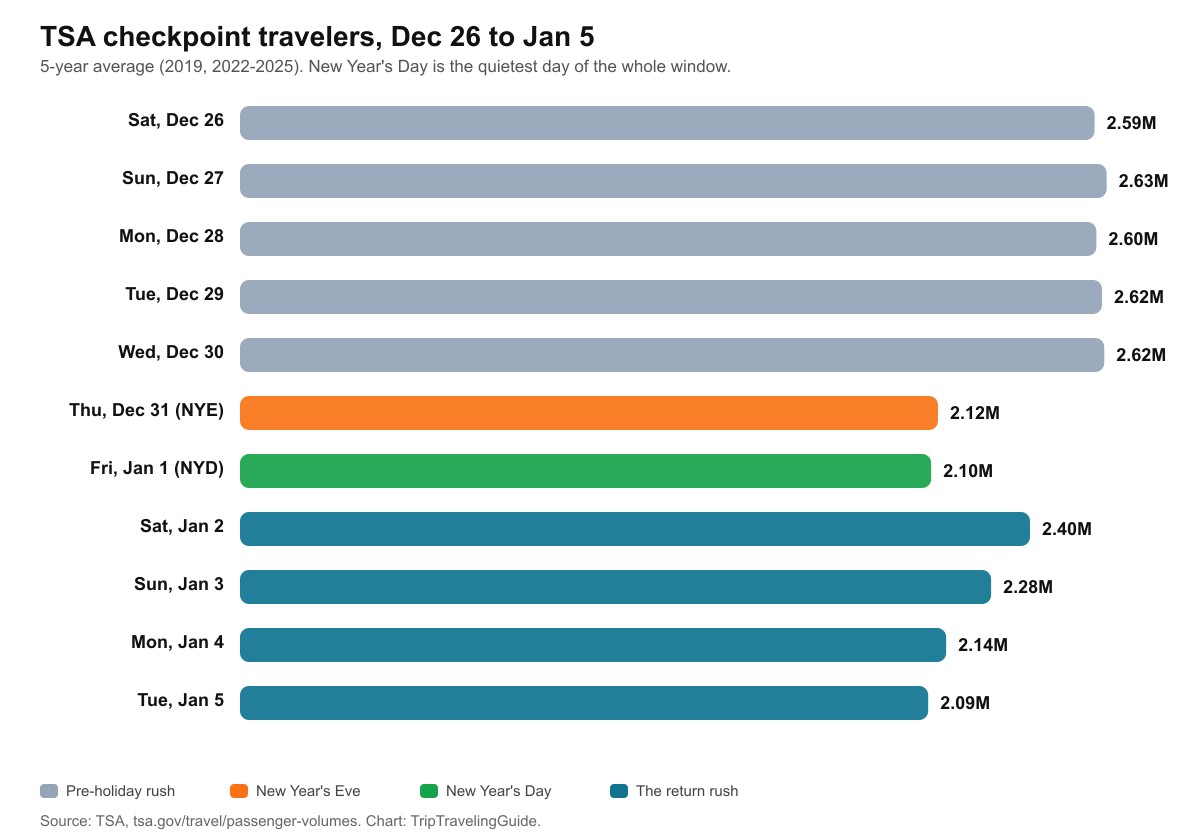
Our chart, built from TSA's own daily checkpoint counts for 2019 and 2022 to 2025.
Why could New Year's 2026-27 be different from a typical year?
Because of an unusual calendar alignment. Christmas Day 2026 falls on a Friday, and so does New Year's Day 2027. NerdWallet travel writer Sally French flagged this in an August 2026 update: both Christmas Eve and New Year's Eve land on Thursdays, which creates two separate four-day weekends with only three working days, Monday December 28 through Wednesday December 30, sitting between them.
That matters because our own averages come from years with a normal midweek lull between Christmas and New Year's. French's reasoning is that some travelers may treat the entire 11-day stretch as one long trip this time, rather than popping home in between, which could push crowds higher on the two bookending weekends and leave the usual "quiet week" less quiet than our five-year average suggests. The last time Christmas fell on a Friday was 2020, a pandemic year that makes for a poor comparison, so nobody has clean recent data on how this exact calendar plays out.
Advertisement
This is her informed reasoning about a specific calendar quirk, not a measured statistic, and we have not adjusted our own averages to account for it. Treat the day-by-day table above as the long-run baseline, and treat this section as a reason to book a little earlier than usual if your trip falls in that Dec 28-30 window or on either bookending weekend.
Is New Year's Day a busy air travel day?
No. New Year's Day is the least busy day in our entire 11-day window, averaging 2.10 million TSA checkpoint travelers against a window-wide average closer to 2.4 million. It edges out even New Year's Eve, which most people already assume is quiet.
The reason is straightforward. Most people who traveled for the holidays are already at their destination by December 31, and most people heading home wait until January 2 or later, once the first days of the new year have passed and normal schedules resume.
Is it cheaper to fly on New Year's Eve or New Year's Day?
New Year's Day, by a small margin, based on how few people are flying that day. Airfare tracking sites echo the same idea without giving hard numbers: Going's holiday travel guide says flying in the evening on New Year's Eve or early morning on New Year's Day is generally cheaper, while The Vacationer names the night of December 31 and the morning of January 1 as good options and calls January 2 and 3 "likely to be much busier."
Our own checkpoint data supports the shape of that advice, even though neither of those sites cites a specific dataset for it. Fewer travelers on a given day does not guarantee a cheaper seat, since airline pricing depends on route-level demand and how many seats are already booked, not the national checkpoint count. What the data can tell you is which days have historically had the most empty seats to work with.
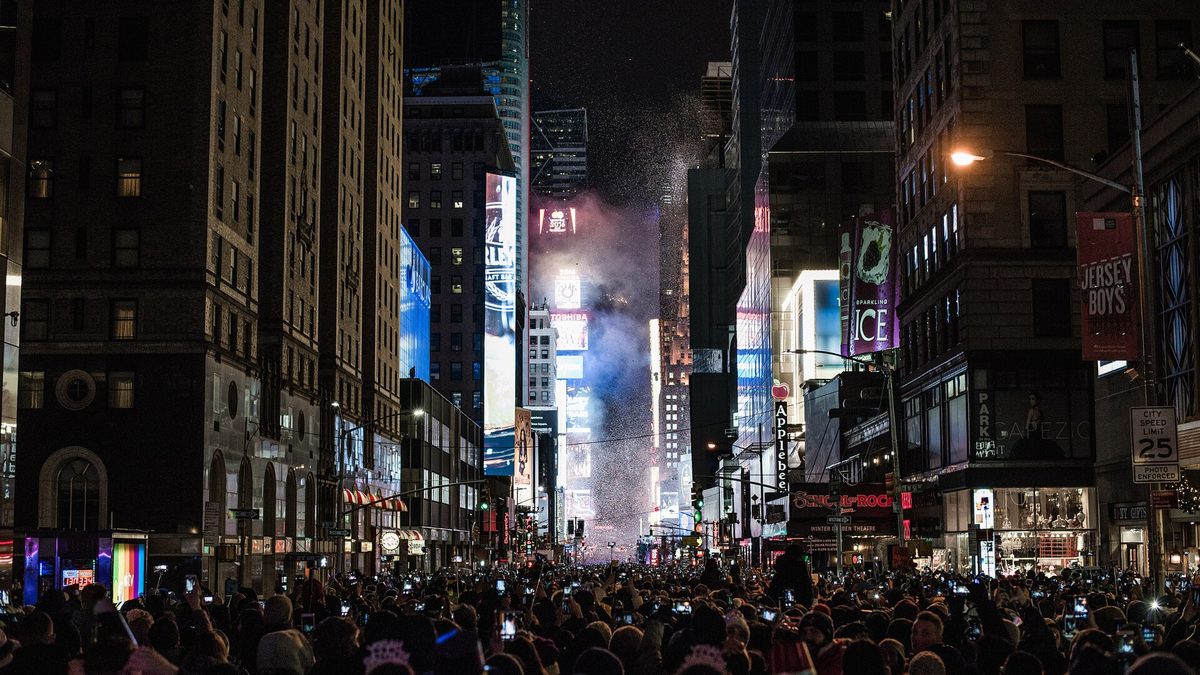
New Year's Eve in Times Square, January 1, 2016. Most people traveling for the holiday are already where they're going by this point in the night.
What is the worst day to fly after New Year's?
Saturday, January 2, based on the same five-year record. It averages 2.40 million travelers, about 14% above New Year's Day and the single busiest day in the entire post-holiday stretch. Sunday, January 3 stays elevated too, at 2.28 million.
That matches what The Vacationer's uncited advice already says about avoiding January 2 and 3, and it lines up with ordinary logic: most people who took time off for the holidays are due back at work or school within days of January 1, so they compress their return travel into that first weekend.
When should you fly home after New Year's?
Tuesday, January 5 is your best bet if your schedule can stretch that far. It averages 2.09 million travelers, essentially tied with New Year's Day itself for the quietest point in the whole window, once the Saturday and Sunday return crush has passed.
If you can fly home on | Expect |
|---|---|
Sat, Jan 2 or Sun, Jan 3 | The busiest days of the whole window |
Mon, Jan 4 | Easing off, still above the holiday itself |
Tue, Jan 5 | Back to an ordinary travel day |
Why is New Year's Day quieter than New Year's Eve?
Because the two days serve different trips. New Year's Eve still carries some last travelers finishing their journey before the night's celebrations, while New Year's Day is a full rest day for almost everyone already at their destination. Nobody is rushing to travel on January 1 itself, and nobody is rushing home yet either, since most trips run into at least the following weekend.
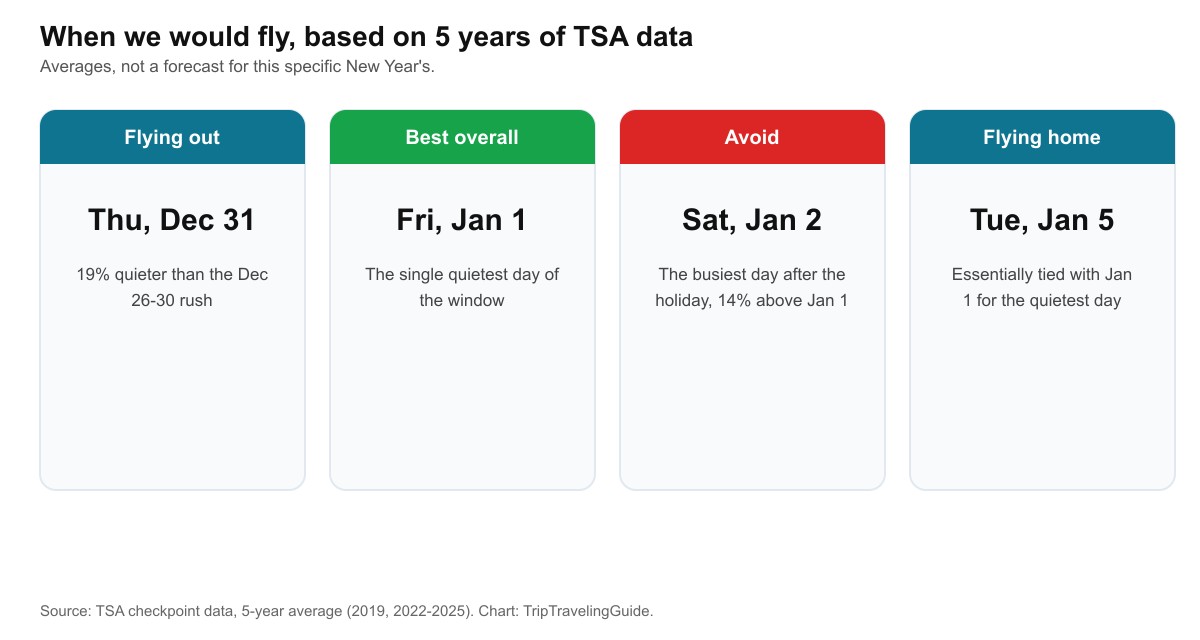
Our summary of the five-year TSA pattern. Not a forecast for this specific New Year's.
Does a quiet TSA day actually mean a cheaper flight?
Usually, but not always. TSA's count measures how many people pass through security nationally, not how full any one flight is or what any one route costs. A quiet national travel day still has plenty of full flights on popular routes, and a busy national day can have empty seats on unpopular ones.
Going's guide, updated 8 May 2026, adds a separate seasonal point: the three-week window from around December 17 through January 7 is typically the most expensive stretch of the whole year to fly, and prices ease outside it. That's a different claim from which day within the window is cheapest, and both can be true at once.
What are the limits of this data?
Every figure above comes from TSA's own published daily checkpoint counts at tsa.gov, averaged across five years: 2019, 2022, 2023, 2024 and 2025. We excluded 2020 because pandemic-era volumes would distort any average, and we excluded 2021 as well, since its early-January numbers were still recovering from the pandemic and would pull the "quiet day" figures artificially low.
Advertisement
TSA counts people, not flights, seats or dollars. A national count says nothing about your specific route, airline or airport, and a quiet checkpoint day is not a guarantee of a cheap fare or an empty seat next to you. The percentages compare our own five-year averages to each other. They are not a forecast of what December 31, 2026 or January 1, 2027 will look like. Going's and The Vacationer's advice on eve-versus-day pricing is not backed by a cited dataset in either case, which is why we present it as directional agreement with our numbers rather than independent proof.
Quick answers about flying around New Year's
Why is New Year's 2026-27 different this year?
Christmas 2026 and New Year's Day 2027 both fall on a Friday, giving two four-day weekends with just three workdays between them. NerdWallet flags this as a reason the usual quiet lull between the holidays might run busier than our five-year average, though it's judgment, not a measured statistic.
Are TSA lines shorter on New Year's Day?
Usually. Fewer checkpoint travelers generally means shorter security lines, though TSA doesn't publish wait times separately from volume, only the passenger counts we based this guide on.
Are New Year's Eve flights cheaper if you fly at night?
Going's holiday guide says yes, since most travelers are focused on evening celebrations rather than flying. Our checkpoint data doesn't break days into morning and evening, so we can't confirm the size of that gap ourselves.
What is the busiest travel day around New Year's?
Saturday, January 2, in our data, averaging 14% more travelers than New Year's Day. Sunday, December 27 is close behind it on the outbound side, as the single busiest pre-holiday day in our five-year record.
Is New Year's Eve a busy day at the airport?
Less than you'd expect. It's the second-quietest day in our window, only slightly busier than New Year's Day itself, and dramatically quieter than the days right before Christmas.
Is it better to travel on New Year's Day or the day after?
New Year's Day, by our data. January 2 is the busiest return day of the whole period we measured, about 14% above January 1.
When should I fly home after New Year's to avoid crowds?
Tuesday, January 5 if you can wait that long. It's essentially tied with New Year's Day for the quietest point in our entire 11-day window.
Sources and method
Transportation Security Administration, daily checkpoint passenger volumes, published at tsa.gov/travel/passenger-volumes for 2019, 2022, 2023, 2024 and 2025. Read directly from those archive pages on 27 September 2026.
55 daily figures were read across the five years, covering December 26 to January 7 of each year.
2020 was excluded because pandemic-era volumes would distort every average. 2021 was excluded because its early-January figures were still depressed by the pandemic, well below every other year in the record.
All figures are counts of people screened at TSA checkpoints nationally, not flights, seats or fares.
Both charts are our own, plotted from that record.
NerdWallet, "The Best Days to Travel Around Christmas In 2026" (Sally French, updated 27 August 2026): the Christmas Day/New Year's Day both-fall-on-Friday calendar alignment and its likely effect on the usual holiday lull. Accessed 27 September 2026.
Going, "New Year's Travel Guide" (updated 8 May 2026): the December 17 to January 7 peak-pricing window and eve/day booking advice. Accessed 27 September 2026.
The Vacationer, "Best & Worst Days to Fly & Travel for the Holidays": its New Year's Eve, New Year's Day and January 2-3 recommendations, cross-checked against our TSA data. Accessed 27 September 2026.
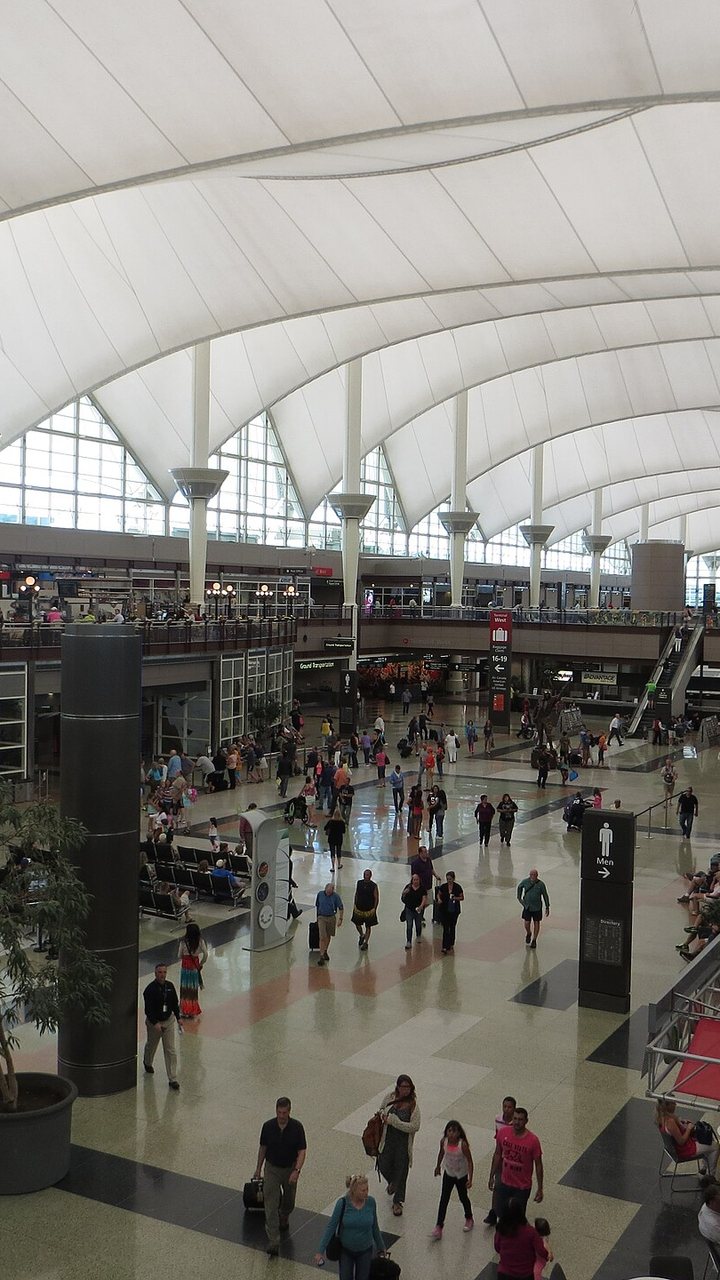
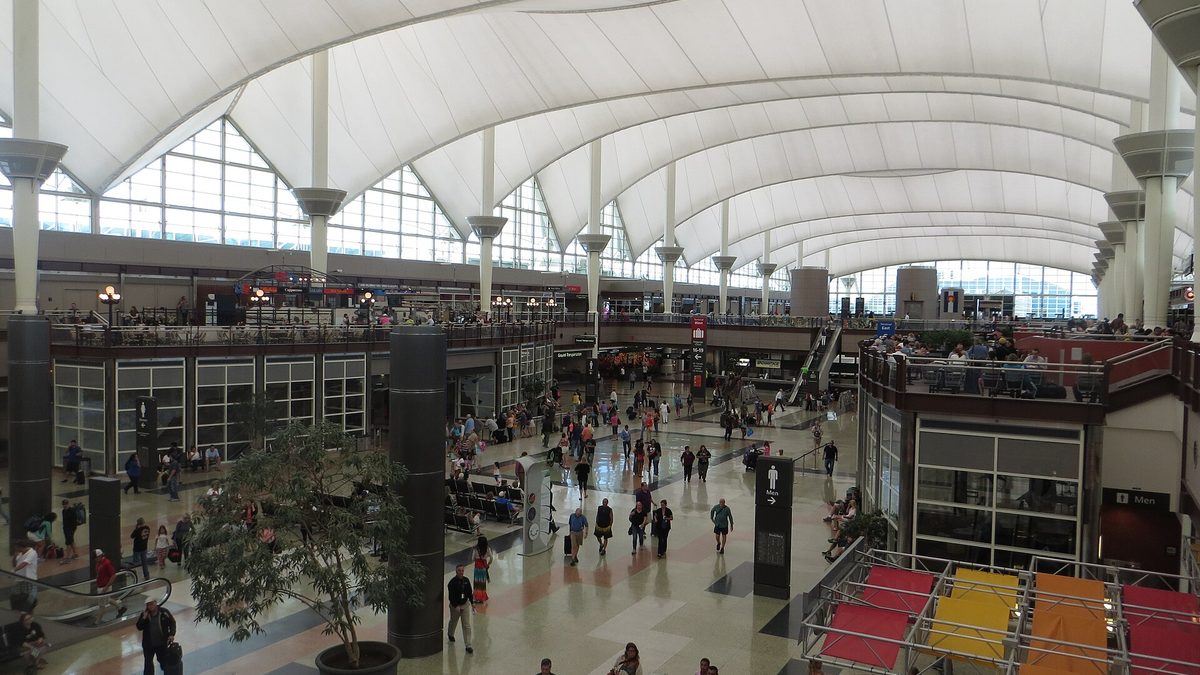
Cover photograph: the Jeppesen Terminal at Denver International Airport, 7 August 2014, by Sunnya343, CC BY-SA 4.0, via Wikimedia Commons.
Times Square photograph: New Year's Eve crowds in New York City, 1 January 2016, by Andrew Muller, CC BY 3.0, via Wikimedia Commons.
More from us on flying: our guide to when to book Christmas flights in 2026, our TSA-based guide to the best day to fly for Thanksgiving, and the rest of our air travel guides.
Counted from TSA's own record on 27 September 2026. The averages and charts are ours, and the underlying daily figures are TSA's. Dates for 2026-27 are calculated from the calendar, not forecast, and passenger volumes for this coming New Year's are not knowable yet.
Topics
Advertisement