How long does fall foliage last?

Color on one tree lasts a median 41 days, and different species peak a month apart. From 14,006 tree-years of US phenology records, state by state.
Advertisement
Fall foliage lasts far longer than the two weeks most guides quote, and the reason is that the trees around you are not on the same schedule. We pulled every autumn leaf-color record the USA National Phenology Network holds for 14 common American trees, 21,151 tree-years from 7,442 individual monitored trees between 2011 and 2025, and measured it.
Across the 14,006 tree-years where observers recorded a tree reaching at least half its leaves colored, the median peak date was 19 October. But a single national date hides the thing that actually decides your trip.
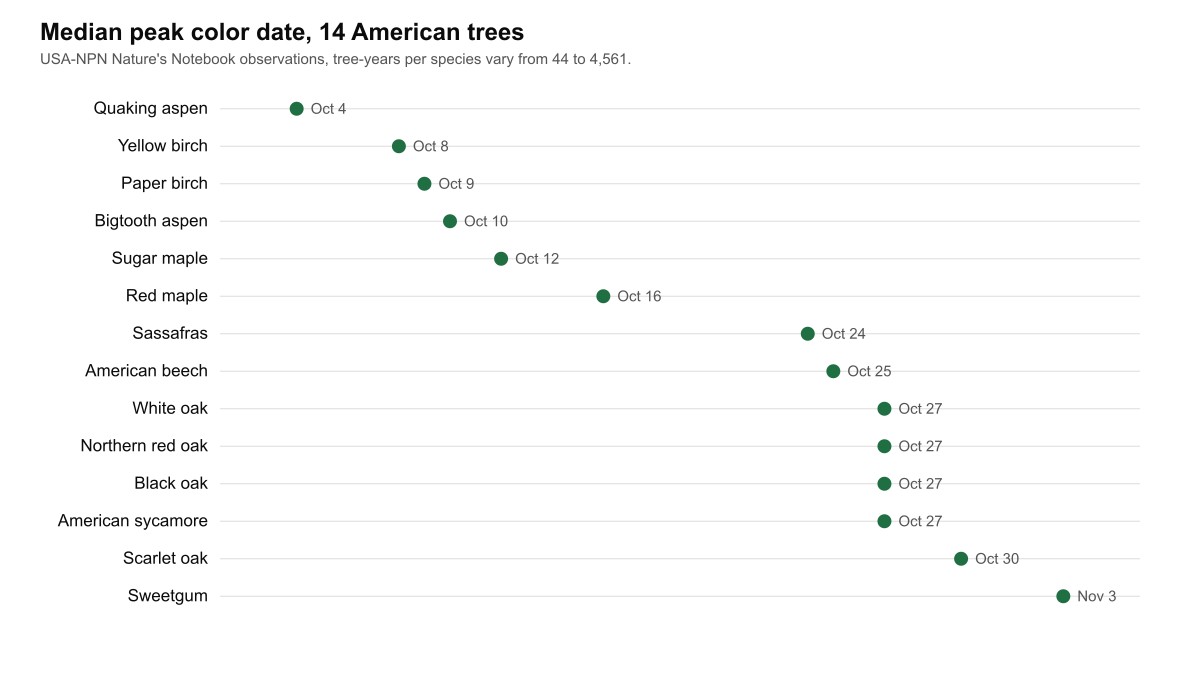
Quaking aspens hit peak a median 4 October. Sweetgums hit it a median 3 November. That is a month apart, in the same country, in the same autumn.
How long does fall foliage last?
On a single tree, color lasts a median 41 days from the first colored leaf to the last one recorded, measured across 18,945 tree-years. A quarter of trees held color for 20 days or less and a quarter held it past 63 days. The commonly repeated "one to two weeks" describes peak, not the season.
Those are two different questions that get answered as if they were one. A tree showing its first color is not a tree worth driving six hours to photograph, and a hillside past peak is not a bare hillside. The gap between them is where most trip planning goes wrong.
How long does peak fall foliage last?
Peak on one tree is short, roughly one to two weeks, which is where the familiar figure comes from. Peak across a mixed forest is much longer, because the species reach it weeks apart. In Tennessee the gap between the earliest and latest tree we measured was 39 days.
This is the single most useful thing in the whole dataset. A pure stand of one species gives you a spectacular week and then nothing. A mixed hardwood slope gives you something worth looking at for over a month, because as the birches drop the oaks are only starting.
How long does fall foliage last after peak?
From first color to peak took a median 28 days across 14,006 tree-years, with the middle half falling between 13 and 45 days. After peak the decline is faster than the climb, and a single storm ends it. That asymmetry is why arriving slightly early beats arriving slightly late.
If you have to guess wrong in one direction, guess early.
Which trees change color first in the fall?
Aspens and birches go first, maples next, oaks and sweetgums last. Quaking aspen reached peak a median 4 October and sweetgum a median 3 November, a 30 day spread. Sugar maple, the tree most people picture, sits in the middle at 12 October.
| Tree | Median peak date | Tree-years measured |
|---|---|---|
| Quaking aspen | 04 Oct | 690 |
| Yellow birch | 08 Oct | 591 |
| Paper birch | 09 Oct | 499 |
| Bigtooth aspen | 10 Oct | 44 |
| Sugar maple | 12 Oct | 2,298 |
| Red maple | 16 Oct | 4,561 |
| Sassafras | 24 Oct | 208 |
| American beech | 25 Oct | 1,094 |
| White oak | 27 Oct | 1,048 |
| Northern red oak | 27 Oct | 1,494 |
| Black oak | 27 Oct | 304 |
| American sycamore | 27 Oct | 250 |
| Scarlet oak | 30 Oct | 51 |
| Sweetgum | 03 Nov | 893 |
Pick your week by the tree you want to see, not by the state. If you are going for the postcard sugar maple red, the second week of October is your target almost anywhere it grows. If you want a long, slow, mixed display and you do not care about hitting one species exactly, go later and go somewhere with oaks.
Why do leaves change color at different times?
Species is the biggest single factor in this record, ahead of the state you are standing in. A sweetgum in Massachusetts colors later than a quaking aspen in Massachusetts, and the difference between those two trees is larger than the difference between many neighboring states.
Latitude and elevation matter too, and both push in the expected direction where the range is wide enough to measure. What our data cannot separate cleanly is how much of the state to state variation is climate and how much is simply which trees happen to be monitored there. Colorado's monitored sample is almost entirely aspen. Alabama's is not.
That caveat is worth carrying into every foliage map you read, including ours. If you want more on how seasonal forecasting goes wrong in practice, our piece on the gap between the La Nina outlook and the almanacs covers the same problem in winter.
When do leaves change color?
Across the 32 states with enough records to quote, median peak ran from 7 September in Alaska to 24 November in Florida, a spread of 78 days. Most of the country falls in October. The table below gives every state where at least 25 monitored tree-years were recorded.
Advertisement
| State | Median peak date | Tree-years measured |
|---|---|---|
| Alaska | 07 Sep | 165 |
| Wisconsin | 03 Oct | 718 |
| Arizona | 04 Oct | 25 |
| Colorado | 05 Oct | 157 |
| Oregon | 08 Oct | 36 |
| South Dakota | 08 Oct | 41 |
| New Hampshire | 09 Oct | 1,251 |
| Vermont | 10 Oct | 46 |
| Minnesota | 11 Oct | 849 |
| Connecticut | 11 Oct | 79 |
| Maine | 13 Oct | 523 |
| New Jersey | 15 Oct | 69 |
| California | 17 Oct | 123 |
| Illinois | 17 Oct | 175 |
| New York | 20 Oct | 2,319 |
| Massachusetts | 20 Oct | 1,717 |
| Indiana | 20 Oct | 391 |
| Michigan | 22 Oct | 97 |
| West Virginia | 22 Oct | 108 |
| Virginia | 23 Oct | 675 |
| Ohio | 23 Oct | 126 |
| North Carolina | 27 Oct | 1,007 |
| Kentucky | 27 Oct | 250 |
| Tennessee | 29 Oct | 1,651 |
| Pennsylvania | 31 Oct | 206 |
| Oklahoma | 03 Nov | 77 |
| Maryland | 08 Nov | 254 |
| Louisiana | 10 Nov | 182 |
| Mississippi | 13 Nov | 150 |
| Texas | 17 Nov | 35 |
| Alabama | 17 Nov | 283 |
| Florida | 24 Nov | 51 |
Two entries in that table should stop you. Maryland peaks a week after Pennsylvania, and Tennessee peaks nine days after New York. The tidy north to south wave that every foliage map draws is real at the scale of the whole country and unreliable at the scale of neighboring states, because the trees being counted are not the same trees.
Earliest fall colors in USA
Alaska, and it is not close. Alaskan trees reached peak a median 7 September across 165 tree-years, 26 days ahead of the next state. Outside Alaska the earliest peaks were Wisconsin on 3 October, Arizona on 4 October and Colorado on 5 October, all within three days of each other.
Wisconsin ahead of Vermont surprises people. It should not: Wisconsin's monitored trees skew to early species, and the state sits further north than most of New England.
When is peak fall foliage in the Smoky Mountains?
Tennessee's monitored trees reached peak a median 29 October, one of the latest in the country. For the park itself we cannot give you an elevation by elevation answer from this data, and it would be dishonest to pretend otherwise. The monitored Tennessee sites span 469m to 675m, nowhere near the park's full range.
What Tennessee does show is the widest species spread we measured anywhere: yellow birch peaked a median 2 October and northern red oak a median 10 November, 39 days apart. That is the real answer for the Smokies. There is no single peak week. There is a six week procession.
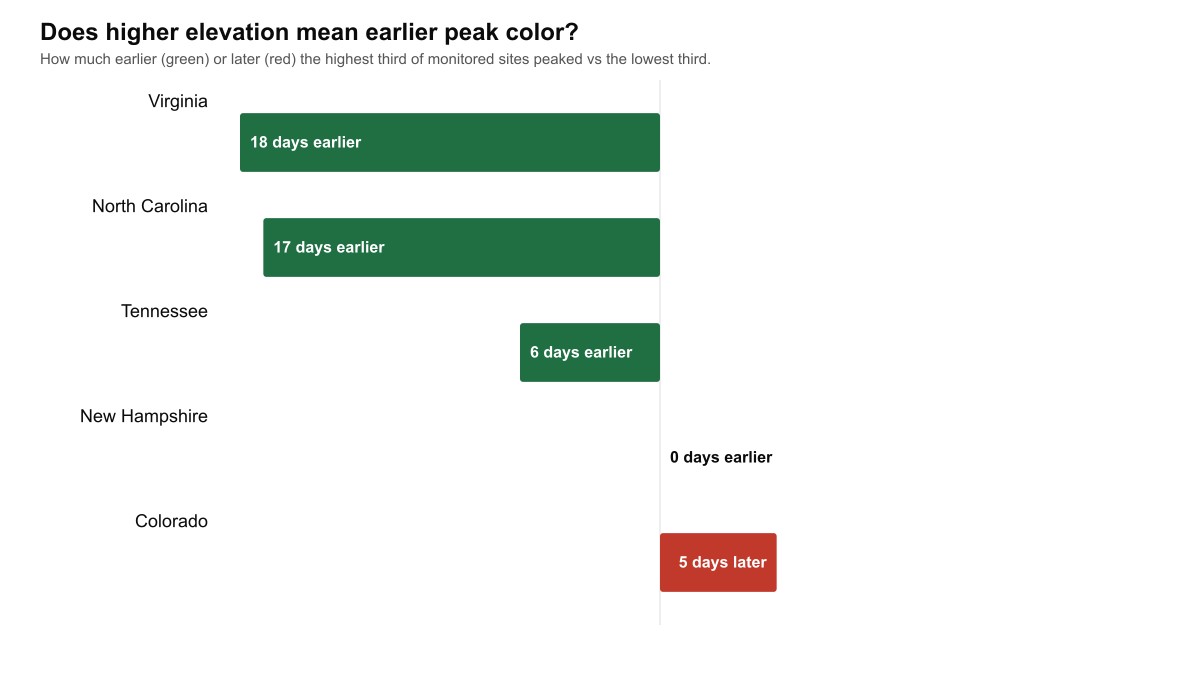
Here is where we part company with most foliage writing. "Higher elevation peaks first" is treated as a rule, and in our data it only holds where the mountains are genuinely big. North Carolina's high sites peaked 17 days before its low ones and Virginia's 18 days. Tennessee managed 6 days. New Hampshire showed no difference at all, and Colorado's high sites peaked 5 days later than its low ones.
Elevation is a strong signal in the southern Appalachians and a weak one elsewhere. Treat it as a local rule, not a national one.
When do aspens turn yellow in Colorado?
Colorado's monitored aspens reached peak a median 5 October across 91 tree-years. That is the last week of September into the first week of October, which matches what Colorado tourism has always said, and this is one of the rare cases where the folk wisdom and the record agree closely.
Be careful with how much weight you put on Colorado here. The state contributed only 157 tree-years in total and four species, of which the aspens are the only ones that are native and abundant. It is a real number from a thin sample.
If you are already planning a Colorado trip around the seasons, our Colorado snow outlook for 2026 and 2027 covers the other end of the same calendar.
How long does fall foliage last in Colorado?
A median 37 days of color on a single Colorado tree, from 198 tree-years, slightly shorter than the national median of 41. Colorado's display is concentrated because the state's show is essentially one species. When the aspens go, there is no second act of oaks behind them.
How long does fall foliage last in New England?
A median 43 days of color per tree across 4,645 tree-years from the six New England states, marginally above the national figure. Species peaks there run from yellow birch on 8 October to black oak on 30 October, a 22 day spread, which is narrower than Tennessee's.
New England's reputation is built on intensity and on sugar maple, not on length. If you want the longest possible season you are better served further south, where the oak and sweetgum tail keeps going into November.
How long does peak foliage last in New Hampshire?
New Hampshire's trees peaked a median 9 October, the earliest in New England, with a median 41 days of color per tree across 1,570 tree-years. Its monitored sites span only 557m to 766m, and across that narrow band we found no elevation difference at all in peak timing.
Do leaves change color in Texas?
Yes, and later than almost anywhere else in the country. Texas trees reached peak a median 17 November across 35 tree-years, tied with Alabama and behind only Florida. The sample is small, so treat 17 November as an indication rather than a firm date.
The south is not excluded from fall color. It is simply on a different calendar, one that runs when the northern season is already over.
Advertisement
Do leaves change color in Florida?
Florida recorded the latest peak of any state, a median 24 November across 51 tree-years, almost all of it red maple and sweetgum in the north of the state. That falls in Thanksgiving week most years, the one place where a holiday trip and peak color coincide.
Our guide to the best day to fly for Thanksgiving covers the flight side of that same week.
Fall foliage 2026 predictions
We are not publishing one. Not because it is hard, but because the year to year swing in this record is large enough that any date we gave you would be a guess wearing a number. The same monitored red maples in New York State moved 19 days between their earliest and latest year.
The chart that stood here (median peak color date for New York red maples, 2014 to 2025) was lost when its original host was decommissioned. We kept two of its twelve values in the text above (27 October in 2021, 8 October in 2025); the other ten were not preserved anywhere we could verify, so we have not reconstructed a chart from a guess. [HUMAN INPUT NEEDED: re-pull the full 2014-2025 series from USA-NPN Nature's Notebook if this chart should be restored.]
Those are the same trees in the same state, so the swing is weather, not geography or species. Peak landed on 27 October in 2021 and 8 October in 2025. Any map that tells you in August exactly which week will peak in October is selling confidence it has not got.
What to do instead: use the median date for your state from the table above to choose your week, then watch the official live trackers in the fortnight beforehand and adjust. Maine's state foliage reports start on 16 September, and New Hampshire and Vermont publish weekly through the season. Those are observations of what is happening now, which is a different and more reliable thing than a forecast made in spring.
What this record cannot tell you
Four limits, stated plainly, because a dataset this size invites over-reading. It is a record of monitored individual trees rather than a survey of American scenery, its coverage is uneven between states, and nothing in it forecasts a future season. Each of those constrains what you should take from the tables above.
- It is not evenly spread. New York contributed 2,319 tree-years and Arizona 25. Sixteen states had too few records to quote at all, including Georgia, Washington, Utah and South Carolina.
- It counts monitored trees, not scenery. Volunteers record individual tagged trees, many in gardens and campuses rather than on the ridgelines you would drive to.
- It cannot tell you about this year. Every figure here is a median of past years.
- We have not walked these routes. Nobody at this site has done a leaf-peeping season in Vermont or the Smokies. What we have done is the measurement, and where the measurement runs out we have said so rather than filled the gap.
The honest summary is that this record is very good at telling you which week is a sensible bet and which tree to look for, and no good at all at telling you what 2026 will do. More seasonal timing work sits in our weather for traveling section.
Common questions
How long does fall foliage last in Maine?
Maine's monitored trees held color a median 28 days each, from 782 tree-years, the shortest window of any New England state we measured. Median peak fell on 13 October. The state's own foliage reports begin on 16 September and run weekly through the season.
How long does fall foliage last in New York?
New York trees held color a median 43 days each across 2,885 tree-years, more records than any other state contributed. Median peak was 20 October. Peak dates varied by about three weeks between its lowest and highest sites, though in New York that gap tracks latitude as much as elevation.
How long does fall foliage last in Vermont?
Vermont trees held color a median 31 days each, but that rests on only 74 tree-years, and its peak date on 46. Both are the thinnest samples of any New England state here. Median peak was 10 October. Treat the Vermont figures as indicative rather than settled.
Do leaves change color in September?
In most of the country you will see first color in September but not peak. Alaska is the exception, with a median peak of 7 September. Elsewhere the median gap between first color and peak was 28 days, which pushes peak into October almost everywhere.
Do leaves change color in November?
Yes, across the southern states. Maryland peaked a median 8 November, Louisiana 10 November, Mississippi 13 November, Texas and Alabama 17 November and Florida 24 November. Sweetgum, the latest species we measured anywhere, reached peak a median 3 November even in northern states.
Do leaves change color in California?
California trees reached peak a median 17 October across 123 tree-years, close to the national median of 19 October. The sample is small for a state that size and spans very different climates, so it tells you little about any particular part of California.
Sources
- USA National Phenology Network, Nature's Notebook observational data, phenophase "Colored leaves", 14 species, 2011 to 2025. Retrieved 12 August 2026 from the NPN observational data portal. Peak is defined here as the first date a tree was recorded at 50% or more of its leaves colored.
- USGS Open-File Report 2018-1060, USA National Phenology Network observational data documentation.
- Maine Bureau of Parks and Lands foliage reports, New Hampshire and Vermont state foliage trackers, for live in-season conditions.
Every number here is a median, and each one is stated with the number of tree-years behind it so you can judge how far to trust it.
Advertisement