Daylight Saving Time 2026: What It Means for Flights and Winter Travel

Clocks fall back 1am on November 1, 2026. Does it affect flight times? How much earlier does it get dark? And where does the bill to end clock changes stand?
Advertisement
Daylight saving time ends in the United States at 2am on Sunday, 1 November 2026, when clocks fall back one hour. Flight durations don't change. Sunset times jump an hour earlier overnight in every city at once. And a bill to end the twice-a-year switch for good, the Sunshine Protection Act, already passed the House and is waiting on the Senate.
Key facts:
- Date and time: clocks fall back 1 hour at 2am on Sunday, 1 November 2026
- Flight length: unaffected, aviation schedules run on UTC internally
- Sunset shift: about 1 hour earlier overnight (for example, Chicago: 5:45pm to 4:44pm)
- States that don't change clocks: Hawaii, most of Arizona, Puerto Rico, US Virgin Islands, American Samoa, Guam, Northern Mariana Islands
- Permanent-DST bill status: passed the House 308-117 on 14 July 2026, awaiting a Senate vote, none scheduled
- Next change: clocks spring forward again on 8 March 2027
When do clocks fall back in 2026?
Clocks fall back one hour at 2am on Sunday, 1 November 2026, in every part of the US that observes daylight saving time. The clock moves from 1:59am straight to 1am, so that specific hour between 1 and 2am happens twice that night.
One quick correction worth making: the official term is "daylight saving time," singular, not "daylight savings time." It's a small thing, but it's wrong often enough in casual writing that it's worth getting right.
Why do we have daylight saving time at all?
Daylight saving time exists to shift daylight into the evening during the warmer months, and the US has used some version of it since 1918. The current schedule, second Sunday in March to first Sunday in November, has only existed since 2007, when the Energy Policy Act of 2005 extended it by about a month on each end.
Under today's rules, daylight saving time runs for 238 days a year, or roughly 65 percent of the calendar. Standard time is now the shorter season, not the default most people picture.
One detail that surprises people: daylight saving time and US time zones are regulated by the Department of Transportation, not NIST, even though NIST is the agency that keeps the country's official time. NIST's own clocks run on UTC and don't observe daylight saving at all.
Has permanent daylight saving time been tried before?
Yes. Congress put the entire country on year-round daylight saving time starting January 1974, during the energy crisis, to cut electricity use. It lasted about ten months.
Dark winter mornings, with kids waiting for school buses before sunrise, turned public opinion against it fast enough that Congress reversed the law that October. Anyone proposing permanent daylight saving time today is proposing something the US already tried and backed out of once.
Does daylight saving time actually affect flight times?
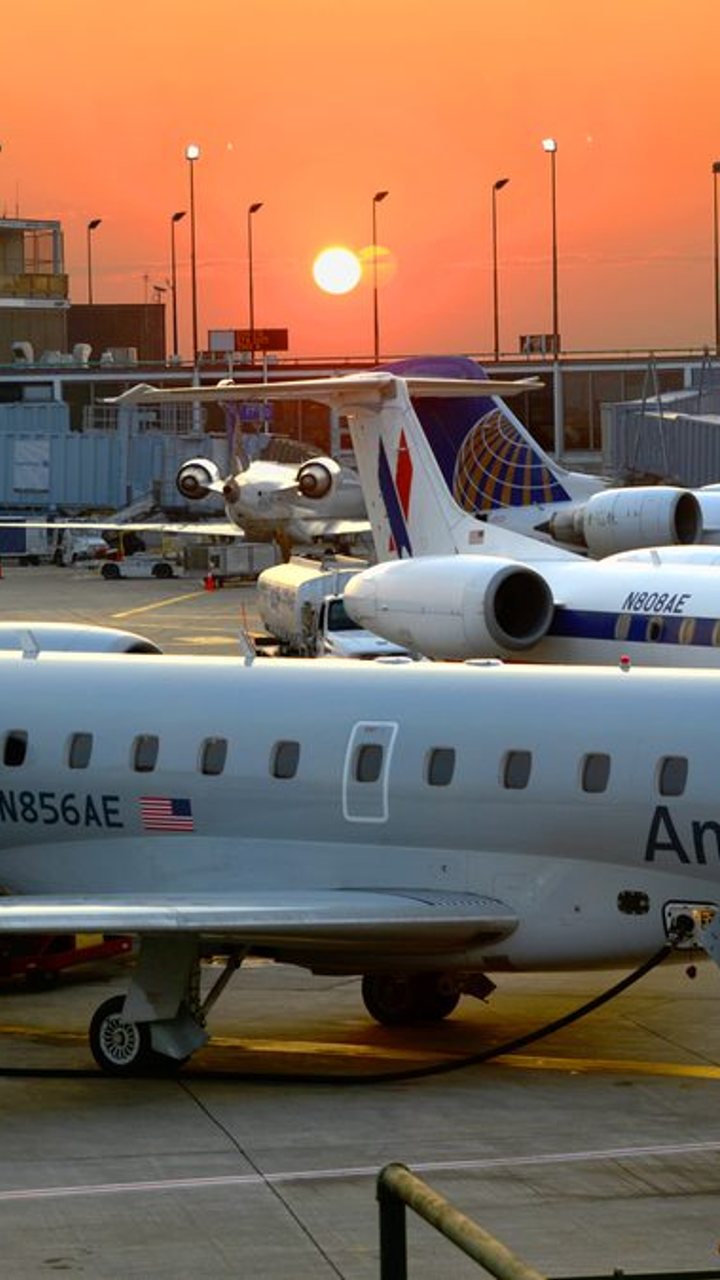
No. A flight's actual duration never changes because of a clock switch. Airlines and air traffic control run on UTC internally specifically to avoid this kind of confusion, and that system doesn't observe daylight saving at all.
Advertisement
The real headache is international connections. The US and Europe don't switch their clocks on the same date, and Europe typically shifts about a week before the US does in the fall. That creates a short window, often a week or more, where the usual time difference between a city like New York and London is temporarily off by an hour. Check the local times on each leg of a late-October or early-November transatlantic booking rather than assuming the gap you're used to still applies.
How much earlier will it get dark where you live?
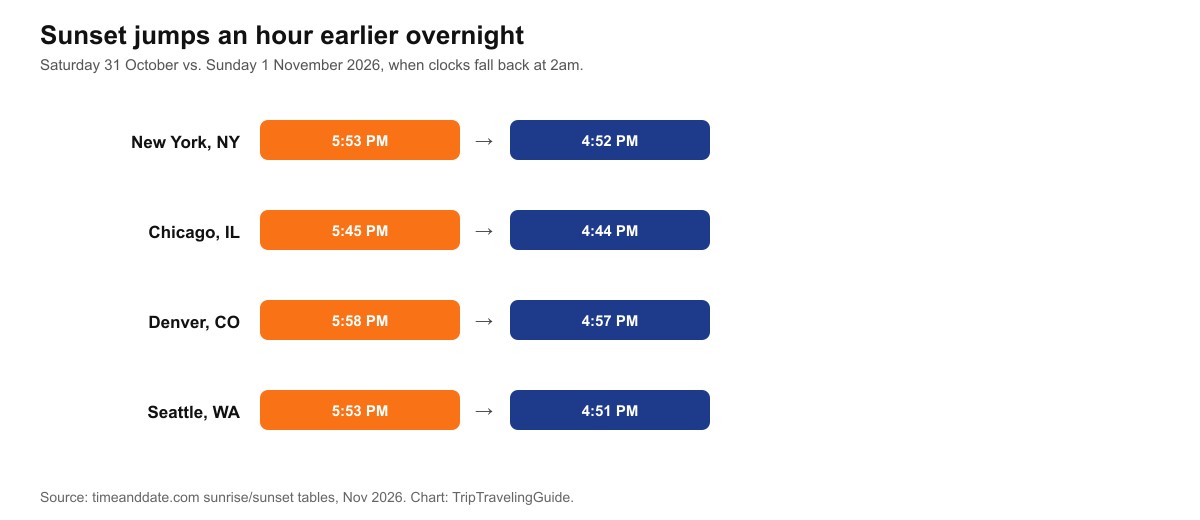
Sunset moves about one hour earlier overnight, the same Sunday, not gradually. Chicago goes from a 5:45pm sunset on Saturday 31 October to 4:44pm on Sunday 1 November. New York drops from 5:53pm to 4:52pm.
| City | Sunset, 31 Oct | Sunset, 1 Nov |
|---|---|---|
| New York, NY | 5:53 PM | 4:52 PM |
| Chicago, IL | 5:45 PM | 4:44 PM |
| Denver, CO | 5:58 PM | 4:57 PM |
| Seattle, WA | 5:53 PM | 4:51 PM |
Sunsets keep creeping earlier after the switch too, down to 4:22pm in Chicago and 4:31pm in New York by the winter solstice on 21 December. If you're driving anywhere that first week of November, 5pm now looks like dusk, not daylight. Deer activity, school pickup traffic and tired commuters all cluster right into that newly dark hour.
Which states and territories don't change their clocks?
Six places in the US don't observe daylight saving time:
- Hawaii
- Arizona (outside the Navajo Nation, which does observe it)
- Puerto Rico
- US Virgin Islands
- American Samoa
- Guam and the Northern Mariana Islands
Arizona opted out in 1968, and federal law still lets a state choose permanent standard time that way. It does not let a state choose permanent daylight saving time on its own, which is exactly the gap the Sunshine Protection Act is trying to close at the federal level.
Could this be the last time the clocks change?
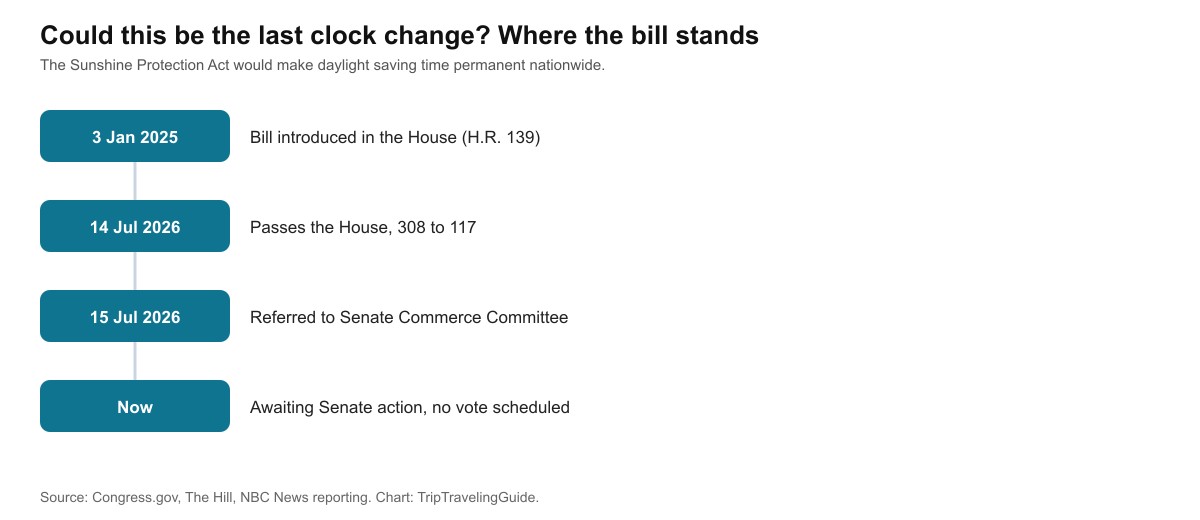
Not this year. The Sunshine Protection Act, which would make daylight saving time permanent nationwide, passed the House 308 to 117 on 14 July 2026 with President Trump's backing. It was referred to the Senate Commerce Committee the next day and has no vote scheduled.
This is the bill's second trip through Congress. An earlier version passed the Senate by unanimous consent in March 2022, then died when the House never took it up before that Congress ended.
One catch worth knowing: the bill would lock in daylight saving time, not standard time, the same choice Congress already reversed in 1974. That means darker winter mornings in exchange for lighter winter evenings. Some sleep scientists prefer the opposite, permanent standard time, because morning light matters more for the body's clock. Ending the twice-a-year switch is popular. Which time to keep permanently is not a settled question.
Advertisement
What does this mean for holiday travel planning?
Build extra buffer into any drive after dark starting the first week of November, since 5pm will look and feel like night from here through December. Our USA winter forecast hub covers what's coming on the weather side, and our flight-cancellation guide covers what to do if a storm hits your route. Earlier darkness doesn't cancel flights by itself, but it does shrink your margin for delays getting to the airport.
What are the limits of this guide?
The clock change itself is fixed and certain. Nothing about the date or the hour is in question. What's genuinely uncertain is the Senate's timeline on the Sunshine Protection Act, which has no scheduled vote as of this writing, and whether any version that passes would take effect before the next scheduled change on 8 March 2027. Treat the legislative section as current as of early October 2026, not as a guarantee of what Congress does next.
Quick answers about daylight saving time 2026
When do clocks fall back in 2026?
2am on Sunday, 1 November 2026. Clocks move back one hour, from 1:59am to 1am.
Does daylight saving time affect flight length?
No. Flight duration is unaffected. A connection during the week-plus window when the US and Europe are on different switch schedules can get confusing instead.
How much earlier will it get dark after November 1?
About an hour, overnight. Chicago's sunset moves from 5:45pm to 4:44pm between Saturday and Sunday.
Will the US stop changing clocks?
Not this year. The Sunshine Protection Act passed the House in July 2026 but is still waiting on the Senate, with no vote scheduled. An earlier version died the same way in 2022.
Has the US tried permanent daylight saving time before?
Yes, from January to October 1974. Dark winter mornings turned public opinion against it, and Congress reversed it after about ten months.
Which states don't observe daylight saving time?
Hawaii and most of Arizona, plus Puerto Rico, the US Virgin Islands, American Samoa, Guam and the Northern Mariana Islands.
Sources
- timeanddate.com, Daylight Saving Time 2026 in the United States
- timeanddate.com, sunrise/sunset tables, November 2026
- NIST, Daylight Saving Time rules and history
- Wikipedia, "Sunshine Protection Act"
- The Hill, House passage of the Sunshine Protection Act, July 2026
- Reporting on the 1974 year-round daylight saving time experiment and its repeal
- Reporting on UTC use in aviation scheduling and US-Europe daylight saving transition timing
Topics
Advertisement