Can You Check the Passenger List on a Flight?

You cannot see a flight's passenger list, and airlines will not confirm a named traveller. What the regulations actually say, and what you can check instead.
Advertisement
You cannot check the passenger list on a flight. No airline, airport or flight tracker will release a manifest to the public, and no carrier will confirm whether a named person is booked, checked in or on board. There is no form, no fee and no workaround.
That answer is not popular. Most of the guides ranking for this question tell you to log into the airline site and download the manifest, or to phone the airport and ask. We checked those instructions against the regulations and against what airline systems document themselves as exposing. They do not work, and one of the pages making that claim was ours.
We also found something none of the top results mention, and it cuts against the usual explanation. Airlines refuse these requests as a matter of internal policy, not because a US privacy statute forbids it. The detail is in the next section, and it changes what you should expect if you ask.
This is a research guide built from primary sources: the Code of Federal Regulations, US statute, the GDPR text and airline and vendor documentation, all linked below and checked on 18 July 2026. We are not lawyers, and this is not legal advice.
What does the law actually say about flight manifests?
Less than almost everyone writing about this assumes. Here is the honest version, which took us longer to establish than the confident version would have.
There is no general US federal regulation making airline passenger records confidential. People cite one constantly. We went looking for it and it is not there. 14 CFR 399.79 contains no privacy provision. The Stored Communications Act, often invoked, does not cover airline reservation records. 49 U.S.C. 40103 gets cited in these articles and is about the use of airspace.
What does exist is narrower and worth quoting properly. 14 CFR §243.9(c) governs the emergency contact details a carrier collects for covered international flights:
"The contact information collected pursuant to section 243.7(a)(2) of this part shall be kept confidential and released only to the U.S. Department of State, the National Transportation Safety Board (upon NTSB's request), and the U.S. Department of Transportation pursuant to oversight of this part."
Subsection (d) adds that it "shall only be used by covered airlines for notification of family members or listed contacts following an aviation disaster" and "shall not be used for commercial or marketing purposes." That is a tight rule about one data field, not a blanket ban on discussing who is flying.
49 U.S.C. §44909 sends manifests to the State Department after a disaster abroad and to Customs and Border Protection for inbound international flights. It has no public-release provision. 14 CFR §121.693 requires a load manifest carrying "names of passengers", kept at least three months under §121.695, as an operational record.
So why will nobody tell you anything? Because carriers treat it as confidential by internal procedure, and that procedure is not published. We read Delta's privacy policy in full: it is verifiably silent on whether the airline will confirm a named passenger to a caller. The practice is real and consistent. The legal citation people attach to it usually is not.
Outside the US the picture inverts, and there the statute really does do the work. See the section on the GDPR and the UK Data Protection Act below.
Does any of the advice in the top results work?
No. We took every method repeated across the pages currently ranking for this question and checked each one against the regulation above and against what the airline systems document themselves as exposing. Here is what each claim actually amounts to.
| What the guides tell you to do | What actually happens |
|---|---|
| Log into the airline site and download the passenger manifest | No such option exists. Manage Booking shows your own reservation, not the flight. |
| Open the airline app to see fellow travellers' names | The app shows your booking. No carrier exposes other passengers. |
| Call customer support and ask for the list | Refused. Agents cannot confirm or deny that a named person is booked. |
| Call the airport desk or email the station manager | Those lines handle baggage, ticketing and complaints. They have no authority to release passenger data. |
| Search the aircraft registration number on a government site | Registration lookups return aircraft owner and airworthiness data. There is no passenger field. |
| Use a flight tracker | Trackers read ADS-B, an aircraft telemetry broadcast. It carries position, altitude and speed. It has no passenger data at all. |
FlightAware states its own limits plainly in its FAQ: it cannot provide the "pilot's name, address, phone number, number of people on board, and color of aircraft". It will not even give you a passenger count, let alone names.
A correction to our own earlier version
An earlier version of this page, published in 2024, listed several of the methods in that table as if they worked, including phoning airport desks to request a list. That was wrong. We have removed it. If you followed that advice and an agent refused you, they were right and we were not.
What can you actually find out about someone's flight?
Quite a lot, as long as you are asking about the aircraft rather than the people inside it. Flight-level data is public. Passenger-level data is not.
Advertisement
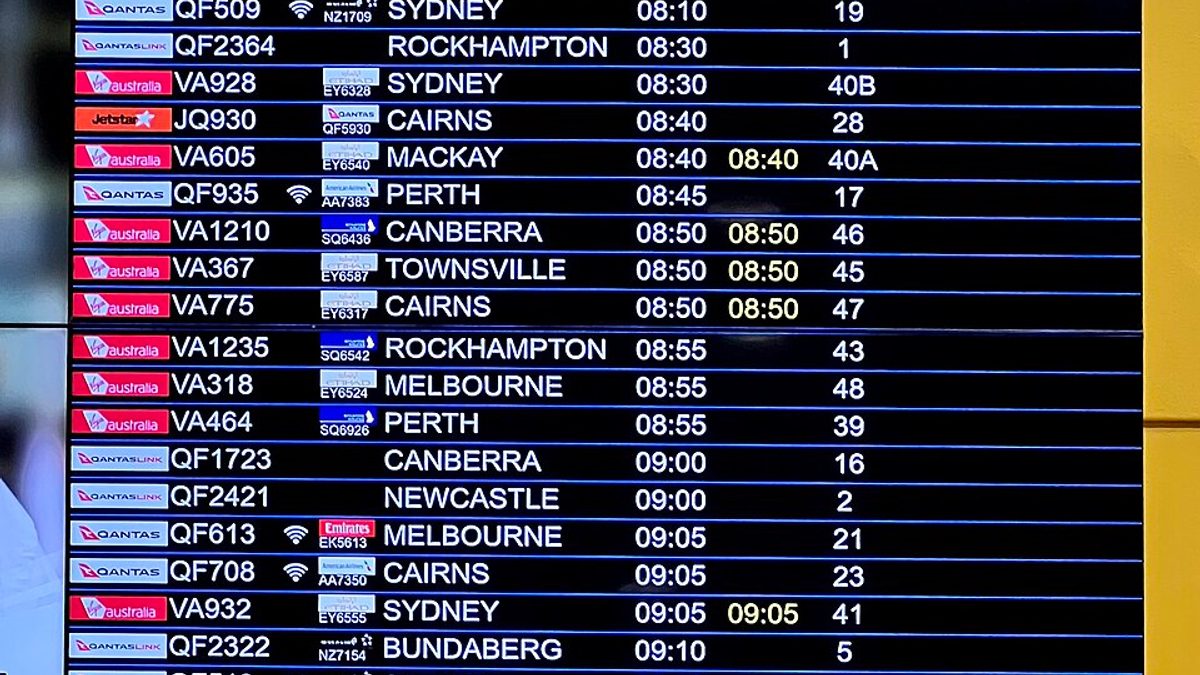
- Status, gate and terminal, from the airline's own flight-status page using the flight number
- Actual departure and landing times, which is the answer to "have they landed yet"
- Diversions and delays, usually visible on a tracker before the airline updates its page
- Baggage claim belt on arrival
If your real question is whether someone's plane got down safely, this covers it. Enter the flight number, watch it land. You do not need the manifest and you were never going to get it.
How to check whether someone's flight has landed, step by step
- Get the flight number, not the passenger name. It looks like AA1234 or BA118. Ask them for it, or read it off a forwarded booking email or itinerary.
- If you only know the route and rough time, search the airline's flight-status page by departure and arrival airport plus date. It will list every flight on that pairing so you can identify theirs.
- Open the airline's own flight status page first. It is the fastest to update for gate changes and it is the same feed the airport uses.
- Cross-check on a tracker such as FlightAware or Flightradar24 for the live position, actual wheels-down time and any diversion. Trackers often show a diversion before the airline page reflects it.
- Read the arrival time carefully. "Landed" is wheels down. Taxiing, immigration and baggage add anywhere from 20 minutes to well over an hour on a long-haul international arrival, so do not panic at silence straight after landing.
- Check the arrival airport's own arrivals board for the baggage belt if you are meeting them.
What none of these steps will tell you is whether your person is actually on board. That is the honest limit, and it applies no matter which tool you use.
Worth saying, because it sits underneath a lot of these searches: flying remains extraordinarily safe, and the run of headlines has made it feel otherwise. We looked at that gap in what is actually behind the recent crash coverage.

Do airline seat maps show who is sitting where?
Seat maps show status, never names. ExpertFlyer, the tool most often recommended for this, describes its own product accurately: "occupied seats, blocked seats, premium rows, and available spots are all clearly marked". There is no name field anywhere in it.
Two details matter if you plan to read anything into a seat map. "Occupied" means somebody selected that seat, which is not the same as checked in, and definitely not the same as boarded. "Blocked" often means the airline is holding the seat for crew or for a fare class, so there may be nobody attached to it at all.
SeatGuru is a different thing again: cabin layout and legroom reviews, not live occupancy.
What about apps that show who is on your flight?
That category was real and it has faded. KLM launched Meet & Seat in February 2012, calling itself the first airline to build social networking into its regular flight process. It ran on intercontinental routes, opened 90 days before departure and closed 48 hours out.
The important part is how limited it was even at its peak. You linked a Facebook or LinkedIn profile, and you could see other people who had also opted in. Never the flight. Malaysia Airlines' MHbuddy, from 2011, only ever surfaced your own Facebook friends. Satisfly was acquired in January 2015 and is listed as permanently closed.
We could not confirm whether Meet & Seat still runs. KLM has published no discontinuation notice and we could not verify the feature is live, so treat it as unconfirmed rather than dead. We found no currently operating example of a social seating tool we can vouch for in 2026.
Can you see other passengers on a group or corporate booking?
You can see the people on your booking, because they share one record. A PNR is a single reservation holding the itinerary for a passenger or a group travelling together, so a family of four booked in one transaction sits in one PNR and the booker sees all four names.
This is why booking together matters more than people expect. It is also the only reliable way to be seated with someone, which we get into when comparing long-haul cabins and seat selection on business class routes.
That boundary is the booking, not the flight. Group reservations, generally 10 or more passengers, work the same way: one code, one organiser, one name list submitted to the airline. Even travel agents working inside a global distribution system cannot browse other agencies' bookings freely.
The part nobody warns you about
The record locator, that six-character code on your boarding pass and your luggage tag, is the key to the whole booking. US customs regulation defines a PNR as covering "each passenger or group of passengers included under the same reservation record", and the standard PNR field list includes "other names on PNR", contact details, billing information and the full change history.
Photograph your boarding pass for social media and you have published that code. Anyone who reads it can see everyone you are travelling with. The realistic privacy risk here is not a stranger obtaining a manifest, which will not happen. It is your own booking reference leaking the people beside you.
Advertisement
Cover the code and the barcode before you post anything, and shred old tags. The same caution applies to any booking confirmation you forward, including on longer multi-passenger itineraries like the Kochi to Lakshadweep route, where families routinely book as one party.
Is a passenger list released after a plane crash?
Not to the public, and this is where most articles on this topic get it backwards.
Under the Aviation Disaster Family Assistance Act of 1996, codified at 49 U.S.C. §1136, the NTSB holds "primary Federal responsibility for facilitating the recovery and identification of fatally-injured passengers". The designated family-support director must "request, as soon as practicable, from the air carrier ... a passenger list". Families are then "briefed, prior to any public briefing", under §1136(e)(1).
The sequence is deliberate: airline to NTSB and the relief organisation, then to families privately, then whatever is said publicly. Nobody publishes the manifest so relatives can scan it.
In practice the carrier stands up a hotline within hours. After the Potomac mid-air collision on 29 January 2025, American Airlines told relatives: "If you believe you may have loved ones on board Flight 5342, call American Airlines toll-free at 800-679-8215." The airline deployed more than 220 CARE team members.
If you think someone you love was on that flight, do this
- Find the airline's accident hotline, not the reservations number. Carriers publish a dedicated toll-free line within hours of an accident, on their newsroom page and across their social accounts. Reservations staff cannot help you and will redirect you anyway.
- Have the flight number and the traveller's full name as it appears on the booking ready before you call. Passport or ID number speeds up verification if you have it.
- Say clearly that you are calling about a possible passenger. That routes you to the care team rather than the general queue.
- Expect them to take your details and call you back. They will not read a list to you over the phone. Verification and next-of-kin notification follow a set process, and they contact families before anything is said publicly.
- If the airline line is jammed, the NTSB Transportation Disaster Assistance office is on (800) 683-9369 or assistance@ntsb.gov. They coordinate family support for US accidents.
- Do not rely on news reports or social media lists. Early passenger names circulating online are frequently wrong, and correcting them later does not undo the damage.
This is slow and it is meant to be. The process exists so families hear it from a trained person, privately, and not from a list on the internet.
Does this change outside the United States?
The reasoning differs, the answer does not.
European Union. A passenger name is personal data under GDPR Article 4(1). Article 6(1) then states that processing "shall be lawful only if and to the extent that at least one of the following applies", and a stranger's curiosity satisfies none of the six lawful bases. There is nothing for the airline to rely on, so it declines.
United Kingdom. Section 170 of the Data Protection Act 2018 makes it a criminal offence to knowingly or recklessly obtain or disclose personal data without the controller's consent. An agent who leaks a name has not made a compliance error. They have committed an offence.
India. The Digital Personal Data Protection Act 2023 received assent in August 2023, with rules notified on 14 November 2025 under a phased commencement. The substantive obligations, including notice and consent, are scheduled for 14 May 2027. The airline confidentiality practice already applies; the statutory duties arrive then.
The neat part is that GDPR Article 6(1)(d) permits processing "necessary in order to protect the vital interests of the data subject or of another natural person". The same article that blocks the everyday request is what allows the manifest to move after a crash.
Who can legally obtain a passenger manifest?
- The State Department, following an aviation disaster involving US citizens abroad, under 49 U.S.C. §44909
- Customs and Border Protection, which holds standing electronic access to PNR data for international flights under 19 CFR 122.49d and needs no subpoena to use it
- The NTSB, on request, during an accident investigation
- The Department of Transportation, for oversight of Part 243
- Law enforcement, through a subpoena, warrant or court order directed at the carrier
A Freedom of Information Act request will not get you a copy either. FOIA Exemption 6 covers files whose disclosure would be a clearly unwarranted invasion of personal privacy, which is what a list of named travellers is.
Sources
- 14 CFR §243.9, Confidentiality of passenger contact information, eCFR
- 19 CFR §122.49d, Passenger Name Record information, govinfo
- Annex to the 2012 EU-US PNR Agreement, OJ L 215, for the standard PNR field list
- 14 CFR §§121.693 and 121.695, load manifest contents and retention
- 49 U.S.C. §44909, passenger manifests
- 49 U.S.C. §1136, Assistance to families of passengers involved in aircraft accidents
- NTSB Transportation Disaster Assistance, (800) 683-9369
- American Airlines newsroom statement on Flight 5342, 29 January 2025
- FlightAware support FAQ, information not available to the public
- GDPR Articles 4(1) and 6(1), consolidated text
- Data Protection Act 2018 (UK), section 170
- Digital Personal Data Protection Act 2023 (India) and the DPDP Rules 2025 commencement schedule
Checked against the sources above on 18 July 2026. Regulations change: confirm current text on eCFR or the relevant regulator before relying on it.
Topics
Frequently asked questions
Advertisement