How Accurate Are Weather Forecasts for Snowfall?

Snow forecasts run accurate to about 1.7-2 inches one day out, worse by day five. Real NWS station data on lead time, bias, and how far out you can trust one.
Advertisement
Snow forecasts run accurate to within about 1.7 to 2 inches one day out, and that error roughly doubles by day five. Nobody publishes that number in plain language, which is why the top search result for "how accurate are weather forecasts for snowfall" is still a Quora thread with no data in it. Here is what the actual station-verified numbers say.
How accurate are weather forecasts for snowfall?
Accurate to within one to two inches for the next day, and progressively less accurate after that. An independent analysis of National Weather Service point forecasts against 754 SNOTEL stations found a same-day error of 1.81 inches, a next-day error of 1.66 inches, and errors climbing toward 2.5 inches by day five.
How many days out is a snow forecast actually reliable?
One to three days for a specific number of inches at a specific location. Meteorologists can often spot a storm's general timing and region up to a week out, but pinning an exact total to a town only becomes reliable inside that 72-hour window, and confidence drops sharply beyond it.
Beyond seven days, models are tracking a pattern rather than a storm, and by two weeks out, most forecasters treat any specific snowfall number as guesswork. That is true even during a strong El Nino winter like the one NOAA expects this season, which shifts the odds without fixing the date.
How accurate is a snow forecast by lead time?
Best at one day out, worst at five, based on an independent comparison of NWS point forecasts against 754 SNOTEL stations and 26,994 forecast-observation pairs across 13 western states in March 2026. The table below shows the mean absolute error, in inches, at each lead time from that analysis.
| Days before the storm | Mean error (inches) |
|---|---|
| Same day (Day 0) | 1.81" |
| 1 day out | 1.66" (best) |
| 2 days out | ~1.9" |
| 3 days out | 2.0"+ |
| 4 days out | 2.33" |
| 5 days out | 2.52" (worst) |
| 6 days out | 2.14" |
That data covers a single 13-day, unusually active storm window in the western US, not a full multi-season climatology, and its own author cautions that a longer record would be needed before treating the pattern as settled. It is still the most specific lead-time breakdown publicly available.
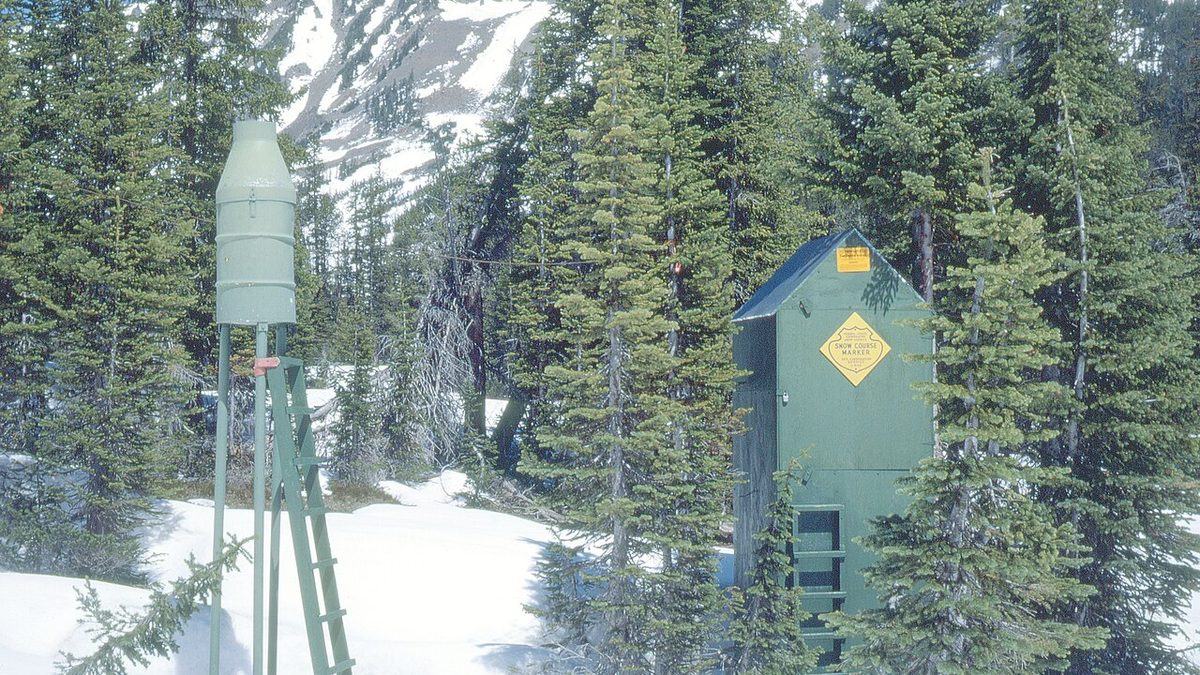
Why is snowfall specifically harder to predict than rain or temperature?
Because a snow forecast has to get two separate things right at once: how much precipitation falls, and whether it falls as snow at all. A peer-reviewed 2024 study of a Utah forecasting site found the GFS model underpredicted total precipitation by 33 percent and the HRRR model by 29 percent across four cool seasons.
Advertisement
What is the snow-to-liquid ratio, and why does it matter?
It is the conversion factor between rainfall-equivalent moisture and actual snow depth, and it moves constantly with temperature. Colder air typically produces a higher, fluffier ratio, while air closer to freezing produces a lower, wetter one, so the same storm can bury one town and barely dust another a few degrees warmer.
Peter Veals, an atmospheric scientist on the University of Utah team behind the Little Cottonwood Canyon study cited above, put it plainly to the university's own newsroom: "If you don't have a good snow-to-liquid ratio, your snowfall forecasts are not going to be as good." His colleague Jim Steenburgh, a University of Utah professor of atmospheric sciences, has criticized the old rule of using a flat 10-to-1 ratio everywhere as having "little relevance to the West."
Why do snow totals vary so much a mile apart?
Mainly lake-effect banding and the rain-snow line. Lake-effect snow forms in narrow bands set by wind direction, so one side of a street can see whiteout conditions while the other stays dry. Farther from the lakes, a swing of just one or two degrees can flip an entire storm from snow to sleet or rain.
Do forecasts over-predict or under-predict snow?
The answer depends entirely on the storm's size. The SNOTEL comparison found NWS forecasts ran slightly high on average, over-predicting by 0.22 to 0.55 inches for typical storms, but the pattern flipped hard for major storms: events that actually dropped 13 to 15 inches were forecast at only 5.5 to 9.2 inches.
That means the forecasts you can trust most are for ordinary snowfall, and the ones most likely to undersell what actually happens are the big, disruptive storms, exactly the ones travel planning depends on getting right.
How accurate is the Farmers' Almanac for snow specifically?
Not very, by direct comparison. We scored five winters of the Farmers' Almanac's own archived forecasts against NOAA station records for the cities it names and got 29.5 percent, far below the roughly 80 percent the almanac claims for itself. Our full scoring breakdown covers the method.
What tools give the most reliable snow forecast?
The National Weather Service's local point forecast and NOAA's National Operational Hydrologic Remote Sensing Center snowfall analysis for anything inside a week. Both pull from the same government observation network cited throughout this article, and neither charges for access or hides its data behind a login.
For a snow-specific view closer to the date, tools like Snow Predictions pull the same underlying weather data into snow-day, travel-safety, and hourly snowfall tools rather than a general-purpose forecast. Treat any specialized tool's own claimed accuracy the same way this article treats everyone else's: check the underlying data source, not just the headline number.
Advertisement
Quick answers about snow forecast accuracy
Can meteorologists predict an exact snow total two weeks out? No. Confidence collapses well before two weeks, and most forecasters will not commit to a specific number that far ahead. Is a five-day snow forecast worth checking? Yes, for general trend, but expect the final number to shift as the storm gets closer.
- Are big storms harder to forecast than small ones? Yes. The SNOTEL data above shows major storms getting under-forecast by roughly 5 to 9 inches, a far bigger miss than typical snowfall sees.
- Does AccuWeather's 45-day forecast actually work for snow? Not reliably. Extended forecasts beyond about 10 days lose most of their skill, regardless of which service issues them.
- Why did my local forecast change the day before the storm? Because accuracy genuinely improves as the event approaches, so a last-minute revision usually reflects better data, not a mistake.
- Is snow harder to forecast than rain? Yes, because it depends on getting both the precipitation amount and the snow-to-liquid ratio right, where a rain forecast only needs the first one.
The limits of this analysis
This rests on two real limits, stated plainly rather than smoothed over. The SNOTEL lead-time data covers 13 days across 13 western states, not a multi-year national climatology, so treat the exact inch figures as a strong signal rather than a permanent constant. The Utah study covers one high-elevation site, not every climate discussed here.
Sources
- OutsideDB, "How Accurate Are NWS Point Forecasts for Snow?". NWS forecasts vs. 754 SNOTEL stations, March 2026.
- Pletcher et al., "Validation of Cool-Season Snowfall Forecasts at a High-Elevation Site in Utah's Little Cottonwood Canyon," Weather and Forecasting, 2024.
- University of Utah, "Improving snowfall forecasts in the Mountain West". Quotes from Peter Veals and Jim Steenburgh, Department of Atmospheric Sciences.
- NOAA National Operational Hydrologic Remote Sensing Center, snowfall analysis.
- OpenSnow, "How Far in Advance Can We Predict a Storm?".
- Forest Preserve District of Will County, "Why is snowfall so hard to accurately predict?".
Our own scoring of Farmers' Almanac accuracy and the station-by-station data behind our nationwide winter outlook both use this same standard: real observed numbers, not a forecaster's self-reported score. Florida's rare but real snow history shows the same gap between claimed and verified data on a single state's scale.
Topics
Advertisement