Polar Vortex Disruption Winter 2026-2027: The Risk Behind the Mild Forecast

NOAA and both almanacs call for a mild El Nino winter, but forecasters flag a polar vortex weakening signal for Jan-Feb 2027, the same setup behind the 2021 Texas freeze.
Advertisement
Winter 2026-2027's headline, from NOAA to both almanacs, is a mild season driven by a historic El Nino. A separate and less-covered signal complicates that headline: long-range stratospheric guidance points to a weakening polar vortex in January and February 2027, the exact kind of pattern that unlocked the February 2021 Texas freeze. A mild winter on average does not rule out a severe individual cold outbreak, and this is the mechanism to watch for one.
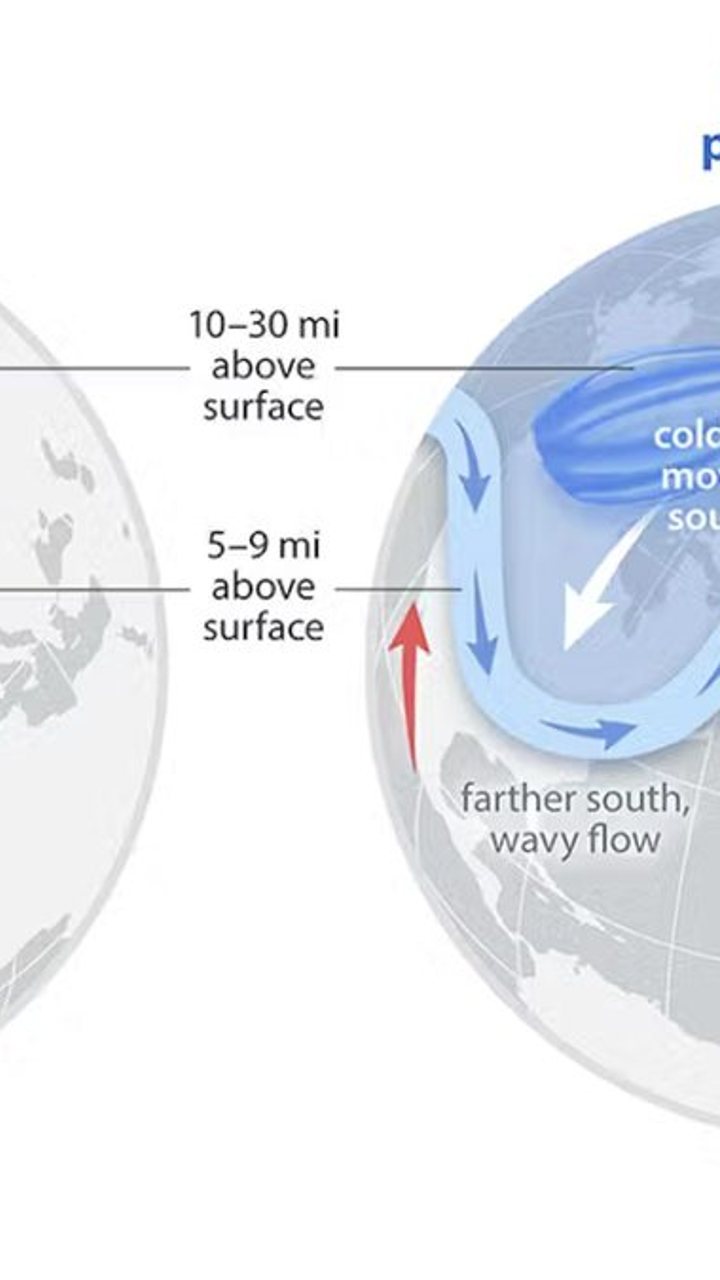
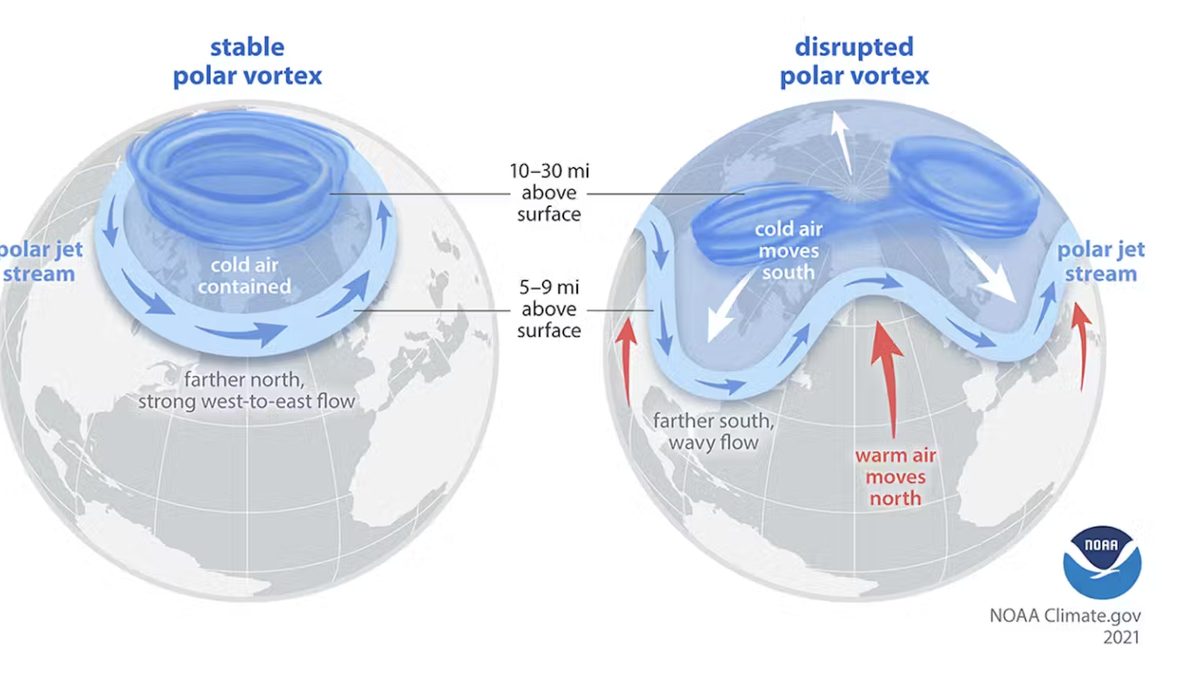
A stable versus a disrupted polar vortex. Diagram: NOAA, public domain.
What is the polar vortex, and why does it matter for US winters?
A persistent area of low pressure and cold air that spins around the Arctic, tens of miles up in the stratosphere, far above the weather most people experience day to day. When it stays strong and tightly circular, it keeps the coldest air locked near the pole. When it weakens, stretches or splits into pieces, that cold air is no longer contained and can spill south into the United States, Canada and Europe.
What is a sudden stratospheric warming event?
A rapid, dramatic warming of the stratosphere, sometimes by several tens of degrees within days, that disrupts or splits the polar vortex. These events, abbreviated SSW, are the usual trigger behind the most severe Arctic outbreaks in the mid-latitudes, including the February 2021 Texas freeze, which followed an SSW event on 5 January 2021.
What are forecasters seeing for winter 2026-2027?
A strengthening vortex through September, followed by a signal for weakening later in the season. As of 18 September 2026, NASA's own stratospheric wind measurements showed the vortex running above its climatological average, but seasonal guidance from the ECMWF and the UK Met Office both show winds dropping below their long-term reference levels specifically in January and February 2027, consistent with "a weaker or more disturbed vortex" in the second half of winter.
This is a seasonal signal, not a forecast for a specific week. Forecasters are explicit that an actual sudden stratospheric warming event cannot be predicted this far in advance, and the current data shows a tendency, not a locked-in outcome.
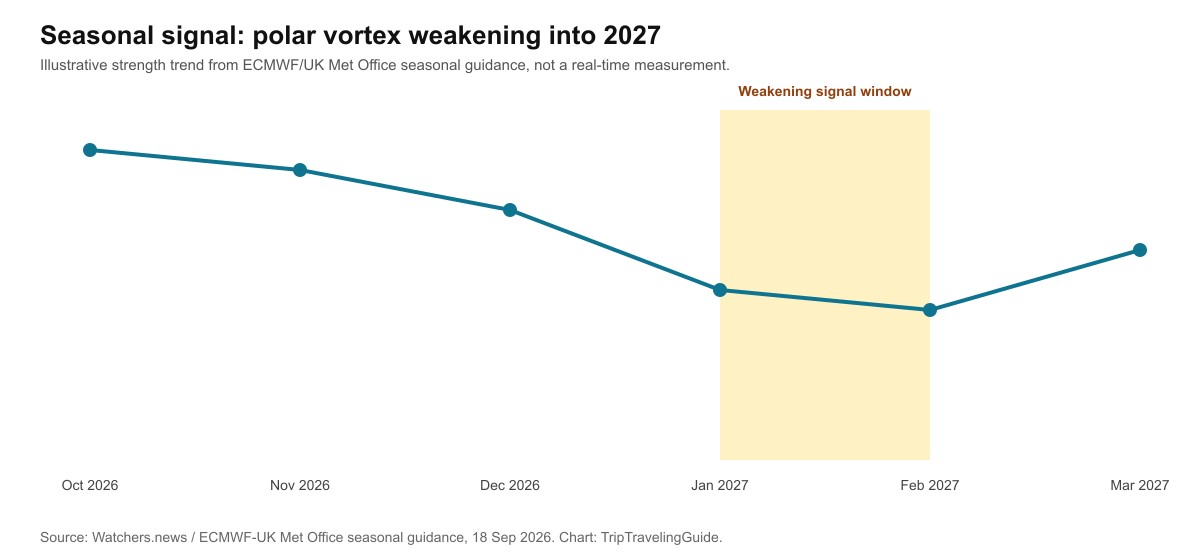
A seasonal weakening signal centered on January-February 2027, drawn from long-range model guidance, not a measured real-time trend.
Advertisement
Does a strong El Nino raise the risk of a polar vortex disruption?
Yes, on average, though it is a tilt in the odds rather than a guarantee. Research by Manzini and colleagues, published in 2024, found that strong El Nino events produce larger average stratospheric responses than weaker El Nino events, partly through their effect on the planetary wave activity that can disturb the vortex. NOAA's Climate Prediction Center gives this winter's El Nino a greater than 90 percent chance of becoming very strong, with a real possibility of becoming the strongest event on record since 1950, which is part of why forecasters are watching the stratosphere especially closely this year.
Has a polar vortex collapse caused a major US freeze before?
Yes, most recently and most severely in February 2021. A sudden stratospheric warming event on 5 January 2021 preceded a polar vortex split, and roughly six weeks later a piece of that dislodged Arctic air plunged into Texas and the southern Plains. NOAA's official count puts the death toll at more than 290, with direct damages of 27.2 billion dollars, making it the costliest winter storm on record in the United States. At its worst, 40 percent of the Texas power grid went offline, leaving more than 4 million homes and businesses without power in the middle of the freeze.
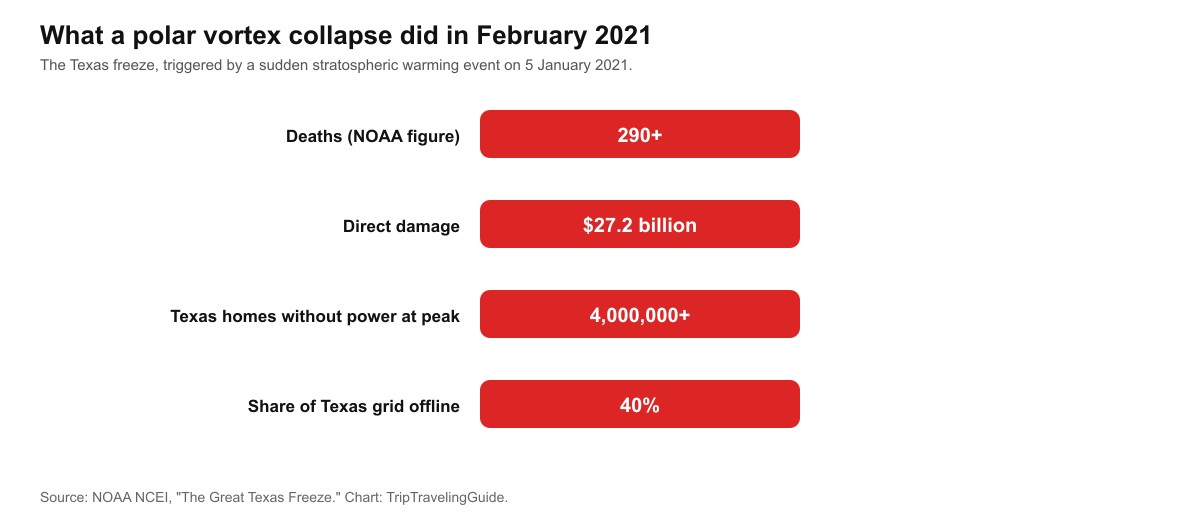
The scale of what a single polar vortex collapse did to one state in February 2021.
Did El Nino cause the 2021 Texas freeze?
No, and this matters for how seriously to take this year's signal. Winter 2020-21 was a moderate La Nina winter, not an El Nino winter, and the stratospheric warming that triggered the freeze happened anyway. A polar vortex collapse does not require El Nino to occur, which means this risk is not something unique to this year's pattern, and a weaker El Nino or even a La Nina winter would not make a severe cold outbreak impossible.
What a strong El Nino does, per the research above, is shift the odds somewhat higher than average, not create a risk that otherwise would not exist.
Could a severe cold outbreak happen even in an otherwise mild, El Nino winter?
Yes, and that is precisely the scenario this signal describes. NOAA, the Farmers' Almanac and the Old Farmer's Almanac all lean toward a milder-than-normal winter overall for most of the country this year, a seasonal average built from El Nino's typical effect on the jet stream. A polar vortex disruption in January or February would not cancel that average outright, but it could produce a sharp, short, severe cold event inside an otherwise mild season, the same shape the 2021 freeze took.
What does this mean for holiday and winter travel planning?
Treat January and February as the window to watch most closely, even if the early-season headlines all point to a mild winter. Our USA winter forecast hub covers the broader NOAA-versus-almanacs picture, and our flight-cancellation guide covers what to do if a storm like this disrupts a booked trip. A seasonal mild lean is real, but it is an average, not a guarantee for any single week.
Advertisement
What are the limits of this forecast data?
A sudden stratospheric warming event cannot be reliably predicted more than one or two weeks ahead of time, even by the agencies tracking the stratosphere daily. Everything in this guide about January-February 2027 is a seasonal tendency drawn from long-range model guidance as of mid-September 2026, not a forecast that a specific storm will happen on a specific date.
We are also not claiming El Nino caused the 2021 freeze, since it demonstrably did not. The honest claim is narrower: a strong El Nino statistically raises the odds of a disrupted vortex this winter, and nobody can tell you today whether that disruption will actually arrive, how strong it will be, or exactly where the resulting cold will land.
Quick answers about the polar vortex and winter 2026-2027
Is a polar vortex collapse expected this winter?
Forecasters see a weakening signal for January-February 2027, not a confirmed event. A real sudden stratospheric warming cannot be predicted this far in advance.
Does El Nino cause polar vortex disruptions?
It raises the odds on average, per 2024 research, but does not cause them directly. The February 2021 Texas freeze happened during a La Nina winter, proving a strong El Nino is not required.
Could this winter still be mild overall despite the risk?
Yes. A polar vortex disruption would likely produce a short, severe cold event inside an otherwise mild El Nino winter, not replace the whole season's milder average.
What happened the last time the polar vortex collapsed badly?
The February 2021 Texas freeze, which NOAA attributes more than 290 deaths and 27.2 billion dollars in direct damage to, the costliest winter storm on record in the US.
When should I start watching for this risk?
January and February 2027, per current ECMWF and UK Met Office seasonal guidance, though the exact timing of any real event cannot be forecast this far out.
Sources
Watchers.news, "Polar vortex strengthens over Arctic, very strong El Nino supports mid-winter weakening signal," 18 September 2026
Severe-Weather.eu, "A New Polar Vortex Is Emerging Over the North Pole, With a Winter 2026/2027 Disruption Risk"
Manzini et al., 2024, research on El Nino strength and stratospheric polar vortex response
NOAA Climate Prediction Center ENSO diagnostic discussion, 2026-2027 outlook
NOAA NCEI, "The Great Texas Freeze," February 2021
NOAA/Climate.gov, "On the sudden stratospheric warming and polar vortex of early 2021"
Wikipedia, "2021 Texas power crisis"
Topics
Advertisement