Snow Predictions for New Jersey 2026-2027: The El Nino Paradox

Snow predictions for New Jersey 2026-2027: AccuWeather calls this the strongest El Nino on record. 76 years of data say coastal snow runs lighter, not heavier.
Advertisement
Every snow prediction for New Jersey this year leads with the same word: El Nino. AccuWeather's Paul Pastelok has called it "the strongest El Nino on record," almost certain to surpass even the famously powerful 1982-83 and 1997-98 events, and NOAA put the chance of a historically strong October-to-December El Nino at 75 percent in its latest update. The instinct is to assume that means a big, snowy winter is coming. We pulled 76 years of daily station records for Newark, Atlantic City, and Trenton to check that instinct against what actually happened the last seven times a strong El Nino showed up, and the answer runs against the popular assumption. At the coast, strong El Nino winters have historically brought significantly less snow, not more.
The El Nino paradox: what 76 years of records actually show
We took every winter since 1950 where NOAA's Oceanic Nino Index reached +1.5 C or higher for December through February, the agency's own threshold for a strong event, then pulled what Newark Liberty, Atlantic City International, and Trenton-Mercer actually recorded in those seasons. Seven winters qualify: 1957-58, 1972-73, 1982-83, 1991-92, 1997-98, 2015-16, and 2023-24. At Newark, those seven seasons averaged 22.4 inches of snow, 30 percent below the station's 1991-2020 normal of 32.0 inches. At Atlantic City, the gap was wider: 9.1 inches against a 17.6 inch normal, a 48 percent shortfall. Trenton's shorter record only covers three of those seven events, 1997-98, 2015-16, and 2023-24, but it shows the same direction, 14.0 inches against a 25.4 inch normal.
| Station | 1991-2020 normal | Strong El Nino average | Difference |
|---|---|---|---|
| Newark Liberty | 32.0" | 22.4" | -30% |
| Atlantic City | 17.6" | 9.1" | -48% |
| Trenton-Mercer | 25.4" | 14.0" (3 of 7 events) | -45% |
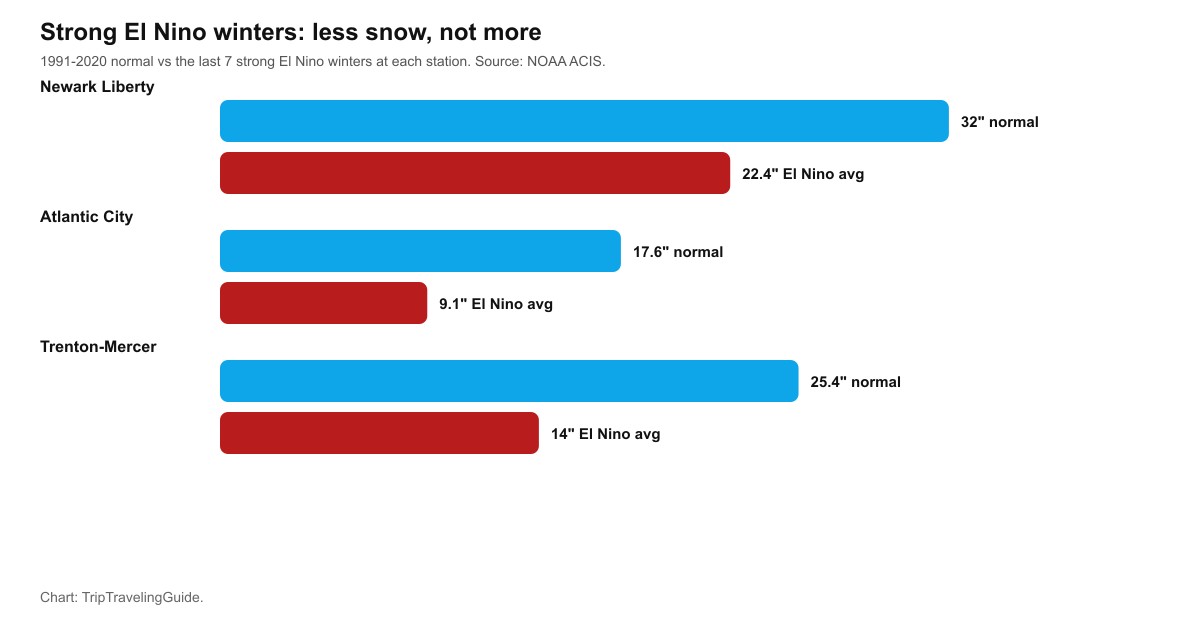
That's the opposite pattern from what strong El Nino winters have historically done in places like southern Colorado, where the same storm track that keeps New Jersey milder tends to feed more moisture into the Southwest instead. It lines up well with what AccuWeather is forecasting for this specific winter, a below-average season for the entire New York-to-Washington corridor, and it's worth being honest about the sample size: seven qualifying winters is small, and no two El Nino events line up the same way. The 48 percent gap at Atlantic City is a real signal. Treat anything closer to the 30 percent range as a direction, not a guarantee.
Snow predictions for New Jersey, 2026-2027: what AccuWeather and the Old Farmer's Almanac actually say
The two most-cited seasonal outlooks don't fully agree, and neither publishes a New Jersey-specific inch total, because that number doesn't exist in any credible forecast. AccuWeather's winter 2026-2027 outlook calls for below-average snowfall across the entire corridor, driven by what its own Long-Range Expert Paul Pastelok describes as a potentially record-shattering El Nino reshaping the storm track south. NOAA backs up the strength of the signal even if it won't touch snowfall totals: as of its latest assessment, the agency put the odds of El Nino becoming a very strong event at better than 90 percent for fall and winter, with a 69 percent chance that October through December sets a record for any El Nino since 1950. AccuWeather's published numbers for the cities bracketing New Jersey: Philadelphia at 5 to 15 inches, down sharply from last winter's 30.1, and New York City at 10 to 20 inches, against 43.4 inches last winter and a roughly 30 inch typical average. The Old Farmer's Almanac takes a softer line. It places New Jersey in its Atlantic Corridor region, forecasting above-normal temperatures, below-normal precipitation, and snowfall it describes as only slightly below normal, with its snowiest windows clustered in late November, early and mid-January, and early and late February. The Almanac claims an 80 percent self-reported accuracy rate on its seasonal calls, though it publishes no independent verification record for New Jersey specifically.
Advertisement
Newark, Atlantic City, or the Highlands: which snowfall number is actually yours
There's no single New Jersey snowfall total, because the state spans a real climate gradient in under 150 miles, and the right number depends entirely on where on the map you live. Newark Liberty, representative of the I-95 corridor and most of the state's population, averages 32.0 inches a season. Atlantic City and the rest of the Shore, where ocean-moderated air pushes more winter storms toward plain rain, average barely half that at 17.6 inches, often finishing a storm 10 or more inches lighter than inland New Jersey sees the same day. The real snowbelt sits up in Sussex and Warren Counties, the Highlands region, where terrain along the Kittatinny Ridge and around High Point regularly outperforms the state average by a wide margin. Newton, the Sussex County station with the longest record, averaged around 34.0 inches a season in its last full reporting period, though its official gauge stopped reporting consistently after 2004 and can't speak to recent seasons directly. If you live along the Shore, plan around Atlantic City's numbers. If you're in the northwest highlands, plan for meaningfully more than Newark gets. The I-95 corridor sits in the middle, and that's where most New Jersey residents actually experience the season.
When does the first snow usually show up in New Jersey
At Newark, the median first measurable snowfall, computed directly from 29 recent seasons of daily station data, lands on 8 December, about a week earlier than some secondhand roundups suggest. The spread around that date is wide: the earliest first snow in that span came on 29 October 2011, and the latest ran all the way to 13 January 2000. Roughly 1 season in 10 sees its first flakes by mid-November, and another 1 in 10 doesn't see any until after the new year. In the station's full 76-year record, the single earliest first snow on record fell on 20 October 1952. None of that tells you what this specific season will do, but it does mean that a snowless Thanksgiving in New Jersey is the historical norm, not an anomaly, and panic about a "missing winter" in early December is premature most years.
February, not January, is Newark's snowiest month
Most people assume January carries the New Jersey winter. The 29-year station record says otherwise. February averages 10.3 inches at Newark, January comes in just behind at 9.1, and the two months combined make up roughly 61 percent of an entire season's snow. December holds a respectable 5.4 inches, March a similar 5.8, and by April the season is nearly over at half an inch. If a given winter is going to deliver its headline storm, the data says to bet on February before you bet on January, even though January gets more of the public's attention as the "dead of winter."
Advertisement
New Jersey's biggest snowstorms, and why no two sources agree on the ranking
Ask three sources for New Jersey's record snowstorm and you'll likely get three different answers, and we'd rather show you the disagreement than pretend it doesn't exist. The National Centers for Environmental Information's official state record, confirmed in a 2022 review, is 29.7 inches in 24 hours at Long Branch on 26 December 1947. Several more recent roundups instead point to January 2016's Winter Storm Jonas, which dropped 28.1 inches at Newark Liberty, beating that airport's own prior record of 27.8 inches set during the January 1996 blizzard, with some individual towns in Morris and Somerset Counties reporting 30 inches during the 2016 storm. New Jersey's state climatologist has publicly pushed back on more recent storms being compared to these events, noting that a widely covered February 2026 storm didn't crack the state's top 10 despite heavy local coverage. The honest takeaway: "biggest storm" depends entirely on whether you're measuring one official station over 24 hours, a statewide roundup of unofficial reports, or local news memory, and those three methods don't produce the same winner.
Where this leaves you: no forecaster, including this page, can tell you how many inches New Jersey will get this winter, because that number doesn't exist until the season is over. What does exist is a real, if modest, statistical lean toward a lighter coastal season under a strong El Nino, backed by both the 76-year station record and AccuWeather's independent seasonal call, alongside the Old Farmer's Almanac's softer "slightly below normal" read. North Jersey and the interior counties carry more uncertainty either way. Check the National Weather Service Mount Holly office for the Philadelphia-South Jersey corridor, or the Upton, New York office for North Jersey, for any forecast inside the next 7 to 10 days, since that's the window where these numbers actually firm up. For the bigger winter picture, see our USA winter forecast 2026-2027 guide, and for how the same El Nino pattern has played out in other states, our Maryland and Pennsylvania guides.
Sources
- Station snowfall records for Newark Liberty International Airport, Atlantic City International Airport, Trenton-Mercer Airport, and Newton, NJ, retrieved from the Regional Climate Centers ACIS data service. Every seasonal average, El Nino comparison, and monthly figure on this page was computed from those daily records
- NOAA Climate Prediction Center, ENSO diagnostic discussion, and Oceanic Nino Index, used to select the strong El Nino winters on this page
- AccuWeather's 2026-2027 winter outlook, as reported via syndicated coverage
- MyWild Report, New Jersey winter forecast 2026-27, for AccuWeather's Paul Pastelok quote and updated NOAA El Nino confidence figures
- Old Farmer's Almanac, long-range weather forecast for Newark, NJ
- NJ 101.5, what the Old Farmer's Almanac is saying for the rest of 2026
- NJ blizzard coverage citing the state climatologist on historical storm rankings
- NJ Weather, a winter sampler, January 2016 recap
- TripTravelingGuide, USA winter forecast 2026-2027
- TripTravelingGuide, snow predictions for Maryland 2026-2027
- TripTravelingGuide, snow predictions for Pennsylvania 2026-2027
Topics
Advertisement