Snow predictions For Pennsylvania 2026-2027

Nobody forecasts a season's snowfall. So we opened 598 Pennsylvania winters: what strong El Nino really did to Erie, Pittsburgh and Philadelphia.
Advertisement
Snow predictions for Pennsylvania come in two kinds, and only one of them is checkable. Nobody can tell you a seasonal snowfall total for 2026-27. What we can do is open the record: 598 complete winters at eight Pennsylvania weather stations, going back to 1950. Here is what it shows.
NOAA's Climate Prediction Center issued an El Niño Advisory on 13 August 2026, with a greater than 90% chance of a very strong event through the coming winter, and a 69% chance it becomes the strongest in the record since 1950. Almost every Pennsylvania winter outlook you will read this autumn is built on that fact.
So we went and checked what strong El Niño has actually done to Pennsylvania snowfall, seven times, since 1950.
The answer surprised us, and it disagrees with the almanacs.
Will it snow in Pennsylvania this winter?
Yes. Every one of Pennsylvania's eight long-record weather stations has recorded measurable snow in every single winter since 1950. The question is never whether, only how much, and that part nobody can answer in August. Seasonal snowfall is not forecastable more than about a week out.
That last sentence is not our opinion. It is what NOAA prints on its own seasonal outlook: the outlook does not project seasonal snowfall accumulations, because snow forecasts are not predictable more than a week in advance.
Which puts every "Pennsylvania snow predictions 2026-2027" page in an awkward spot, including the ones with a real meteorologist attached. They are forecasting a quantity the national forecast agency declines to forecast.
We are not going to do that. We pulled the record instead.
Does it snow in Pennsylvania?
Pennsylvania gets snow every winter, statewide, without exception in 76 years of record. How much depends almost entirely on where in the state you are. Erie's normal season is 87.5 inches. Philadelphia's is 19.1 inches. Both are Pennsylvania, 300 miles apart.
That 68 inch gap is the single most useful fact about snow in this state, and most pages answering "does it snow in Pennsylvania" skip straight past it with a statewide average that describes nowhere.
Does it snow in Pennsylvania every year?
Yes at seven of our eight stations. The one exception is Philadelphia, which recorded 0.0 inches for the whole 1972-73 season. That is the only completely snowless winter at any Pennsylvania station in our 598 season record, and it happened during a strong El Niño.
Philadelphia has come close again since. The 2019-20 season brought 0.3 inches, and 2022-23 brought 0.3 inches. Both are rounding errors against a 19.1 inch normal.
Does Pennsylvania get a lot of snow?
The northwest does. Erie has out-snowed Buffalo in 33 of the 74 winters where both records are complete, which is not a comparison most people expect to be close. The southeast does not. Lancaster averages 8.1 inches a year, closer to Nashville's 4.6 than to Erie's 55.2.
Pennsylvania is two different snow climates sharing a state line, and no single statewide number describes either of them.
How much snow does Pennsylvania get on average?
A normal Pennsylvania season runs from 19 inches in Philadelphia to 88 inches in Erie. The figures below are medians of every complete July to June season we could assemble from 1950-51 to 2025-26, so a single freak winter does not distort them the way a mean would.
| City | Seasons | Normal season | Biggest on record | Smallest on record |
|---|---|---|---|---|
| Erie | 74 | 87.5 in | 166.3 in (2017-18) | 24.8 in (2023-24) |
| Pittsburgh | 76 | 41.1 in | 80.0 in (1950-51) | 16.3 in (2023-24) |
| State College | 76 | 40.8 in | 109.3 in (1993-94) | 13.2 in (2019-20) |
| Wilkes-Barre / Scranton | 68 | 38.6 in | 98.3 in (1995-96) | 7.3 in (1988-89) |
| Williamsport | 76 | 37.0 in | 85.9 in (1995-96) | 7.0 in (1988-89) |
| Harrisburg | 76 | 28.5 in | 81.3 in (1960-61) | 5.1 in (2019-20) |
| Allentown | 76 | 28.1 in | 75.4 in (1995-96) | 5.3 in (2019-20) |
| Philadelphia | 76 | 19.1 in | 78.7 in (2009-10) | 0.0 in (1972-73) |
Look at the two right-hand columns before you look at anything else. Harrisburg's range runs from 5.1 inches to 81.3 inches. That is a sixteen-fold spread around a 28.5 inch normal. Anyone printing a single number for Harrisburg this winter is describing a distribution as if it were a point.
How much snow does Erie PA get a year?
Erie's normal season is 87.5 inches, the highest in Pennsylvania by a wide margin and more than double the next city on the list. Its record season is 166.3 inches in 2017-18. Its lowest was 24.8 inches, and that was 2023-24, the most recent strong El Niño winter.
Erie's snow is not ordinary storm snow. It is lake effect, which is why it collapses so completely in some winters and buries the city in others.
How much snow does Pittsburgh get a year?
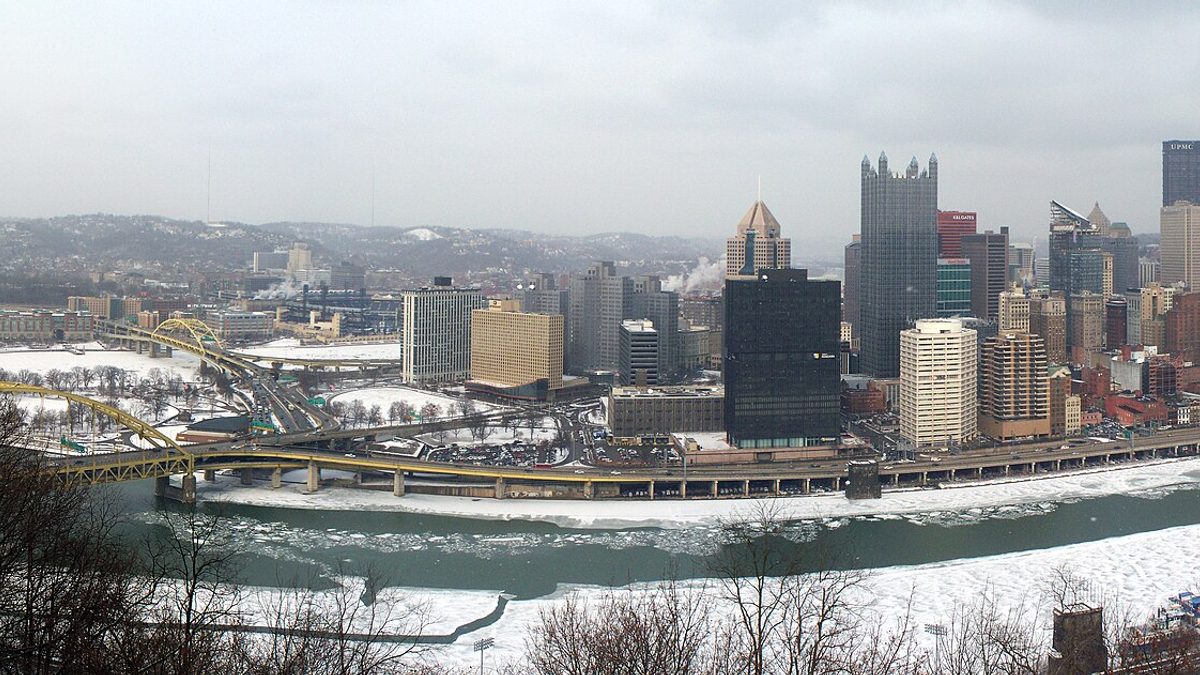
Pittsburgh's normal season is 41.1 inches, spread across roughly five months. January is the snowiest month at 13.1 inches, followed by February at 11.8 and December at 8.3. Its record season was 80.0 inches in 1950-51; its lowest was 16.3 inches in 2023-24.
Pittsburgh is the station in this whole dataset with the cleanest El Niño signal, and we come back to it below.
How much snow does Philadelphia get?
Philadelphia's normal season is 19.1 inches, the lowest of the eight stations we pulled. February is its snowiest month at 8.4 inches, ahead of January at 7.1 and March at 3.6. Philadelphia's record season, 78.7 inches in 2009-10, is more than four times that normal.
Philadelphia is the most volatile snow city in Pennsylvania. It has recorded a zero season and a 78.7 inch season inside the same 76 years. If you are planning around Philadelphia snow, plan for nothing and be surprised.
How much snow does Scranton and Wilkes-Barre get?
The Scranton and Wilkes-Barre area, measured at Avoca in the Wyoming Valley, has a normal season of 38.6 inches. January and February tie exactly at 10.2 inches each, and March adds another 8.9. Its record was 98.3 inches in 1995-96 and its lowest 7.3 inches in 1988-89.
How much snow does State College get?
State College averages 40.8 inches a season, essentially the same as Pittsburgh despite sitting 130 miles further east. February is marginally its snowiest month at 11.6 inches, with January close behind at 11.3. Its record season was 109.3 inches in 1993-94 and its lowest 13.2 inches in 2019-20.
State College also has the longest snow season of the central stations. March still delivers 9.4 inches on average there, more than December does in Philadelphia.
How much snow does Harrisburg get?
Harrisburg's normal season is 28.5 inches, putting the state capital nearer the Philadelphia end of the range than the Pittsburgh end. February leads at 9.1 inches, with January at 9.0 and December contributing 4.6. The 1960-61 season brought 81.3 inches; the 2019-20 season brought 5.1.
What months does it snow in Pennsylvania?
Pennsylvania's snow season runs November to March across the state, with April snow common in the west and October snow occasional in the mountains. The table below gives mean monthly snowfall over the 1991 to 2020 normals period, the same window NOAA uses.
Advertisement
Figures are inches. A blank cell means less than 0.05 inches, which is what Philadelphia averages in October.
| City | Oct | Nov | Dec | Jan | Feb | Mar | Apr |
|---|---|---|---|---|---|---|---|
| Erie | 0.1 | 9.6 | 26.1 | 31.7 | 18.8 | 14.4 | 2.5 |
| Pittsburgh | 0.4 | 2.4 | 8.3 | 13.1 | 11.8 | 7.6 | 0.9 |
| State College | 0.4 | 2.5 | 7.6 | 11.3 | 11.6 | 9.4 | 0.9 |
| Wilkes-Barre / Scranton | 0.6 | 2.7 | 6.8 | 10.2 | 10.2 | 8.9 | 1.3 |
| Williamsport | 0.1 | 1.7 | 7.4 | 9.8 | 9.1 | 7.1 | 0.8 |
| Harrisburg | 0.2 | 0.8 | 4.6 | 9.0 | 9.1 | 5.6 | 0.4 |
| Allentown | 0.2 | 0.9 | 5.3 | 9.8 | 10.4 | 6.3 | 0.5 |
| Philadelphia | 0.2 | 3.6 | 7.1 | 8.4 | 3.6 | 0.3 |
Does it snow in Pennsylvania in October?
Occasionally, and almost entirely in the west and the mountains. Erie has recorded October snow in 16 separate years since 1950, Pittsburgh in 15, State College in 12. Philadelphia has managed it twice in 76 years, in 1979 and 2011.
October snow in Pennsylvania is a mountain and lakeshore event. If you are visiting Philadelphia in October, the odds are roughly one in 38.
Does it snow in Pennsylvania in November?
Yes, reliably in the northwest and barely at all in the southeast. Erie averages 9.6 inches in November and recorded snow in 27 of 29 recent years. Philadelphia averages 0.2 inches and recorded November snow in just 3 of 30 years, so nine Novembers in ten pass with nothing.
Does it snow in Pennsylvania in December?
Yes, everywhere in the state. December is the month the season becomes real: Erie averages 26.1 inches, Pittsburgh 8.3, State College 7.6, Philadelphia 3.6. Pittsburgh recorded December snow in 29 of the last 30 years, Erie in all 30, Philadelphia in 21 of 30.
Does it snow in Pennsylvania in March?
Yes, and more than most visitors expect. Pittsburgh recorded March snow in all 30 years of the current normals period, averaging 7.6 inches. State College averages 9.4 inches in March and Erie 14.4. Only Philadelphia drops off, at 3.6 inches.
March is the most underestimated snow month in Pennsylvania. Four of the eight stations get more snow in March than in December: State College, Wilkes-Barre, Harrisburg and Allentown. Philadelphia's two months are dead level at 3.6 inches each.
Does it snow in Pennsylvania in April?
In the west and centre, yes, most years. Erie recorded April snow in 23 of 30 years and Pittsburgh in 19 of 30. In the southeast it is rare: Philadelphia, Harrisburg and Allentown each managed April snow in just 7 of 30 years.
Has it ever snowed in Pennsylvania in May?
Yes, eleven times across our eight stations in 76 years. The Scranton and Wilkes-Barre area accounts for five of them, in 1963, 1966, 1967, 1973 and 1977. Pittsburgh recorded May snow in 1963 and 1966, Erie in 1963 and 1989, State College in 1963, Williamsport in 1977.
June and July snow has never been recorded at any of the eight, which answers the other two questions people type into Google. Philadelphia, Harrisburg and Allentown have no May snow in the record at all.
Notice how many of those years cluster in the 1960s and 1970s. The last May snow at any of our eight stations was Erie in 1989.
When does it start snowing in Pennsylvania?
In the northwest, November. Erie has recorded November snow in 27 of the last 29 years. In central Pennsylvania, late November into early December. In the Philadelphia area, December, and in three of the last thirty years it did not start until January.
The practical version: if you are travelling to Erie or the Laurel Highlands and want snow, the last week of November is already a reasonable bet. For Philadelphia, do not bother before mid-December.
When does it snow the most in Pennsylvania?
It depends which half of the state you are in, and this is the detail almost every guide gets wrong. Western Pennsylvania's snowiest month is January. Eastern Pennsylvania's is February. Erie peaks at 31.7 inches in January; Philadelphia peaks at 8.4 inches in February.
The split runs roughly along the Susquehanna. Erie, Pittsburgh and Williamsport peak in January. Philadelphia, Allentown, Harrisburg and State College peak in February. Wilkes-Barre and Scranton sit exactly on the fence at 10.2 inches in both.
It matters if you are booking. A Poconos trip in late January is aimed at the wrong month by about two weeks.
What part of Pennsylvania gets the least snow?
The southeast corner, and specifically the Lancaster and York area. Lancaster averages 8.1 inches a year and York 10.0, against Erie's 55.2, on the same NOAA 1991 to 2020 normals. Philadelphia at 12.0 inches and Norriton at 9.5 sit in the same quiet pocket.
Those city figures come from the National Centers for Environmental Information normals rather than our own station pull, because Lancaster and York are not in our eight station set. They are means, not medians, which is why Philadelphia's 12.0 here differs from the 19.1 inch median in our table above. Both numbers are correct and they measure different things.
Does Erie PA get lake effect snow?
Yes, and it is the reason Erie gets four and a half times Philadelphia's snow. Cold air crossing the open water of Lake Erie picks up moisture and dumps it downwind. That is why Erie's snow is concentrated in December and January, before the lake ices over.
You can see the lake in the numbers. Erie's December and January together average 57.8 inches, which is more snow in two months than Pittsburgh, State College or Scranton get in an entire season.
The lake also explains Erie's collapses. When the lake freezes early or the air stays marginal, the machine switches off, and you get a 24.8 inch season like 2023-24.
Will it snow in Pennsylvania on Christmas?
Your odds range from 11% in Philadelphia to 50% in Erie. We counted every 25 December since 1950 with at least one inch of snow on the ground, which is the standard definition of a white Christmas, and worked out the frequency at each station.
| City | White Christmases | Odds | Of those, 5 inches or more |
|---|---|---|---|
| Erie | 33 of 66 | 50% | 14 |
| Wilkes-Barre / Scranton | 19 of 46 | 41% | 7 |
| Williamsport | 25 of 71 | 35% | 7 |
| State College | 24 of 75 | 32% | 6 |
| Pittsburgh | 23 of 76 | 30% | 4 |
| Harrisburg | 18 of 76 | 24% | 6 |
| Allentown | 18 of 75 | 24% | 4 |
| Philadelphia | 8 of 76 | 11% | 3 |
Erie is the only place in Pennsylvania where a white Christmas is a coin flip. Everywhere else it is the exception, and in Philadelphia it is rare enough that most people alive there have seen fewer than ten.
If a white Christmas is the actual goal of your trip, Erie and the Poconos are the two places in this state worth booking for it. The Lancaster and York countryside, which is what most Pennsylvania Christmas marketing shows you, is the worst bet in the state.
Does El Niño mean more snow in Pennsylvania?
No. In our record it means less, at every single station. We took the seven winters since 1950 with a strong El Niño signal and compared them against each city's normal. All eight Pennsylvania stations came in below normal, from 10% down in Allentown to 46% down in Williamsport.
Advertisement
We classified a winter as strong El Niño at a Climate Prediction Center Oceanic Niño Index of +1.5 or higher for December to February. That gives seven: 1957-58, 1972-73, 1982-83, 1991-92, 1997-98, 2015-16 and 2023-24.
| City | Normal | Strong El Niño median | Change | Below normal | Range across the seven |
|---|---|---|---|---|---|
| Erie | 87.5 in | 59.1 in | -32% | 5 of 6 | 24.8 to 104.8 in |
| Pittsburgh | 41.1 in | 29.6 in | -28% | 7 of 7 | 16.3 to 37.0 in |
| State College | 40.8 in | 26.9 in | -34% | 5 of 7 | 17.9 to 58.1 in |
| Wilkes-Barre / Scranton | 38.6 in | 23.9 in | -38% | 4 of 6 | 15.5 to 59.1 in |
| Williamsport | 37.0 in | 20.0 in | -46% | 6 of 7 | 7.7 to 49.1 in |
| Harrisburg | 28.5 in | 18.7 in | -34% | 4 of 7 | 11.4 to 41.6 in |
| Allentown | 28.1 in | 25.2 in | -10% | 4 of 7 | 7.4 to 63.6 in |
| Philadelphia | 19.1 in | 11.2 in | -41% | 4 of 7 | 0.0 to 41.8 in |
Pittsburgh is the striking one. Seven strong El Niño winters since 1950, seven below normal seasons, no exceptions. Its best strong El Niño winter, 37.0 inches in 1957-58, still fell short of its 41.1 inch normal.
Two of those seven winters produced record lows that still stand. Philadelphia's only snowless season, 1972-73, was a strong El Niño. And 2023-24, the most recent one, was simultaneously the lowest season ever recorded at Erie and at Pittsburgh.
The honest counterweight: Erie's 1991-92 season delivered 104.8 inches, well above its normal, in a strong El Niño. Allentown's 1957-58 brought 63.6 inches against a 28.1 inch normal. The tendency is real and the exceptions are large.
What the almanacs say for 2026-2027
Both the Old Farmer's Almanac and the Farmers' Almanac place Pennsylvania in a cold and snowy category for the coming winter. Neither publishes a method that can be checked, and neither publishes a verified accuracy rate. That is the whole reason to treat them as entertainment.
We are not calling them wrong. A strong El Niño winter with above normal snow in Pennsylvania has happened, at Erie in 1991-92 and at Allentown in 1957-58. We are saying that the historical record leans the other way, and that a forecast you cannot audit is not evidence. We looked at the two competing winter outlook methods in more detail last season.
What this record cannot tell you
Four real limits, stated plainly. Seven events is a small sample. Our stations are city and airport gauges, not mountains. The El Niño signal is stronger in recent decades than in older ones. And none of this is a forecast for 2026-27.
Seven is not many. Seven strong El Niño winters across 76 years is enough to see a lean and not enough to prove a mechanism. If you split them, the four events since 1990 show the effect more clearly than the three before it. Four cases cannot separate a genuine atmospheric shift from coincidence, and we are not going to pretend otherwise.
These are eight gauges, not a state. Pennsylvania has 2,000 feet of relief between the Delaware Valley and the Allegheny Front. If you live in Somerset County or on the Pocono plateau, none of these numbers is yours, and your season will run higher than the nearest city on this list.
Winters have been warming. Some of the decline in the recent El Niño winters is the long term warming trend rather than El Niño itself. We have not separated the two here.
This is research, not experience. This guide is built from official NOAA data and public sources. Nobody on this team spent a winter in Erie, and we are not meteorologists. Where you want a forecast for a specific week, the National Weather Service offices in State College, Pittsburgh, Cleveland and Mount Holly are the ones to read.
Common questions
How often does it snow in Pennsylvania?
Pittsburgh records measurable snow in January and February in all 30 years of the current normals period, and in March in all 30 as well. Philadelphia records January snow in 29 of 30 years. Snow itself is annual everywhere in the state; heavy snow is not.
Which recent Pennsylvania winters were the big ones?
2017-18 gave Erie its record 166.3 inches. 2020-21 was strong statewide: Allentown 58.1 inches, Pittsburgh 57.7, Wilkes-Barre 53.2. The most recent season, 2025-26, ran near or above normal at most stations, with Philadelphia at 30.1 inches and Pittsburgh at 51.6.
What was the worst snow year in Pennsylvania?
For a lack of snow, 2019-20: it produced record lows at State College (13.2 in), Harrisburg (5.1 in) and Allentown (5.3 in) in the same winter. For volume, 1995-96, which set the standing record at Wilkes-Barre (98.3 in), Williamsport (85.9 in) and Allentown (75.4 in).
Does it snow more in the Poconos than the rest of Pennsylvania?
Yes. Our nearest station, Avoca in the Wyoming Valley, averages 38.6 inches, and the Pocono plateau above it runs considerably higher because of elevation. East Stroudsburg averages 24.5 inches on the NOAA normals, and the ridges behind it get more.
Is Pennsylvania getting less snow than it used to?
The last ten seasons are mixed rather than uniformly declining. Pittsburgh ran 32.0, 59.8, 36.6, 21.7, 57.7, 44.8, 17.6, 16.3, 34.0 and 51.6 inches. There is no clean downward line in that. What has changed is the size of the swings between neighbouring winters.
Where should I go in Pennsylvania if I want to see snow?
Erie for the highest odds and the deepest cover, particularly late December through January. The Poconos for accessibility from New York and Philadelphia. The Laurel Highlands southeast of Pittsburgh for the western snowbelt. Avoid the Lancaster and York area, which is the least snowy corner of the state.
Sources
- Seasonal and monthly snowfall totals: NOAA Regional Climate Centers Applied Climate Information System, monthly snowfall for eight Pennsylvania stations, pulled 16 August 2026 and summed into July to June seasons in our own code. 598 complete seasons after dropping any season missing an October to May month.
- White Christmas frequency: daily snow depth on 25 December at the same eight stations, same source and pull date.
- El Niño classification: NOAA Climate Prediction Center Oceanic Niño Index, December to February values.
- Current ENSO status: NOAA CPC ENSO Diagnostic Discussion, issued 13 August 2026.
- City normals for Lancaster, York, East Stroudsburg and others: NOAA National Centers for Environmental Information 1991 to 2020 normals, via Current Results.
- Almanac positions: almanac.com long range outlook and farmersalmanac.com extended forecast.
Pennsylvania is one page in a larger set. We ran the same method on 36 US cities across 76 years of snowfall records, and the state pages for Maryland, Virginia and Colorado follow the same structure.
We will update this page when the Climate Prediction Center publishes its official winter outlook in mid-October, and again when the season's first real numbers arrive in December. The date at the top changes only when the content does.
Advertisement