Altitude Sickness in Colorado: How Common It Is and What Actually Helps

Altitude sickness in Colorado hits about 1 in 4 visitors. A UCHealth doctor on the real odds, when symptoms start, and what actually prevents it.
Advertisement
You land at Denver International Airport, 5,433 feet above sea level, feeling fine. By dinner you've got a headache that two ibuprofen won't touch, your legs feel heavier on the hotel stairs than they should, and you can't figure out why. That's altitude sickness in Colorado, and it catches more visitors off guard than almost anything else about this state, because nothing about Denver looks like a place that could make you sick. Keep reading and we'll walk through what's actually happening in your body, how long it lasts, and the handful of things that make the biggest difference.
Key facts about altitude sickness in Colorado:
- How common it is: About 25 percent of out-of-state visitors to Colorado's mountains get mild to moderate acute mountain sickness, versus roughly 7 to 8 percent of Denver residents who travel up, according to Dr. Benjamin Honigman, director of Altitude Medicine at UCHealth University of Colorado Hospital
- When symptoms start: Usually 6 to 24 hours after you reach a higher elevation, not immediately on arrival
- Denver itself: At 5,280 feet, Denver rarely causes more than mild symptoms. The real risk starts above 8,000 feet, which is most of the ski towns
- The single biggest risk factor: Going straight from near sea level to a mountain town above 8,000 feet without a night in Denver first. CU Anschutz researchers say this roughly quadruples your odds of symptoms
- Serious cases are rare: Fewer than 1 percent of acute mountain sickness cases progress to high altitude cerebral edema (HACE), and fewer than 1 percent of those are fatal
- What actually helps: Gaining elevation gradually, drinking two to three times your normal water intake, skipping alcohol for the first day or two, and not scheduling a strenuous hike or ski day for day one
How common is altitude sickness in Colorado, really?
More common than most visitors expect. Roughly 1 in 4 out-of-state travelers who head into Colorado's mountains develop mild to moderate acute mountain sickness, according to Dr. Benjamin Honigman, a UCHealth emergency medicine physician who has studied altitude illness for decades. Denver residents making the same trip get off easier, with symptoms in only about 7 to 8 percent of cases, since their bodies are already partly adjusted to being a mile up. A landmark 1993 study of more than 3,000 travelers at Colorado's moderate-elevation resorts found almost the same figure, 25 percent, and found that 65 percent of those cases showed up within the first 12 hours of arrival. The condition is common enough, and mild enough in most cases, that a lot of people who get it never realize that's what it was.
What are the symptoms, and when do they actually start?
The usual symptoms are headache, fatigue, dizziness, nausea, loss of appetite, trouble sleeping, and shortness of breath with activity, and they typically begin 6 to 24 hours after you reach a higher elevation, not the moment you step off the plane. That delay is exactly why so many visitors misdiagnose it as a hangover, dehydration from the flight, or just being tired from travel, especially if symptoms hit the next morning instead of the first evening. Children often show it differently than adults do: instead of complaining of a headache, they tend to get unusually tired, cranky, or lose their appetite, and some simply throw up without the other warning signs.
Advertisement
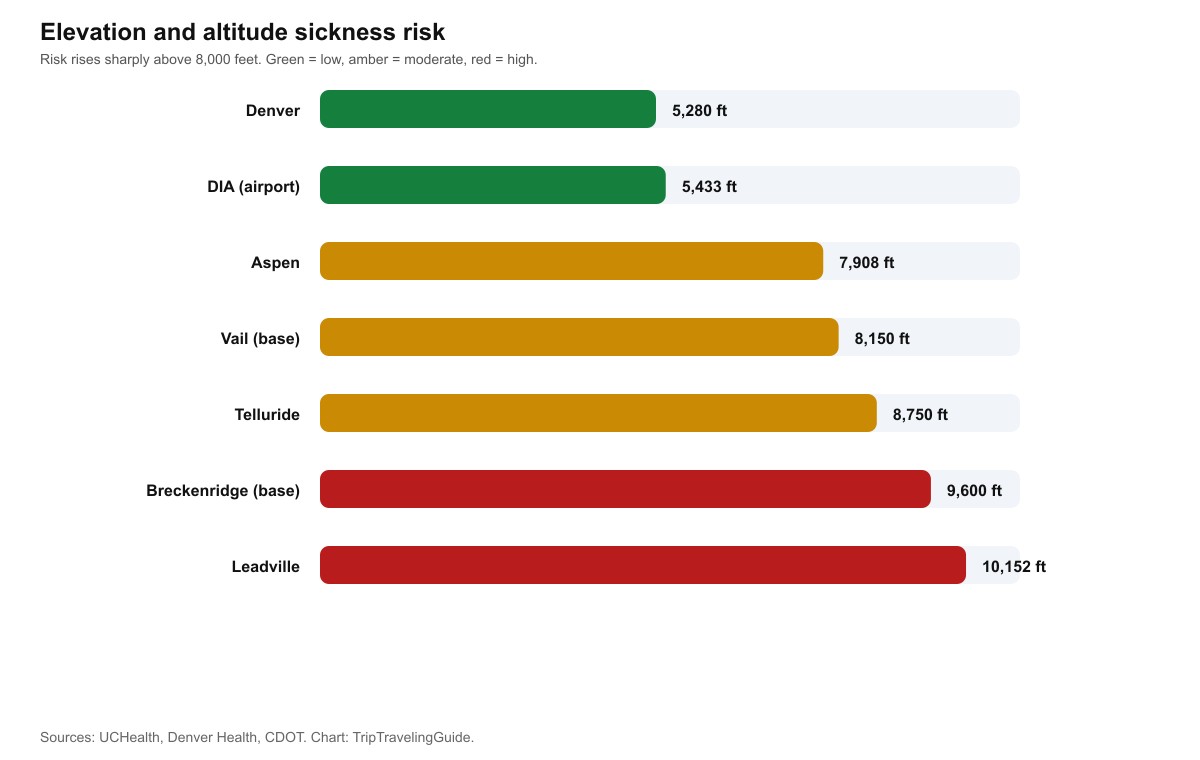
| Location | Elevation | Altitude sickness risk |
|---|---|---|
| Denver (city) | 5,280 ft | Low. Mild symptoms possible, rarely more |
| Denver International Airport | 5,433 ft | Low, same as the city |
| Aspen | 7,908 ft | Moderate, risk rises sharply above 8,000 ft |
| Vail (base) | 8,120-8,150 ft | Moderate to high |
| Telluride | ~8,750 ft | Moderate to high |
| Breckenridge (base) | 9,600 ft | High |
| Leadville | 10,152 ft | High, the highest incorporated city in the US |
Why do some people get hit hard and others feel nothing?
It mostly comes down to how fast you climb and how far you started below sea level, not fitness. People who live near sea level, younger travelers, and anyone with a prior history of altitude sickness all face higher odds, per the 1993 Colorado resort study. The biggest single lever, though, is how you get there. CU Anschutz researchers found that travelers who skip acclimatizing and go directly from near sea level to a high mountain town are up to four times more likely to develop symptoms than those who spend a night in Denver first. Fitness level barely matters here. A marathon runner from Houston and someone who hasn't exercised in years face roughly the same risk, because the problem is thinner air and lower oxygen pressure, not cardiovascular conditioning.
How can I actually prevent altitude sickness in Colorado?
Gain elevation gradually, drink far more water than usual, and don't push hard on day one. Spending your first night in Denver (5,280 feet) before heading up to a ski town above 8,000 feet gives your body a head start, and if your itinerary allows it, breaking a Breckenridge or Leadville trip into two stops instead of one straight shot makes a real difference. Beyond pacing, the specifics that matter most are drinking roughly two to three times your normal water intake, since you lose fluid faster at altitude, and limiting alcohol for the first day or two, because it compounds dehydration and makes symptoms worse. Eating regular meals, avoiding a strenuous hike or a full ski day immediately on arrival, and getting real sleep that first night round out the list. None of this is complicated, but almost nobody does all of it on a tight vacation schedule, which is a big part of why the 25 percent figure holds up year after year. If you're planning the trip around a storm, as we cover in our Colorado snow guide, build the acclimatization day into your schedule before the weather does it for you.
Does Diamox (acetazolamide) actually work, and should I bring it?
It can help, but it's a prescription decision, not something to self-start without talking to a doctor first. The standard preventive dose studied in clinical trials is 125 mg of acetazolamide taken twice daily, starting about 24 hours before you ascend, and some protocols run it at a higher dose or extend it for a day or two after arrival. A 2020 randomized trial found that a lower 62.5 mg dose did not perform as well, so going lower than 125 mg twice daily isn't well supported for prevention. Side effects are common enough to know about in advance: tingling in the fingers and toes, numbness around the mouth, and more frequent urination, since the drug is a mild diuretic. Given that Colorado's mountain towns are a far lower-risk setting than the Himalayas or the Andes, plenty of people decide the pacing and hydration steps above are enough on their own, and that's a reasonable call for most short ski trips. Anyone with kidney problems or a sulfa allergy should talk to a doctor before considering it at all.
Advertisement
When does this stop being annoying and start being dangerous?
Seek medical care immediately if you have shortness of breath at rest, persistent vomiting, chest tightness, difficulty walking normally, confusion, or blue lips or fingernails. Those are warning signs of the two serious complications: high altitude cerebral edema (HACE), swelling in the brain, and high altitude pulmonary edema (HAPE), fluid in the lungs. Both are genuinely rare. Fewer than 1 percent of acute mountain sickness cases progress to HACE, and that typically takes more than four days spent above 10,000 feet, which rules out most weekend ski trips. HAPE is more common in Colorado's own mountain towns specifically, with Summit County alone seeing 200 to 300 cases a year, usually within 2 to 3 days of arrival at elevations between 8,000 and 10,000 feet. Even among HACE and HAPE cases, fewer than 1 percent turn fatal, and Dr. Honigman credits that low number to people recognizing the warning signs early and getting to a lower elevation or a hospital before things escalate. Ordinary mild symptoms, by contrast, usually clear up within a day or two of rest, fluids, and backing off strenuous activity, no hospital required.
What are the limits of this guide?
The 25 percent figure for out-of-state visitors traces back to research UCHealth's own altitude medicine director cites, but the underlying landmark study is from 1993, and a more recent clinician estimate from the same UCHealth system puts the real range as wide as 15 to 40 percent for people sleeping at 8,000 feet or higher, partly because so many mild cases go unrecognized or unreported. Treat 25 percent as a reasonable planning number, not a precise current statistic. None of this is medical advice, and if you have a heart or lung condition, are pregnant, or are traveling with young children, talk to a doctor who knows your history before a high-elevation trip, not just this article. If you're heading to the mountains for ski season, pair this with our ski season 2026-27 opening dates guide and, if you're driving I-70, our Colorado traction law 2026 guide, since the drive up is when a lot of people first notice symptoms.
Quick answers about altitude sickness in Colorado
How common is altitude sickness in Colorado?
About 25 percent of out-of-state visitors to Colorado's mountains get mild to moderate symptoms, versus roughly 7 to 8 percent of Denver residents traveling to the same elevations.
Can you get altitude sickness in Denver?
It's possible but uncommon and usually mild. Denver sits at 5,280 feet, below the roughly 8,000-foot threshold where real risk begins.
How long does altitude sickness last?
Mild cases typically improve within a day or two of rest, hydration, and avoiding strenuous activity. Symptoms usually start 6 to 24 hours after arrival at altitude.
Does spending a night in Denver before going higher actually help?
Yes. Going straight from near sea level to a mountain town above 8,000 feet is linked to roughly four times the risk compared with acclimatizing in Denver first.
When should I see a doctor for altitude sickness?
If you have shortness of breath at rest, persistent vomiting, chest tightness, trouble walking normally, confusion, or blue lips or fingernails, seek care immediately rather than waiting it out.
Sources
- Denver7, altitude sickness deaths are rare in Colorado, UCHealth doctor says
- Denver Health, altitude sickness in Colorado, symptoms, prevention, and when to seek medical care
- PubMed, acute mountain sickness in a general tourist population at moderate altitudes (1993)
- CU Anschutz Medical Campus, altitude sickness is typically mild but can sometimes turn very serious
- TripTravelingGuide, ski season 2026-2027 opening dates
- TripTravelingGuide, Colorado traction law 2026
Topics
Advertisement