
Colorado Traction Law 2026: Why Your 2WD Car Still Needs Chains

Colorado traction law 2026: a trooper says 2WD cars need chains even with good tires. What changed, rental car rules, fines, and real enforcement numbers.
Advertisement
A Colorado trooper summed up the most misunderstood part of this winter's rule in four words: "there is no tire-only option for 2WD vehicles." If you drive a front-wheel-drive sedan or a rear-wheel-drive pickup, that sentence matters more than almost anything else in the Colorado traction law 2026 update, because it means a brand-new set of snow tires does not get you off the hook the way it would in an all-wheel-drive car. You still need chains or an approved device in the trunk, whether you ever use them or not.
Key facts :
The clarifying law: HB26-1237, signed 5 May 2026, took effect 1 September 2026 and runs through 31 May 2027, fixing statutory wording lawmakers admitted had become confusing
Two-wheel-drive vehicles: Must carry chains or an approved alternative traction device (ATD) on two or more drive tires, regardless of tire tread or rating, per Colorado State Patrol guidance in place since August 2025
AWD and 4WD vehicles: Can comply either with qualifying tires (3/16 inch tread, winter, M+S, or all-weather rated) or with chains or an ATD
Where it applies: Automatically on I-70 between Dotsero and Morrison every year from 1 September to 31 May, and anywhere else CDOT activates it when weather demands it
Fine: Commonly cited as $100 plus a $33 surcharge for noncompliance, rising to $500 plus a $157 surcharge if it closes a travel lane, though a few sources quote lower figures
New this year: Rental car companies must now notify customers about the traction and chain laws before they drive off, under a separate 2025 law aimed at out-of-state renters
The stricter Chain Law (every vehicle needs chains, AWD and 4WD included) is reserved for the worst storms and is rarely used, last activated in March 2019
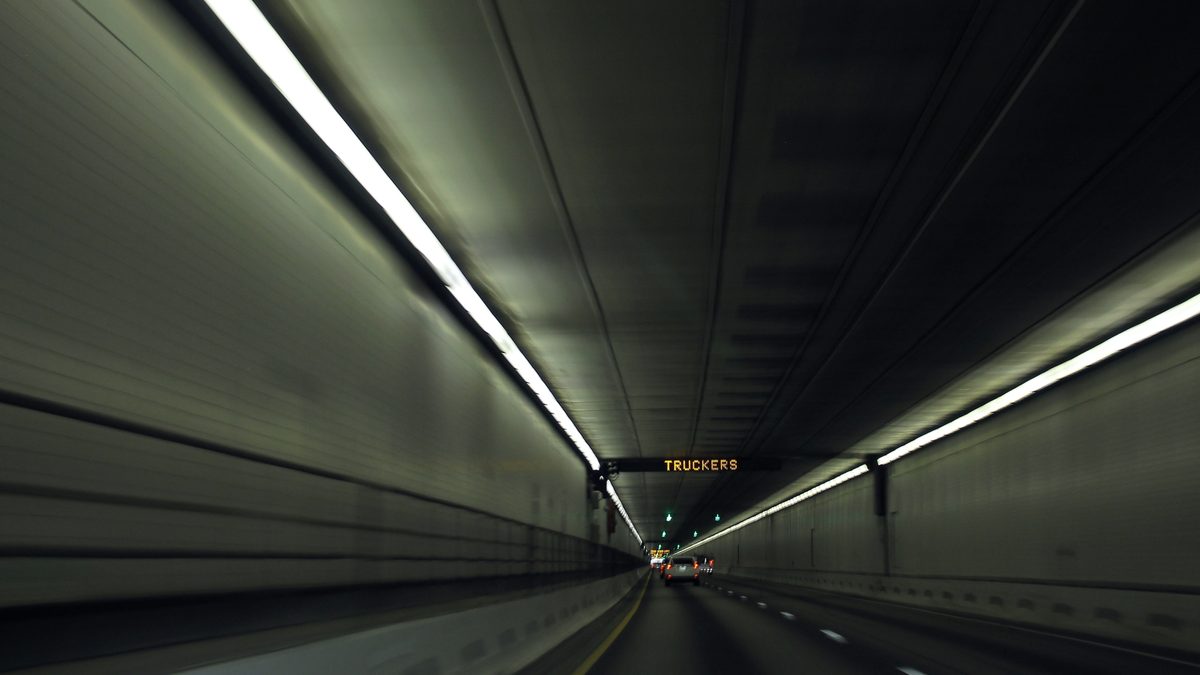
Westbound I-70 approaching the Eisenhower Tunnel. Photo: formulanone, CC BY-SA 2.0.
What exactly changed in the Colorado traction law 2026 update?
Two bills, a year apart, got Colorado here. SB25-069, signed 15 May 2025, did two things that sound unrelated but both ended up on this page: it let CDOT license private vendors to run roadside chain-up and chain-removal stations, and it required rental car companies to tell customers about the traction and chain laws before handing over the keys. Then came the part that actually caused confusion. Somewhere in how the traction statute had been amended over the years, the language covering two-wheel-drive vehicles got muddled enough that lawmakers themselves acknowledged drivers couldn't tell what applied to them. HB26-1237, signed 5 May 2026 and effective 1 September, rewrites that language so the Traction Law explicitly covers every passenger vehicle, not just 4WD and AWD. Colorado State Patrol Chief Matthew Packard put the reasoning simply: "Snow and ice can impact a vehicle of any size."
Does my two-wheel-drive car actually need chains, even with good tires?
This is the question that trips up more drivers than any other, and the honest answer is that sources disagree, which is exactly why we're not going to pretend otherwise. A Colorado State Patrol trooper, quoted directly in local reporting, said two-wheel-drive vehicles have had no tire-only option since August 2025: chains or an approved traction device on two or more drive tires, full stop, no matter what's printed on your tire's sidewall. A couple of legal blogs covering the same law describe it differently, treating qualifying tires as sufficient for 2WD just like AWD, and CDOT's general Traction Law page doesn't spell out a separate 2WD rule at all, which is part of why this keeps causing arguments in comment sections. Given a trooper's direct quote against a page that's simply silent on the distinction, we'd plan around the stricter version: if your car isn't AWD or 4WD, keep chains or an AutoSock in the trunk all winter, whether or not you ever use them.
What about AWD and 4WD vehicles, then?
Those vehicles get the easier path, but it still isn't automatic. AWD and 4WD cars can satisfy the Traction Law with qualifying tires alone: at least 3/16 inch of tread, carrying a mountain-snowflake winter rating, an M+S or M/S mud-and-snow marking, or a manufacturer's all-weather designation. Bald or summer tires fail that test no matter how capable the drivetrain is underneath them, and that's not a small detail. One Front Range dealership that works with CDOT on spinout recovery reported that on a single bad-weather day, 19 of the 22 vehicles troopers assisted after losing control had bald tires. Chains or an ATD remain a fallback for AWD and 4WD too, same as they are the requirement for 2WD, so a set in the trunk never hurts.
Advertisement
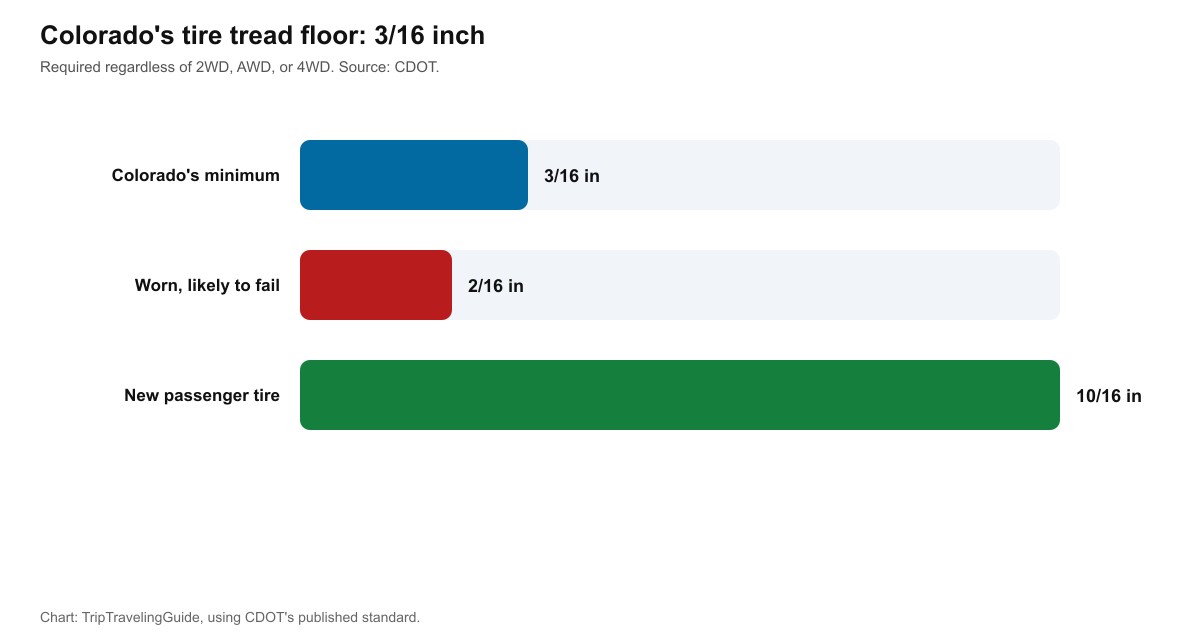
Three-sixteenths of an inch is the floor, not a suggestion. Chart: TripTravelingGuide, using CDOT's published standard.
Why are rental cars suddenly part of this conversation?
Because they're a disproportionate share of the problem, according to the law's own sponsors. State Senator Dylan Roberts, who backed the rental notification requirement, pointed to Colorado State Patrol data showing many drivers cited for traction violations or blamed for I-70 delays were renters, often flying into Denver International Airport with no idea the state has a traction law at all. A bad Presidents' Day weekend made the stakes obvious: spinouts and crashes left some drivers stranded on I-70 for up to nine hours, and CDOT estimates every hour the corridor sits closed costs the state roughly $2 million. Under the 2025 law, rental companies must now notify customers one of three ways, verbally, through a clear in-app notice at online check-in, or with a visible notice inside the vehicle, though they still aren't required to supply chains. AAA's Skyler McKinley put the renter's obligation plainly: "You have a duty to comply with Colorado law over your obligations in any contract." Some companies, including Enterprise, have started hanging tags on rearview mirrors at Colorado locations showing whether that specific car's tires meet state requirements. If a rental doesn't qualify, renters can buy a traction device themselves or ask to swap into a compliant vehicle. If you're driving up for opening weekend at a resort, that's worth checking before you leave the counter, alongside our ski season 2026-27 opening dates guide.
How often does any of this actually get enforced?
More than you'd guess, and almost entirely on one stretch of road. Colorado State Patrol issued 586 citations for Traction Law violations across the 2025-26 season, and 522 of those, nearly 90 percent, were written on the I-70 corridor specifically. That's not troopers randomly pulling cars over on a clear day. Enforcement in practice tends to happen during storm response, after a spinout already has traffic backed up, or at a spot check tied to a specific advisory CDOT has posted on the overhead message boards and on COtrip.org. If you're driving I-70 while Colorado's early-season storms are still active, as we've covered in our Colorado snow this week guide, that's exactly the kind of moment when a trooper is most likely to be checking.
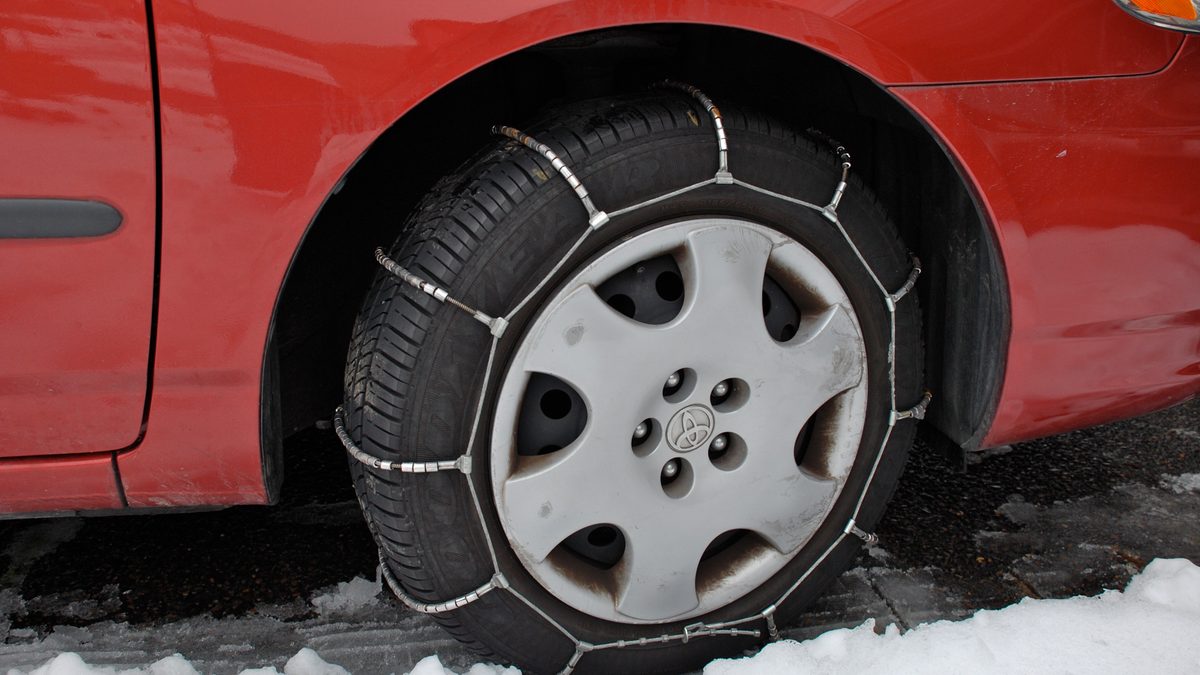
Cable chains installed on a passenger tire satisfy both the Traction Law and the stricter Chain Law. Photo: Steve Morgan, CC BY-SA 3.0.
Situation | What satisfies it |
|---|---|
2WD, Traction Law active | Chains or an approved ATD on 2+ drive tires. Tires alone do not count, per CSP. |
AWD/4WD, Traction Law active | Qualifying tires (3/16" tread, winter/M+S/all-weather) OR chains/ATD |
Any vehicle, Chain Law active | Chains or an approved ATD on 2+ drive tires. No tire rating is accepted, AWD and 4WD included. |
How is the rarer Chain Law different, and should I worry about it too?
The Chain Law is the harder stop, and it's genuinely rare. CDOT only activates it as the last step before closing a highway outright, and when it's active, every vehicle needs chains or an approved device, no tire rating gets anyone out of it, AWD and 4WD included. CDOT's own staff call activation "exceedingly rare," and the last time it kicked in on I-70 was March 2019, during a bomb cyclone. For day-to-day winter driving, the Traction Law is the one to plan around. The Chain Law is the one you hope you never meet.
Advertisement
What are the limits of this guide?
Two things here deserve more hedging than most of what you'll read elsewhere. First, the 2WD chain requirement itself: we're leading with the stricter reading, chains required regardless of tires, because it comes from a trooper quoted directly and matches how CDOT describes AWD/4WD as having an either/or option that 2WD coverage doesn't echo. But CDOT's general Traction Law page never explicitly rules out a tire-only path for 2WD vehicles, and at least two legal explainers describe one anyway. Treat the stricter version as the safe assumption, not a certainty, and confirm with Colorado State Patrol or CDOT directly before you decide chains aren't necessary. Second, the fines: CDOT's own materials and a couple of secondary sources agree on $100 plus a $33 surcharge standard, $500 plus a $157 surcharge if you block a lane, which is what we've used above, but at least one source quotes a lower $50 plus $17 base fine for the same violation. Check CDOT's traction law page or call 511 before you drive, rather than relying on any figure printed here, ours included. For the bigger winter picture beyond this one law, see our Colorado snow predictions 2026-2027 guide.
Quick answers about Colorado's traction law, 2026-27
Does a two-wheel-drive car need chains even with winter tires?
Likely yes. A Colorado State Patrol trooper has said there's no tire-only option for 2WD vehicles since August 2025, though CDOT's general page doesn't spell out that distinction, so confirm directly if you're unsure.
What tire tread depth does Colorado require for AWD and 4WD?
At least 3/16 inch, rated all-weather, mud and snow (M+S or M/S), or winter with the mountain-snowflake symbol.
Do rental cars have to meet the traction law too?
Yes, renters must comply even if their rental agreement says otherwise, and companies must now notify customers of the law before drive-away.
What's the fine for violating Colorado's traction law?
Commonly cited as $100 plus a $33 surcharge, rising to $500 plus a $157 surcharge if the violation closes a travel lane, though figures vary slightly by source.
Where is the traction law automatically in effect?
On I-70 between Dotsero and Morrison, every year from 1 September through 31 May. Elsewhere, CDOT activates it only when conditions require.
Sources
Topics
Advertisement