Snow Predictions for Texas 2026-2027: What 76 Winters Show

NOAA expects a record El Nino. Across Texas's 9 strong El Nino winters Lubbock nearly doubled its snowfall, while Houston finished blank in 6 of 7.
Advertisement
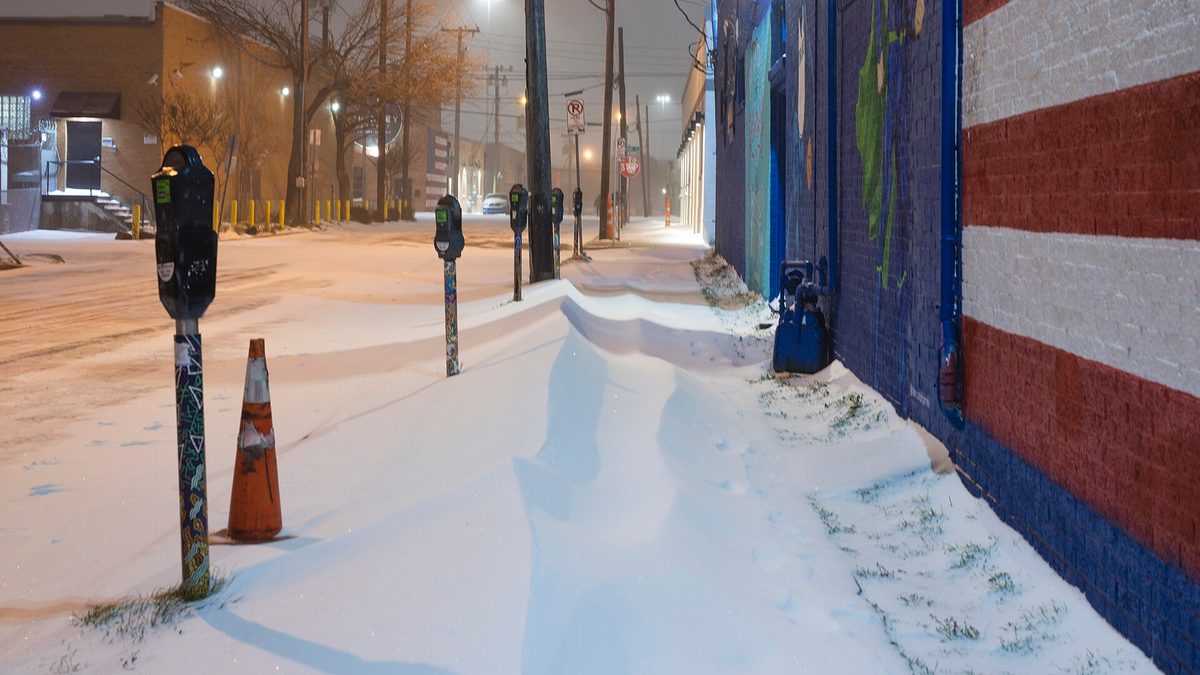
Texas is two different snow states sharing one name. Amarillo averages 16.5 inches a season and has finished exactly one winter in 72 with nothing. Brownsville has recorded measurable snow on two days in its entire history. For 2026-2027 NOAA expects the strongest El Nino since at least 1950, and still publishes no Texas snowfall total.
This guide is built from National Weather Service station records and the NOAA outlooks that existed on 26 August 2026. Every figure is sourced and dated. We do not forecast a seasonal snow total, because that number is not forecastable for a specific city, and any page printing one has invented it.
Will it snow in Texas this winter?
In the Panhandle and West Texas, almost certainly. Amarillo and Lubbock have each gone blank once in more than 70 recorded winters. In Dallas, most years bring something small. In Houston, San Antonio and along the coast, the honest answer is probably not, whatever El Nino does.
Where you stand in Texas decides this far more than which winter it is. The gap between Amarillo and Brownsville is roughly the gap between Chicago and the Bahamas, and it sits inside one state line.
What is the Texas winter forecast for 2026-2027?
No agency has published a Texas snowfall forecast, and none will. What exists is an ENSO outlook, a seasonal temperature and precipitation outlook in probabilities, and two almanac forecasts written in adjectives. Below is every published position as it stood on 26 August 2026, with dates.
| Source | Issued | What it actually says for Texas |
|---|---|---|
| NOAA CPC, ENSO discussion | 13 Aug 2026 | Greater than 90% chance of a very strong El Nino through winter 2026-27. A 69% chance the October to December peak beats every event since 1950. No snowfall figure |
| NOAA CPC, seasonal outlook | 20 Aug 2026 | Equal chances for winter temperature across the southern tier. Modest 33 to 50% tilt to above-normal precipitation. The strong wet signal sits over California and the Southeast, not Texas |
| Farmers' Almanac | August 2026 | "A Wet and Stormy Southern Tier." An active storm track through Texas, and storms that "could produce sleet, freezing rain, or heavy, wet snow." No total |
| Old Farmer's Almanac | Checked 26 Aug 2026 | Its Dallas page was still showing an outlook labelled "November 2025 to October 2026", which is last winter. That text says snowfall below normal |
| OpenSnow | Aug 2026 | Above-normal snowfall favoured for the Southwest, meaning California, Utah and Colorado. Texas is not in the above-normal snowfall zone |
Two things are worth pulling out of that table. The strongest snowfall signal any forecaster is willing to put on a map for this winter points at the Rockies and the Sierra, not at Texas. And the Old Farmer's Almanac line that several pages are currently quoting as a 2026-2027 Texas forecast is text written for the winter that already happened.
Is 2026-2027 an El Nino winter?
Yes, and an extreme one. The Climate Prediction Center's 13 August 2026 discussion puts a greater than 90% chance on a very strong event through the fall and winter, and a 69% chance that the October to December peak exceeds every El Nino in the record going back to 1950.
The July index values behind that were plus 1.4C in Nino-3.4, plus 1.7C in Nino-3 and plus 2.9C in Nino-1+2, with subsurface anomalies reaching plus 10C at depth. CPC's own summary sentence is the one nobody quotes: with an event of this magnitude, it writes, the chances of El Nino-consistent impacts are larger, "but they are not guaranteed."
The next ENSO discussion is 10 September 2026 and the next seasonal outlook 17 September 2026. Neither will contain a Texas snowfall number either.
Does El Nino mean more snow in Texas?
For West Texas, yes, clearly. For the big Texas cities, no. This is the single most useful thing in the record and no page currently ranking for this query contains it. We pulled every strong and very strong El Nino winter since 1950 and measured what each station actually recorded.
| Station | Full-record average | Average across 9 strong El Nino winters | Difference |
|---|---|---|---|
| El Paso | 4.5" | 12.0" | 2.7x |
| Lubbock | 8.9" | 17.2" | 1.9x |
| Wichita Falls | 4.8" | 8.1" | 1.7x |
| Abilene | 4.8" | 7.8" | 1.6x |
| Midland | 4.3" | 6.2" | 1.4x |
| Amarillo | 16.5" | 22.5" | 1.4x |
| Dallas Fort Worth | 2.3" | 0.9" | 0.4x, below normal in 5 of 6 |
| Waco | 1.1" | 1.3" | Zero snow in 6 of 9 |
| Austin | 0.6" | 1.2" | Zero snow in 5 of 8 |
| San Antonio | 0.6" | 1.0" | Zero snow in 4 of 8 |
| Houston | 0.3" | 0.7" | Zero snow in 6 of 7 |
| Corpus Christi | 0.1" | 0.2" | Zero snow in 6 of 8 |
| Brownsville | 0.0" | 0.0" | Zero snow in 7 of 7 |
The mechanism explains the split. A strong El Nino drives the subtropical jet across the southern United States, which loads Texas with moisture and storms. It also tends to hold back the Arctic outbreaks that supply the cold. West Texas sits high enough and far enough north to be cold anyway, so extra moisture turns into extra snow. Houston does not, so extra moisture turns into rain.
This is also why Texas behaves differently from the states further east. CPC puts its strongest winter wet signal over California and the Southeast, and in the Southeast that moisture meets cold air often enough to matter, which is why our Georgia snow guide reads differently from this one. Texas is the state where the storm track arrives and the cold usually does not.
Narrow it to the three very strong events, the only real analogues for what CPC says is coming, and the split becomes stark.
| Station | Average | 1982-83 | 1997-98 | 2015-16 | Note |
|---|---|---|---|---|---|
| Amarillo | 16.5" | 47.9" | 31.1" | 13.4" | 1982-83 is its snowiest of 72 seasons |
| Lubbock | 8.9" | 41.2" | no record | 13.3" | 1982-83 is its snowiest of 74 seasons |
| El Paso | 4.5" | 35.0" | 1.0" | 8.1" | 1982-83 is its snowiest of 73 seasons |
| Midland | 4.3" | 12.3" | no record | 8.0" | 3rd snowiest of 70 |
| Abilene | 4.8" | 12.2" | no record | 5.1" | 6th snowiest of 70 |
| Dallas Fort Worth | 2.3" | 0" | 0.5" | 0" | |
| Austin | 0.6" | 0" | no record | 0" | |
| San Antonio | 0.6" | 0" | no record | 0" | |
| Houston | 0.3" | 0" | 0" | 0" | |
| Brownsville | 0.0" | 0" | 0" | no record |
The same winter, 1982-83, produced the snowiest season ever recorded at Amarillo, Lubbock and El Paso, and produced nothing measurable in Dallas, Austin, San Antonio, Houston, Corpus Christi or Brownsville. Across all three very strong El Nino winters, the seven eastern and southern stations recorded zero measurable snow in 16 of 17 city-seasons. The one exception was half an inch at Dallas Fort Worth in 1997-98.
How much snow does Texas get a year?
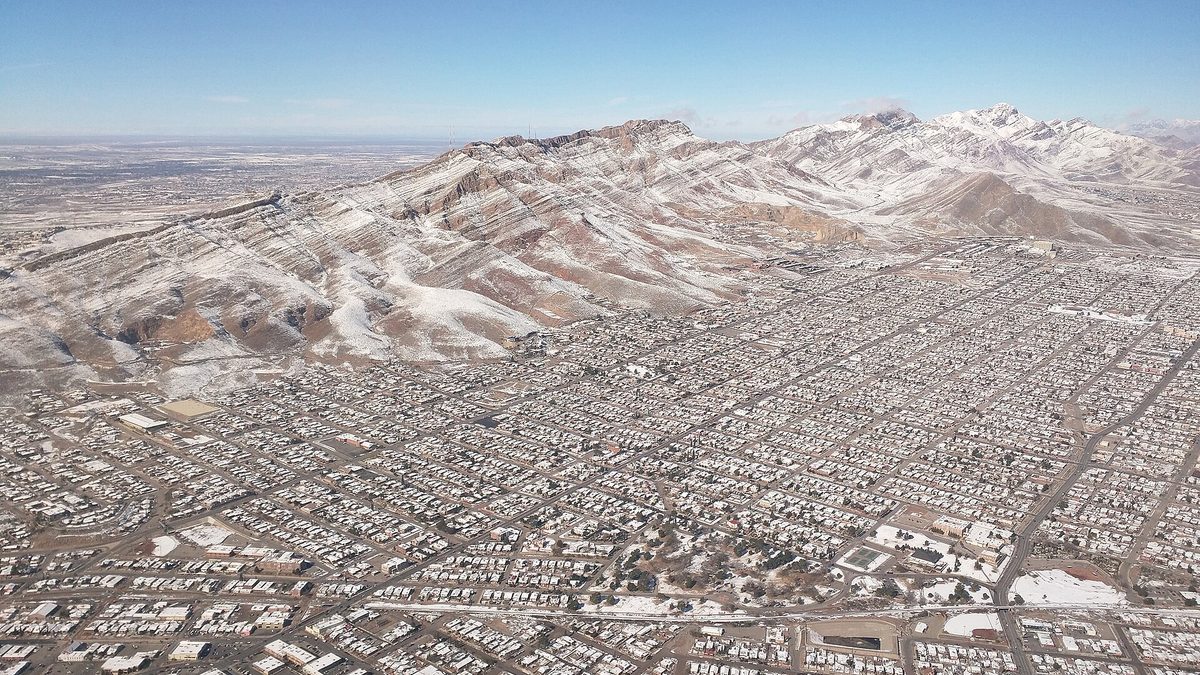
There is no useful single figure for Texas, because the range runs from 16.5 inches a season at Amarillo to nothing at all at Brownsville. The table below is every long-record first-order station in the state, ordered by how much snow it actually gets.
Advertisement
| City | Full-record average | NOAA 1991-2020 normal | Seasons with zero snow | Snowiest season on record |
|---|---|---|---|---|
| Amarillo | 16.5" | 17.2" | 1 of 72 (1%) | 1982-83, 47.9" |
| Lubbock | 8.9" | 7.0" | 1 of 74 (1%) | 1982-83, 41.2" |
| Abilene | 4.8" | 3.7" | 10 of 70 (14%) | 2020-21, 18.8" |
| Wichita Falls | 4.8" | 3.1" | 10 of 74 (14%) | 2009-10, 16.6" |
| El Paso | 4.5" | 2.8" | 17 of 73 (23%) | 1982-83, 35.0" |
| Midland | 4.3" | 4.3" | 10 of 70 (14%) | 2011-12, 19.5" |
| Dallas Fort Worth | 2.3" | 1.6" | 12 of 48 (25%) | 1977-78, 17.6" |
| Waco | 1.1" | 0.7" | 34 of 70 (49%) | 2020-21, 9.0" |
| Austin | 0.6" | 0.2" | 41 of 64 (64%) | 2020-21, 7.8" |
| San Antonio | 0.6" | 0.2" | 52 of 70 (74%) | 1984-85, 15.9" |
| Houston | 0.3" | 0.1" | 45 of 56 (80%) | 1972-73, 4.8" |
| Corpus Christi | 0.1" | 0.2" | 62 of 66 (94%) | 1972-73, 1.3" |
| Brownsville | 0.0" | 0.0" | 57 of 57 (100%) | None on record |
The full-record average and the NOAA normal are different measurements and both are given on purpose. The normal covers 1991 to 2020 only. The full-record average covers every complete season the station has, which at most of these stations means the 1950s onward, and it runs higher at the snowier sites because it includes the big mid-century winters the normal period misses.
Does it snow in Texas every year?
In the Panhandle, effectively yes. Amarillo and Lubbock have each recorded exactly one snowless season in over 70 years. Everywhere else it is a coin toss that gets worse as you move south. Austin goes blank in 64% of winters, Houston in 80%, Corpus Christi in 94%.
Brownsville is the extreme case and it is worth stating precisely. In 57 complete recorded seasons it has never once finished a winter with a measurable seasonal total, and its entire snow history consists of two days: 25 December 2004, when 1.5 inches fell, and 8 December 2017, when 0.3 inches fell.
What did the last 5 years of Texas snow look like?
Mixed in the west and close to empty in the east. Below is every complete season from 2021-22 to 2025-26 at all thirteen stations, taken from daily observations rather than seasonal summaries, so the zeros are real zeros and not gaps in the record.
| City | 2021-22 | 2022-23 | 2023-24 | 2024-25 | 2025-26 |
|---|---|---|---|---|---|
| Amarillo | 16.1" | 3.8" | 8.4" | 17.9" | 4.6"* |
| Lubbock | 2.7" | 7.2" | 3.7" | 2.5" | 6.4" |
| Midland | 1.1" | 0.7" | 0" | 0" | 4.1"* |
| Abilene | 3.0" | 0" | 0" | 1.0" | 2.5"* |
| Wichita Falls | 4.4" | 2.0" | 0" | 2.0" | 2.7"* |
| El Paso | 3.5" | 0" | 0" | 0.2" | 0.6" |
| Dallas Fort Worth | 1.7" | 1.3" | 1.5" | 2.6" | 2.4" |
| Waco | 0.2" | 0.1" | 0" | 0" | 0.3"* |
| Austin | 0.2" | 0" | 0" | 0.3" | 0.8" |
| San Antonio | 0" | 0" | 0" | 0.1" | 0" |
| Houston | 0" | 0" | 0" | 1.4" | 0" |
| Corpus Christi | 0" | 0" | 0" | 0" | 0" |
| Brownsville | 0" | 0" | 0" | 0" | 0" |
An asterisk marks a season where the daily record has one to three missing days, so that figure is a floor rather than an exact total.
Read down the 2023-24 column, because that is the important one. 2023-24 was a strong El Nino winter, and nine of the twelve stations with a complete season recorded no measurable snow at all. Midland, Abilene, Wichita Falls, El Paso, Waco, Austin, San Antonio, Houston and Corpus Christi all finished blank. Amarillo managed 8.4 inches against its 16.5 inch average and Lubbock 3.7 against 8.9. It was the weakest of the nine strong El Nino winters at almost every station in the state.
Two other things stand out. 2024-25 is the only recent season where the Gulf Coast got anything, and it came from one storm on 21 January 2025. And 2022-23 and 2023-24 back to back gave San Antonio, Houston, Corpus Christi and Brownsville nothing whatsoever, four consecutive blank city-seasons in the state's four largest southern markets.
What was the snowiest Texas winter in recent memory?
2020-21, and it was a La Nina winter, which is the opposite phase to the one forecast for 2026-2027. The February 2021 storm produced the snowiest season on record at Abilene, Waco and Austin, the second snowiest at Midland and the third at Wichita Falls.
| City | 10 to 20 February 2021 total | Season total | Season rank |
|---|---|---|---|
| Amarillo | 12.4" | 33.8" | 4th of 72 |
| Abilene | 10.1" | 18.8" | 1st of 70 |
| Wichita Falls | 10.8" | 13.8" | 3rd of 74 |
| Midland | 5.6" | 13.8" | 2nd of 70 |
| Waco | 4.6" | 9.0" | 1st of 70 |
| Austin | 6.5" | 7.8" | 1st of 64 |
| San Antonio | 6.2" | 6.4" | 4th of 70 |
| Dallas Fort Worth | 5.0" | 5.0" | 7th of 48 |
| Houston | 1.0" | 1.0" | 10th of 56 |
Look at the Austin and Waco rows in particular. Almost the entire record-setting season fell in one eleven-day window, and the ENSO state that winter was a moderate La Nina with a December to February index of minus 0.91. The biggest Texas snow event in living memory happened in the phase that is supposed to produce less.
That is the caveat this whole page rests on. A tendency across nine winters is not a promise about one, and one storm on one track can rewrite a city's record regardless of what the Pacific is doing.
Will it snow in Dallas this winter?
Probably a little, as usual. Dallas Fort Worth has recorded snow in each of the last five winters, between 1.3 and 2.6 inches a season, against a full-record average of 2.3 inches. What the record does not support is the idea that a strong El Nino improves those odds.
Dallas is the clearest counterexample in the state. Across the six strong El Nino winters it has a complete record for, it averaged 0.9 inches against its own 2.3 inch average, finished below normal in five of the six, and recorded nothing at all in three of them, including both 1982-83 and 2015-16.
Its biggest single day on record is 11.2 inches on 11 February 2010, and its snowiest season is 17.6 inches in 1977-78. Neither was a strong El Nino year.
Will it snow in Houston this winter?
The base rate says no. Houston Intercontinental has finished 45 of its 56 complete seasons with no measurable snow, and recorded measurable snow on 19 days in the entire record. Its full-record average is 0.3 inches a season, and a strong El Nino has not historically changed that.
Across the seven strong El Nino winters with a complete Houston record, six produced zero. All three very strong events produced zero. The single El Nino winter that delivered anything was 1972-73, which remains Houston's snowiest season at 4.8 inches.
The most recent snow was 21 January 2025, when Intercontinental measured 1.2 inches and Hobby measured 3.0, the second largest snow day in Hobby's record. That same storm gave Port Arthur 4.5 inches, the largest single snow day ever recorded there. It arrived in a La Nina winter.
Will it snow in Austin or San Antonio this winter?
Both are long shots in any winter. Austin has finished 41 of 64 seasons with nothing and San Antonio 52 of 70, which is 64% and 74% of their recorded winters respectively. Neither has ever recorded measurable snow in a very strong El Nino winter.
When these cities do get snow it tends to be memorable rather than routine. San Antonio's biggest day on record is 13.2 inches on 12 January 1985, still the largest single snowfall in its history by a factor of four. Austin's biggest is 6.1 inches on 15 February 2021.
Austin's most recent measurable snow was 24 and 25 January 2026, totalling 0.8 inches. San Antonio's was 0.1 inches on 21 January 2025.
How much snow do Amarillo and Lubbock get?
Amarillo averages 16.5 inches a season across 72 complete winters and Lubbock 8.9 inches across 74. These are the two places in Texas where snow is a normal part of winter rather than an event, and both have gone snowless exactly once in their entire records.
Amarillo sits at 3,607 feet on the High Plains and Lubbock at 3,259, and that elevation is most of the explanation. Both stand roughly 3,000 feet above Dallas Fort Worth, which sits at 544 feet. Lubbock, 120 miles south of Amarillo and about 350 feet lower, averages roughly half as much.
Both hold their records from the same winter. Amarillo's snowiest season is 47.9 inches in 1982-83 and Lubbock's is 41.2 inches in the same year. Lubbock also holds its 24-hour record from that winter, 16.3 inches on 20 and 21 January 1983, and its single-storm record of 16.9 inches from the same event.
Where does it snow the most in Texas?
The Panhandle, and specifically the High Plains around Amarillo, Dalhart and Perryton. Amarillo's 16.5 inch seasonal average is the highest of any long-record station in Texas, roughly seven times Dallas and more than fifty times Houston. Elevation, not latitude, is doing most of the work.
Above the official station network, the Guadalupe Mountains in far West Texas reach 8,751 feet at Guadalupe Peak, the highest point in the state, and take snow more often than anywhere at lower ground. There is no long-running weather station at that elevation, so no verifiable seasonal average exists for it and we are not going to invent one.
Advertisement
When does it snow in Texas?
January and February carry most of it statewide, and the window is short everywhere outside the Panhandle. In Amarillo and Lubbock the season runs from November into March. In Dallas it is realistically January and February. On the Gulf Coast there is no season, only occasional single days.
The dates of the notable events make the point better than an average does. The state's biggest storm was 20 and 21 December. Uri was 14 to 16 February. The Gulf Coast event was 21 January. San Antonio's record day was 12 January. Texas snow is a handful of individual dates, not a season.
What was the worst snowstorm in Texas history?
The storm of 20 and 21 December 1929, which produced the certified all-time state 24-hour snowfall record. Hillsboro recorded 26 inches and nearby Clifton 24 inches, with a swath of more than 12 inches running two to three counties wide across Central Texas.
The detail worth keeping from the National Weather Service account is what happened either side of that swath. Dallas Fort Worth, less than 60 miles from Hillsboro, recorded only a dusting in the same storm and reached 70F on Christmas Day four days later. Clifton, under two feet of snow, bottomed out at 0F.
That is how Texas snow works. The band is narrow, it lands where it lands, and being 60 miles off it means getting nothing.
Does it snow in the Texas Hill Country?
Rarely, and less than its elevation suggests. The Hill Country sits between roughly 1,000 and 2,000 feet, which is not enough to overcome its latitude. The nearest long-record stations are San Antonio at 0.6 inches a season and Austin at 0.6, both of which go blank most winters.
When the Hill Country does get snow it usually arrives with the same storms that reach San Antonio and Austin, and in similar amounts. February 2021 is the recent reference: San Antonio took 6.2 inches across that storm and Austin 6.5.
When was the last time it snowed in Texas?
January 2026 in the northern half of the state. Dallas Fort Worth measured 1.5 inches on 24 January and 0.9 on 25 January, Lubbock took 6.4 inches across the month, and Amarillo 4.4. Austin recorded 0.8 inches across the same two days.
For the southern cities the answer is older. San Antonio, Houston and the coast last saw measurable snow on 21 January 2025. Corpus Christi and Brownsville last saw it on 8 December 2017, more than eight years ago.
What to do with this before winter
Nothing on this page tells you when it will snow, because that is not knowable in August. What it can tell you is how to set expectations, where to look, and which forecast to trust when the time comes. Five things follow from the record.
- Book on geography, not on the ENSO forecast. The gap between Amarillo and Houston in an average winter is far larger than the gap between a strong El Nino and a La Nina winter at either one.
- If you want to see snow in Texas this winter, go to the Panhandle or the Guadalupe Mountains in January or February. Those are the only parts of the state where the odds are meaningfully better than a coin toss.
- Take ice more seriously than snow. A wetter than normal winter with temperatures near freezing is the recipe for freezing rain, which closes Texas roads and takes down power lines far more often than snow does.
- Watch the CPC outlooks, not the almanacs. The next ENSO discussion is 10 September 2026 and the next seasonal outlook 17 September 2026. The official winter outlook lands in mid-October.
- Use the local National Weather Service forecast in the week you travel. Nothing useful about a specific Texas snow event is knowable more than about a week ahead, and that has been true in every winter in this record.
For the wider picture this winter, see our USA winter snow predictions guide, and for the states where a strong El Nino genuinely does favour more snow, our Colorado snow guide. For how the almanacs and the models disagreed last year and who turned out right, see the two sides of the winter forecast.
What this record cannot tell you
It cannot tell you whether it will snow at your address this winter. Nine strong El Nino winters is a small sample, the current event is forecast to be stronger than any of them, and the historical classification uses a different index from the one CPC is quoting for 2026-2027.
Three specific limits are worth stating. The nine strong El Nino winters were classified using the Oceanic Nino Index, while CPC's 69% headline for this winter refers to the Relative Oceanic Nino Index, which is not a like-for-like comparison. Seasons with missing daily observations were excluded rather than estimated, so the station counts differ from each other. And the Farmers' Almanac forecast of heavy wet snow along the southern storm track contradicts what the record shows strong El Nino has done to eastern Texas, and we are not going to pretend that disagreement is settled.
Common questions
How much snow does Texas get on average?
There is no meaningful statewide figure. The range runs from 16.5 inches a season at Amarillo to zero at Brownsville. The Panhandle averages 9 to 17 inches, West Texas 4 to 5, Dallas 2.3, and everything from Waco southward under 1.1 inches.
Does it snow in Houston?
Occasionally. Houston Intercontinental has recorded measurable snow on 19 days since 1969, most recently 1.2 inches on 21 January 2025. It finishes 80% of its winters with none at all, and its snowiest season on record is 4.8 inches in 1972-73.
What is the snowiest city in Texas?
Amarillo, at 16.5 inches a season across 72 complete winters, which is nearly double Lubbock in second place. Its snowiest season on record is 47.9 inches in 1982-83, and it has finished only one recorded winter with no measurable snow at all.
Will Texas have another storm like February 2021?
Nobody can say. What the record shows is that February 2021 was a moderate La Nina winter, not an El Nino one, and that it produced the snowiest season on record at Abilene, Waco and Austin. Extreme Texas snow events do not require El Nino.
Is Texas getting less snow than it used to?
At the southern stations, the recent record is thin rather than clearly declining. Houston, San Antonio, Corpus Christi and Brownsville recorded nothing in three of the last five winters. At Amarillo and Lubbock the last five years sit close to their long-run averages.
Where does the underlying data come from?
Every Texas figure on this page was computed from ACIS StnData, the NOAA Regional Climate Centers database behind the National Weather Service's own xmACIS2 tool, queried on 26 August 2026 for the period July 1950 to June 2026 at thirteen first-order stations.
Sources
Every claim above traces to one of the following, each checked on 26 August 2026. Station figures were computed from the raw ACIS record rather than copied from a secondary source, and seasons with missing daily observations were excluded rather than estimated.
- NOAA Climate Prediction Center, ENSO diagnostic discussion, issued 13 August 2026
- NOAA Climate Prediction Center, prognostic discussion for long-lead seasonal outlooks, issued 20 August 2026
- ACIS data service, NOAA Regional Climate Centers: daily and monthly snowfall for Amarillo, Lubbock, Midland, Abilene, Wichita Falls, El Paso, Dallas Fort Worth, Waco, Austin, San Antonio, Houston, Corpus Christi, Brownsville, Houston Hobby, Galveston, Port Arthur and Victoria
- NOAA 1991-2020 Climate Normals, seasonal and monthly snowfall, returned through the same service
- National Weather Service Fort Worth, the December 1929 snowstorm and the Texas 24-hour record
- National Weather Service Fort Worth, significant North Texas snow and ice events
- National Weather Service Lubbock, snowfall normals and records
- Jan Null, Oceanic Nino Index event classification table, used to identify strong and very strong El Nino winters
- Farmers' Almanac 2026-2027 winter forecast, published August 2026 and covered by Fox Weather on 8 August 2026
- Old Farmer's Almanac, long-range forecast for Dallas, checked 26 August 2026
- OpenSnow, 2026-2027 winter forecast preview
Snowfall figures are official station observations as retrieved in August 2026. Conditions change: check the National Weather Service forecast for your destination in the week before you travel.
Topics
Advertisement