Illinois Snow Predictions 2026-2027: North vs South

Will Illinois have a snowy winter in 2026-2027? NOAA, Farmers' Almanac and Old Farmer's Almanac compared, plus the real north-south snowfall gap: 38 inches at Chicago vs 11 at Carbondale.
Advertisement
Ask someone in Rockford if Illinois gets a snowy winter and they'll say obviously. Ask someone in Carbondale and they'll laugh. Same state, same winter, two completely different answers, because Illinois runs almost 400 miles north to south and its normal snowfall drops from 37 inches a season at the top to barely 11 at the bottom. That gap is bigger than what separates whole regions of the country. Throw a strong El Nino into the mix this year, and NOAA, the Farmers' Almanac and the Old Farmer's Almanac each tell a slightly different story about what 2026-2027 looks like.
Will it snow in Illinois this winter?
Yes. Everywhere. Just not by the same amount. Northern Illinois typically sees 30 to 40 inches a season, central Illinois around 20, the far south under 15. "Will it snow" has one answer here. "How much" has three.
What kind of winter is Illinois getting in 2026-2027?
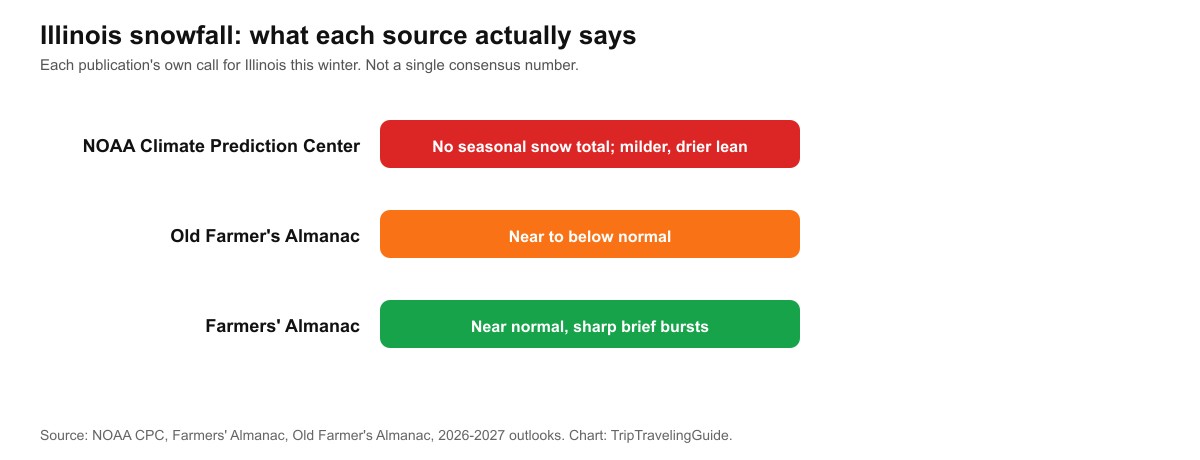
Milder than normal, across the board, is the one thing NOAA and both almanacs agree on. Where they split is what that mildness means for snow. NOAA's Climate Prediction Center leans warmer and drier without ever putting a number on it. The Old Farmer's Almanac calls for near to below normal snow. The Farmers' Almanac expects something closer to a normal total, just delivered in short, sharp bursts instead of one steady accumulation. Three forecasters, three slightly different winters, one state.
What does NOAA's El Nino forecast say about Illinois snow?
Above-average temperatures, strongest across Chicago and the north. NOAA's Climate Prediction Center puts the odds of a very strong El Nino this fall and winter above 90 percent, and there's a real chance it ends up the strongest on record since 1950. That's not a small claim. For Illinois specifically, the agency favors above-average temperatures, especially up north, while its precipitation outlook shrugs and gives equal odds to above, near or below normal.
No seasonal snowfall number from NOAA, same as every year. But a milder, drier pattern historically means less snow than a typical winter here, not a snowless one. Worth remembering before anyone cancels their sled.
What does the Farmers' Almanac predict for Illinois this winter?
A different flavor of mild. The Farmers' Almanac's 2026-2027 outlook lumps Illinois into its wider Great Lakes and Midwest zone and calls for near-normal temperatures with real volatility underneath that average: fast clippers, sudden cold snaps, brief snowy windows, then a thaw, then the cycle again. Not one long snowy stretch. More like weather that can't make up its mind.
It also flags something I think gets glossed over elsewhere: El Nino winters don't behave identically every time in the Midwest. The University of Illinois State Climatologist's own research backs the general pattern, warmer and drier, but "general pattern" is doing a lot of work in that sentence.
What does the Old Farmer's Almanac predict for Illinois this winter?
Depends which Illinois, again. The Old Farmer's Almanac actually splits the state across three of its own forecast zones. Northern Illinois sits in the Upper Midwest zone: warmer early, colder as the season wears on. Central and eastern Illinois fall in the Lower Lakes zone: warmer than normal, wetter, near to below normal snow. Southern Illinois belongs to the Heartland zone: warmer and wetter, same near-to-below-normal snow call.
Across all three, the coldest stretch lands mid- to late January, with the best snow chances scattered through early and late January, late February and early March.
NOAA vs Farmers' Almanac vs Old Farmer's Almanac: where they agree and disagree
Everyone agrees this winter runs warmer than typical. Nobody agrees on what that means for your driveway. NOAA and the Old Farmer's Almanac both point below normal on snow. The Farmers' Almanac points closer to normal, just lumpier. I'm not going to average these into a fake consensus number. They disagree, and that disagreement is the most honest thing I can tell you about this winter.
Advertisement
| Source | Temperature call | Snowfall call | Notable timing |
|---|---|---|---|
| NOAA Climate Prediction Center | Above average, strongest in the north | No seasonal total, milder and drier lean | Pattern holds through the season |
| Farmers' Almanac | Near normal, volatile | Near normal, in sharp brief bursts | Scattered through winter |
| Old Farmer's Almanac | Warmer than normal statewide | Near to below normal | Coldest mid-to-late January |
Why is there such a big snowfall gap between northern and southern Illinois?
Two competing influences, pulling in opposite directions as you move south. Northern Illinois sits close enough to Lake Michigan to catch some lake-effect snow and stays locked inside the path of every Alberta clipper and Arctic outbreak that slides through the Midwest. Southern Illinois sits far enough south, and close enough to the Gulf of Mexico's warm, moist air, that plenty of winter storms arrive as rain, or a slushy rain-snow mix, instead of real snow.
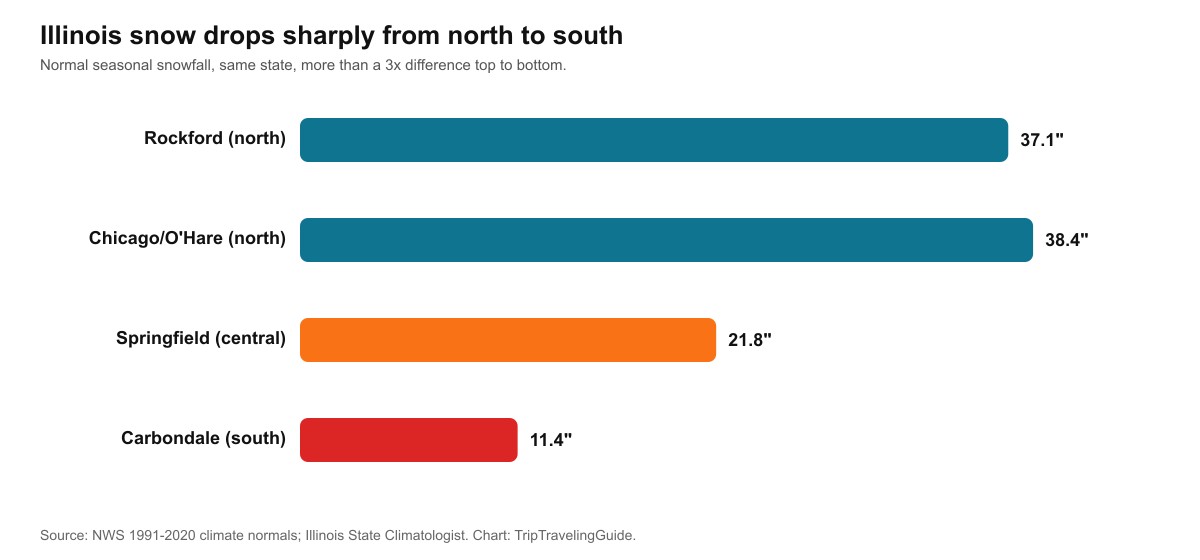
Run the numbers and you get one of the sharpest intrastate snowfall gradients anywhere in the country: about 36 inches normal in the far north, under 10 in the southern tip. First snow dates run almost a month apart too, late November near Chicago against late December down south. Same state. Different winter, basically.
How much snow does each part of Illinois get in a normal year?
Roughly 37 to 38 inches up north, 22 in the center, 11 down south, per National Weather Service 1991-2020 climate normals for Rockford, Chicago's O'Hare, Springfield and Carbondale.
| City | Region | 1991-2020 seasonal normal | Record season |
|---|---|---|---|
| Rockford | North | 37.1 in | 72.9 in (2007-08) |
| Chicago (O'Hare) | North | 38.4 in | 83.7 in (1978-79) |
| Springfield | Central | not in this guide's source set | 45.0 in (1981-82) |
| Carbondale | South | 11.4 in (annual average) | not in this guide's source set |
Our Chicago winter guide goes deeper on the city's own stations, including how O'Hare, Midway and Rockford have behaved in past strong El Nino winters specifically.
How much snow falls each month in Illinois?
December through February, basically, no matter which Illinois you're standing in. The north just gets roughly double the south's total in every one of those months. Chicago O'Hare and Springfield both show January as the single snowiest month on their 1991-2020 normals.
| Month | Chicago (O'Hare) normal | Springfield normal |
|---|---|---|
| October | 0.2 in | 0.1 in |
| November | 1.8 in | 1.2 in |
| December | 7.6 in | 4.3 in |
| January | 11.3 in | 6.7 in |
| February | 10.7 in | 6.1 in |
| March | 5.5 in | 3.1 in |
Springfield's monthly figures add up exactly to its 21.8-inch seasonal normal. Chicago's land at 37.1, a touch under its official 38.4-inch normal. That's a small rounding gap between two separate NWS releases, not a contradiction worth losing sleep over.
How much snow has Illinois gotten in the last 10 years?
All over the place. Chicago O'Hare's own record swings from a near-snowless 13.2 inches to a heavy 50.7 across the last 10 winters, with no steady climb or decline either direction. El Nino or not, one winter tells you almost nothing about the next.
| Winter | Chicago (O'Hare) snowfall |
|---|---|
| 2014-15 | 50.7 in |
| 2015-16 | 31.2 in |
| 2016-17 | 26.1 in |
| 2017-18 | 36.0 in |
| 2018-19 | 49.5 in |
| 2019-20 | 34.8 in |
| 2020-21 | 48.8 in |
| 2021-22 | 32.8 in |
| 2022-23 | 13.2 in |
| 2023-24 | 20.5 in |
Average it out and you get about 34.4 inches across those 10 winters, a bit under the 38.4-inch normal. Notice 2022-23 and 2023-24 sitting back to back at the bottom. Two quiet winters in a row happen without either one setting a record. That's the part a single bad or good season never tells you.
Advertisement
What is Illinois's biggest snowstorm on record?
36 to 41 inches in 24 hours, at Astoria in west-central Illinois, on 28 February 1900. Chicago got its own turn decades later: 23 inches in about 29 hours on 26-27 January 1967, a record that still stands for the city specifically.
What was Illinois's snowiest winter on record?
1978-79. Statewide, 105.1 inches, the most of any winter on the books. It also set Chicago's own O'Hare record at 83.7 inches. Here's the twist: by ocean-temperature index, that was an unremarkable neutral winter, not a strong El Nino or La Nina. The biggest snow season Illinois has ever had arrived without the pattern everyone's watching right now.
When does it usually start snowing in Illinois?
Around 20 November near Chicago. Not until roughly 20 December in the state's southern tip, almost a full month later for the same first inch. Our first snow date guide covers the wider region, including how far the real date can swing from that average in any single year.
What does this mean for winter travel in Illinois?
Where you're going matters more than the statewide headline ever will. Our USA winter forecast hub compares NOAA and both almanacs nationwide, and our Wisconsin snow guide covers the same strong-El-Nino winter one state line over, where the three forecasters split in a similar way.
What are the limits of this forecast data?
A seasonal outlook is an average for an entire winter, for an entire state. Illinois might be the worst-fitting state in the country for that kind of single number, given how much its own climate changes between Rockford and Carbondale. NOAA doesn't even try to give Illinois one snowfall figure. The Old Farmer's Almanac splits the state into three zones instead of pretending it's one region. Take the hint.
Nothing here predicts an exact snowfall total for 2026-2027, anywhere in the state, and we haven't quietly merged three disagreeing sources into one tidy number just to sound confident. If a specific trip depends on the weather, check the National Weather Service's short-range forecast for your part of Illinois closer to the date. A seasonal outlook was never built to do that job.
Quick answers about Illinois's winter 2026-2027
Will Illinois have a snowy winter in 2026-2027?
Likely milder and a bit drier than normal statewide, per NOAA and the Old Farmer's Almanac, though the Farmers' Almanac expects near-normal snow in short, sharp bursts.
Will Illinois get a lot of snow this year?
Depends entirely on where in the state. Northern Illinois normally gets more than three times what the southern tip gets in an average year, regardless of this year's seasonal lean.
What kind of winter will Illinois have this year?
A strong El Nino winter, warmer than normal overall, with disagreement among forecasters on exactly how much snow that leaves for the state.
Does southern Illinois get much snow?
Not much. Carbondale averages around 11 inches a year, closer to parts of the Upper South than to Chicago's 38-inch normal.
What is Illinois's biggest snowstorm on record?
36 to 41 inches in 24 hours at Astoria, 28 February 1900, the heaviest single storm in state history.
What was Illinois's snowiest winter?
1978-79, with 105.1 inches measured statewide, the most of any winter on record, during what was actually a neutral ENSO year rather than a strong El Nino.
Sources
- NOAA Climate Prediction Center ENSO diagnostic discussion, 2026-2027 outlook
- Farmers' Almanac 2026-2027 winter forecast
- Old Farmer's Almanac 2026-2027 winter forecast
- National Weather Service 1991-2020 climate normals, monthly snowfall normals and seasonal snowfall records, Rockford, Chicago O'Hare and Springfield
- Current Results, Illinois annual snowfall by city
- University of Illinois State Climatologist Office
- Reporting on Illinois's 1900 Astoria storm, the 1967 Chicago blizzard and the 1978-79 statewide snowiest winter
Topics
Advertisement